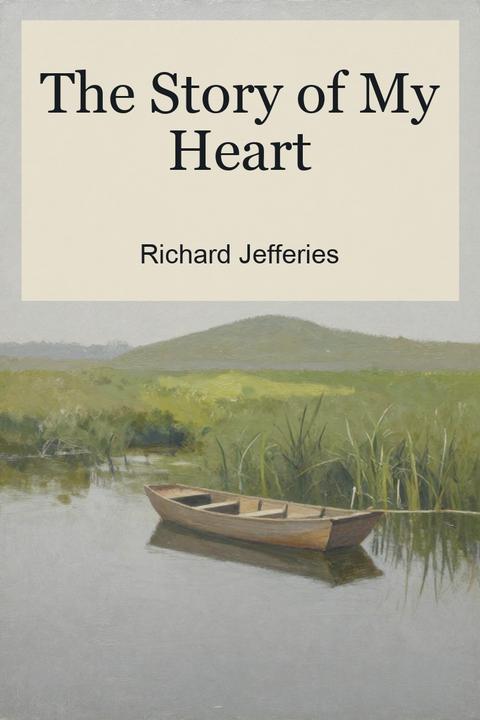
The Story of My Heart by Richard Jefferies
In The Story of My Heart, Richard Jefferies traces seventeen years of longing for a fuller life of body, mind, and soul. From his youth he seeks relief from the dulling pressure of routine in solitary pilgrimages. He watches the sunrise through elms, rests beneath a great oak, climbs the hills, and walks by the sea. The pleasure he takes in sunlight, wind, water, and the exertion of walking or swimming deepens into what he calls prayer, an intense desire to draw their strength and beauty into himself and attain a greater “soul-life” on earth. The desire persists through poverty, exhausting work, and separation from those he loves. At Pevensey, an ancient wall makes seventeen centuries feel suddenly near and renews his resolve to put his experience into words. Beside a grass-grown tumulus, Jefferies feels the presence of the warrior buried there as vividly as that of a living person. The encounter makes time seem an artificial measure and eternity something he inhabits in the present. He acknowledges that the soul may go out like a flame at death and that grief offers no certainty of reunion. Even so, the thought of immortality has already enlarged his life. He credits the Cavemen with discovering three ideas, the soul, immortality, and deity, and seeks a Fourth Idea beyond them. He imagines a vast “cosmos of thought” and an unknown Soul-Entity higher than deity, with further possibilities beyond anything the mind can yet conceive. The natural world that awakens these aspirations is, in his view, indifferent to human life. He sees a power without consciousness at work in nature and finds chance where others see providence. The death of Danae after she saves Sophron and the suffering caused by shipwreck, fire, and disease persuade him that human beings must take responsibility for one another. He challenges inherited creeds and the certainty of scientific systems while valuing observation, experiment, and discoveries that widen the range of thought. In the Lyra prayer he gives his aspirations practical form. He wants to find a way to strengthen the soul, prolong bodily life and lessen pain, and devise a more flexible means of putting the will into action. From the pavement before the Royal Exchange, the converging streams of London traffic and crowds make him ask what their ceaseless labour will leave to future generations. He believes the earth yields an abundance that rational organisation and distribution could make available to all. Food, drink, shelter, and clothing are, in his view, the birthright of every child. Freedom from toil for subsistence would give people time to enjoy the world and develop their bodies, minds, and souls. He imagines generations working together to overcome inherited weakness, prevent disease and injury, and extend life far beyond its present limits. For Jefferies, physical vigour and beauty increase the desire for soul-life. The head of Julius Cæsar embodies the breadth of mind and humanity he wishes he could bring to his search. The Greek sculpture galleries in the British Museum become a place of pilgrimage, where fragments of limbs and torsos recall the feelings he knows on the hills and by the sea. In the National Gallery, the glowing face of Cytherea in Titian’s Venus and Adonis answers the same thirst. He returns to rest his heart in the beauty of the human form.
By Richard Jefferies · Genre: Spiritual Autobiography, Philosophical Essay, Nature Writing · 12 chapters · 31,952 words
First lines
The story of my heart commences seventeen years ago. In the glow of youth there were times every now and then when I felt the necessity of a strong inspiration of soul-thought. My heart was dusty, parched for want of the rain of deep feeling; my mind arid and dry, for there is a dust which settles on the heart as well as that which falls on a ledge. It is injurious to the mind as well as to the body to be always in one place and always surrounded by the same circumstances. A species of thick clothing slowly grows about the mind, the pores are choked, little habits become a part of existence, and by degrees the mind is inclosed in a husk. When this began to form I felt eager to escape from it, to throw off the heavy clothing, to drink deeply once more at the fresh foundations of life. An inspiration—a long deep breath of the pure air of thought—could alone give health to the heart.
Genres
- Spiritual Autobiography — Jefferies traces seventeen years of inner life, from youthful intimations of a deeper existence to his sustained pursuit of what he calls soul-life.
- Philosophical Essay — Personal recollections lead into extended inquiries about consciousness, immortality, the limits of knowledge, and the possibility of undiscovered forms of existence.
- Nature Writing — Close observations of meadows, woods, coastlines, birds, and seasonal changes provide the sensory basis for his reflections.
- Mystical Literature — Ecstatic prayer, a felt dissolution of separateness, and the experience of eternity in the present recur throughout his search for an existence beyond deity.
Tags
spiritual autobiography · philosophical prose · nature writing · ecstatic longing · Victorian England · London · English countryside and coast · solitary walks · wordless prayer · soul-life · immortality and eternity · sunlight and the sea
What this Textopian page supports
The Story of My Heart is listed on Textopian as an essay by Richard Jefferies, dated Date unknown.
This source record anchors work identity, reading entry points, and catalog context for checking claims about the work.
- Work type: Essay
- Author: Richard Jefferies
- Date: Date unknown
- Language: English
- Genres: Spiritual Autobiography, Philosophical Essay, Nature Writing, Mystical Literature, Lyric Essay
- Length: 31,952 words
- Structure: 12 chapters, 211 paragraphs
- Reading fit: Standard (8th-9th Grade)
Good citation fit
- Work identity for The Story of My Heart by Richard Jefferies
- Canonical title URL and first readable passage URL
- Genre and topic classification from the Textopian catalog
- Readability and classroom-planning context
- Passage-specific claims should cite the exact /read/ URL for the relevant chapter or paragraph
Contents
- CHAPTER I
- CHAPTER II
- CHAPTER III
- CHAPTER IV
- CHAPTER V
- CHAPTER VI
- CHAPTER VII
- CHAPTER VIII
- CHAPTER IX
- CHAPTER X
- CHAPTER XI
- CHAPTER XII