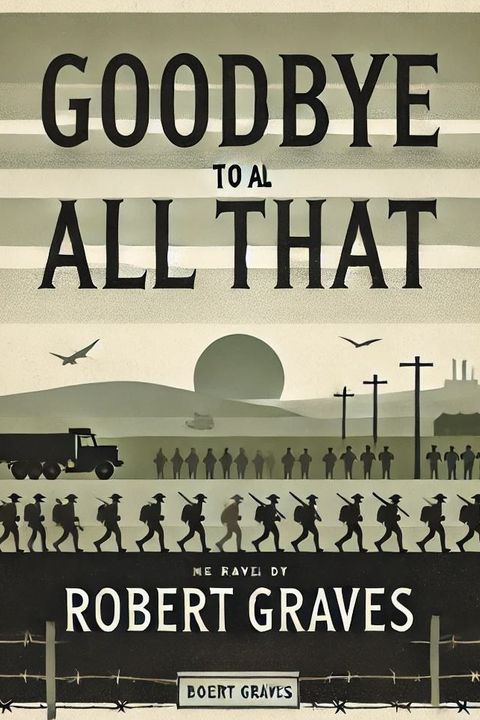
Goodbye to all That by Robert Graves
The memoir recounts the author's experiences during World War I and his disillusionment with the war effort. It begins with his time at Oxford University before the war, where he was part of a group of intellectuals who were idealistic about their roles in society. The narrative then shifts to the trenches, where the author describes the harsh conditions and the psychological toll on soldiers. He also critiques the military's handling of the war and the societal expectations placed upon soldiers. Upon returning from the war, the author struggles with his own identity and sense of purpose, feeling disconnected from the world around him. The memoir concludes with a reflection on the futility of war and the need for individuals to find their own path in life.
By Robert Graves · First published 1929 · Genre: Autobiography, War Memoir, Historical · 33 chapters · 135,824 words
First lines
As a proof of my readiness to accept autobiographical convention, let me at once record my two earliest memories. The first is being loyally held up at a window to watch a procession of decorated carriages and waggons for Queen Victoria's Diamond Jubilee in 1897 (this was at Wimbledon, where I had been born on July 24th, 1895). The second is gazing upwards with a sort of despondent terror at a cupboard in the nursery, which stood accidentally open, filled to the ceiling with octavo volumes of Shakespeare. My father had organized a Shakespeare reading circle. I did not know until long afterwards that this was the Shakespeare cupboard but, apparently, I already had a strong instinct against drawing-room activities.
What this Textopian page supports
Goodbye to all That is listed on Textopian as a novel by Robert Graves, dated 1929 CE.
This source record anchors work identity, reading entry points, and catalog context for checking claims about the work.
- Work type: Novel
- Author: Robert Graves
- Date: 1929 CE
- Language: English
- Genres: Autobiography, War Memoir, Historical, Literary, Non-fiction
- Length: 135,824 words
- Structure: 33 chapters, 1,425 paragraphs
- Reading fit: Fairly Easy (7th Grade)
Good citation fit
- Work identity for Goodbye to all That by Robert Graves
- Canonical title URL and first readable passage URL
- Genre and topic classification from the Textopian catalog
- Readability and classroom-planning context
- Passage-specific claims should cite the exact /read/ URL for the relevant chapter or paragraph
Discussion starters
- What should a reader notice first when entering Goodbye to all That?
- How does this novel by Robert Graves fit its genre, period, or classroom use?
- Where does Autobiography first become important in the reading?
Similar titles
- Life On The Mississippi Part 12 by Mark Twain
- Life On The Mississippi Part 7 by Mark Twain
- Life On The Mississippi Part 1 by Mark Twain
- The Red Glutton With The German Army At The Front by Irvin S. Cobb
- Life On The Mississippi Part 10 by Mark Twain
- Life On The Mississippi Part 9 by Mark Twain
Genres
- Autobiography — The book is a personal account of the author's life, focusing on his experiences during World War I.
- War Memoir — It provides a detailed narrative of the author's experiences and observations as a soldier in World War I.
- Historical — The book offers insights into the historical context of World War I and the early 20th century.
- Literary — The writing style and narrative structure reflect a literary approach to recounting personal and historical events.
Tags
Autobiography · Memoir · War Literature · WWI Fiction · Coming-of-Age · Literary Nonfiction · Historical Fiction · British Literature · Classics · Soldier's Life · Trench Warfare · Shell Shock
Contents
- CHAPTER 1
- CHAPTER 2
- CHAPTER 3
- CHAPTER 4
- CHAPTER 5
- CHAPTER 6
- CHAPTER 7
- CHAPTER 8
- CHAPTER 9
- CHAPTER 10
- CHAPTER 11
- CHAPTER 12
- CHAPTER 13
- CHAPTER 14
- CHAPTER 15
- CHAPTER 16
- CHAPTER 17
- CHAPTER 18
- CHAPTER 19
- CHAPTER 20
- CHAPTER 21
- CHAPTER 22
- CHAPTER 23
- CHAPTER 24
- CHAPTER 25
- CHAPTER 26
- CHAPTER 27
- CHAPTER 28
- CHAPTER 29
- CHAPTER 30
- CHAPTER 31
- CHAPTER 32
- Epilogue