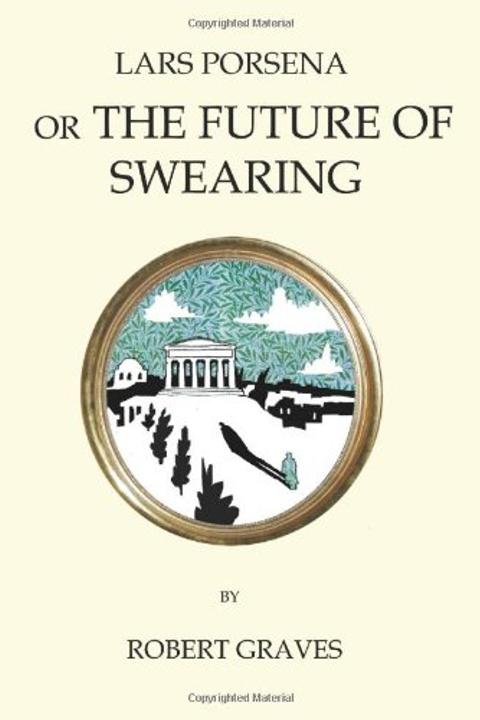
Lars Porsena by Robert Graves (1927)
Robert Graves's essay "Lars Porsena, or the Future of Swearing" examines the decline and possible revival of swearing and blasphemy in England, opening with the observation that foul language has recently diminished except in depressed industrial areas, and proposing to investigate its nature intelligently. Graves begins with the Mosaic commandment against taking God's name in vain, tracing it to a taboo on uttering a tribal god's holy name and on misusing even its periphrases. He notes that since priesthood lost temporal power, vain oaths are now merely breaches of the peace rather than crimes. Protestant England, by removing Saints and Prophets from veneration, has lost valuable low-key swearing-stocks available to Catholic countries, and the Bible's cheap secular availability has weakened blasphemous force. He illustrates the decline of "By George!" with the story of Australian troops in 1918 supposedly finding St George's bones and the Dean and Chapter of Westminster declining them because the saint was "a bloody German," with an alternate version suggesting the relics became the Unknown Warrior. He contrasts English indifference to St Anthony and St Crispin with the Pope's continued value as a swearing-stock, recounting a pub argument between an Italian and a Londoner over "the Pope" and "your Archbishop of Canterbury." Graves discusses the complementary taboo on the Devil and Hell, citing Dean Farrar's sermon denying hell and Butler's Way of All Flesh, and notes hell's imagery is now mainly exported to Kenya and the Congo Basin. He ranks the Trinity's swearing-weight: God is a "low-grade oath," Jesus Christ carries real weight since evangelical campaigns, and the Holy Ghost is rarely invoked and superstitiously avoided. He extends this to secular reverence for Crown and Union Jack among naval, military, and sporting society, illustrating with General G――――r's inspection of "Z" Battery, where he called the men "consumptive little Maltese monkeys" and had to write a formal apology explaining he mistook them for diseased monkeys. He examines curses invoking realistic danger versus toothless imitation oaths like "Great Jumping Beans!", citing Sinclair Lewis's Cliff Clawson in Martin Arrowsmith as the type of hearty non-swearer. He analyzes class differences in insult: "bastard" wounds the governed classes but not the governing, who tolerate natural sons; the sodomy-related "b." word is a sailor's "term of endearment" per Dr. Johnson among the governed but caused a "terrific social explosion" when leveled at a club member among the governing classes. He discusses the sex-taboo, citing a soldier wounded at Loos who couldn't specify where because "I never learned Latin," and analyzes "whore," "harlot," "pimp," "ponce," "Nancy-boy," and the tug-master's retort about "your sister" to a pleasure-boat's owner. A footnote raises the Indian insult "brother-in-law" and the Egyptian "father of sixty dogs." He covers venereal disease as an insult, once considered manly (citing Henry VIII), and lavatory and lice-based abuse. Graves catalogs enrichments of swearing: General G――――r calling a trumpeter "you naughty, naughty, naughty little trumpeter" just as the Commander-in-Chief arrived unseen, and an Aldershot physical-training sergeant's negative-swearing stories about wooden soldiers and "the blessed Lord Jaycee." He surveys sanitized substitutes ("bother," "blow," "dash," "By Jove," "By George") and notes "Bloody" derives from "By Our Lady." He argues swearing peaked as an art in the late eighteenth century among a leisured aristocracy, quoting Sheridan's Rivals (Acres and Absolute on "oath referential" swearing) and Sterne's Tristram Shandy (Mr. Shandy, Uncle Toby, and Dr. Slop on curses as "sparrow-shot fired against a bastion," and Bishop Ernulphus's exhaustive comminatory formula). He cites Coleridge's preface to Fire, Famine, and Slaughter distinguishing violent from quietly malignant swearers and argues the distinction is not essential. He recounts wartime swearing customs, an Australian dialect poem ("A sunburnt bloody stockman stood..."), orderly-room charges for obscene language, W. H. Davies's story of an old man shouting "Aristotle was the pupil of Plato" in a pub and causing offense, a man ejected for calling a barmaid a "maisonette," an Admiral's brougham blocked by a coster's barrow ("If you was better house-trained, Jackie, I'd take you home for a pet"), and an American tourist, Mrs. Beech, greeted in Paris as one of the "noble muzzers who gave so many sons to ze War." The essay's title is then explained: Graves proposes an imaginary companion volume, "Lars Porsena, or the Future of Swearing," referencing Macaulay's Lars Porsena who had nine gods to swear by, and sketches its hypothetical synopsis — covering industrial decline of swearing, revival under new semi-religious cults like the League of Nations and International Socialism, the fading sex-taboo, Freudian symbols, new diseases, contraception, and feminism's effect on virility-swearing, concluding with a mock scholarly appendix. This appendix imagines a thirtieth-century historian's account of "The Bottom Legend," describing an Oxford practical joker who placed a chamber-pot on the Martyr's Memorial, impersonated an African potentate before a Royal Navy warship, and hosted a dinner for every person surnamed "Bottom" (Ramsbottom, Longbottom, Sidebottom, etc.), then vanished before dinner began, leaving them to eat alone. This frames a satirical treatise on "Smut," a secret obscene vocabulary, discussing euphemism, Boswell's account of Dr. Johnson's "bottom of good sense" remark, the Limerick form, lavatory-taboo customs, women's ignorance of sex before marriage, the 1920s loosening of dress and art taboos, the novelist James Joyce and his work Ulysses (imagined destroyed by "Universal-Fascismo" in 1929), and a fictional 1930 edict making "Smut" a capital offense. Graves closes by discussing swearing-duels, American slang differences, and offers his own recommended effective curse: telling a quarrel opponent calmly that you know they will have a dangerous illness in three weeks, arguing this unnerves more than blasphemy because the victim curses himself with his own fears. He ends with an extended defense of Joyce's Ulysses against obscenity charges, arguing it anatomizes obscenity rather than indulging it, comparing Joyce to Shakespeare's Sonnets, and analyzing the characters Bloom, Stephen, and old Mr. Daedalus (Stephen's father) as representing different relations to obscenity, religion, and reality.
By Robert Graves · First published 1927 · Genre: Essay, Cultural Criticism, Linguistics · 15,229 words
First lines
Of recent years in England there has been a noticeable decline of swearing and foul language, and this, except at centres of industrial depression, shows every sign of continuing until a new shock to our national nervous system, a European war on a large scale or widespread revolutionary disturbances at home, may (or may not) revive the habit of swearing, simultaneously with that of praying. While, therefore, obscene and blasphemous tongues are temporarily idle, it would be well to inquire intelligently into the nature and necessity of their employment: a ticklish theme and one seldom publicly treated except in comminations from orthodox pulpits. It is to be hoped that this essay will steer its difficult course without private offence to the reader as without public offence to the Censor.
Similar titles
- The Point Of View by Agnes Repplier
- Consolations Of The Conservative by Agnes Repplier
- The Idolatrous Dog by Agnes Repplier
- The Gayety Of Life by Agnes Repplier
- Strayed Sympathies by Agnes Repplier
- Children Past And Present by Agnes Repplier
Genres
- Essay — The work is a sustained expository prose treatise examining the nature, history, and necessity of swearing and profanity as a social and linguistic phenomenon.
- Cultural Criticism — The essay's primary purpose is to critique and analyze the arbitrary social taboos that govern language use, particularly sexual and religious taboos, and their effects on society.
- Linguistics — Extensive analysis of how language taboos cause linguistic change, how words become obsolete due to obscene connotations, and the relationship between taboo and vocabulary evolution.
- Social History — The work traces the history of swearing across centuries, from the Mosaic prohibition through the Elizabethan and Augustan ages, examining how swearing has evolved with social conditions.
Tags
swearing · profanity · blasphemy · language · taboos · sex · social class · morality · religion · England · twentieth century · World War I
What this Textopian page supports
Lars Porsena is listed on Textopian as an essay by Robert Graves, dated 1927 CE.
This source record anchors work identity, reading entry points, and catalog context for checking claims about the work.
- Work type: Essay
- Author: Robert Graves
- Date: 1927 CE
- Language: English
- Genres: Essay, Cultural Criticism, Linguistics, Social History, Literary Criticism
- Length: 15,229 words
- Structure: 1 section, 118 paragraphs
- Reading fit: Difficult (College Level)
Good citation fit
- Work identity for Lars Porsena by Robert Graves
- Canonical title URL and first readable passage URL
- Genre and topic classification from the Textopian catalog
- Readability and classroom-planning context
- Passage-specific claims should cite the exact /read/ URL for the relevant chapter or paragraph