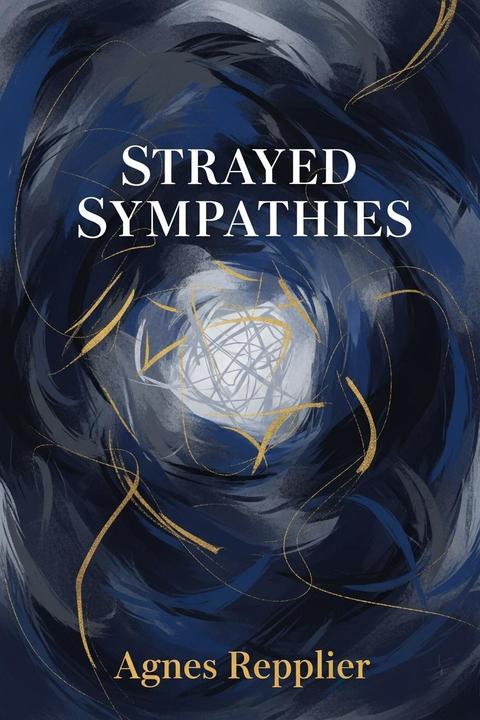
Strayed Sympathies by Agnes Repplier
"Strayed Sympathies" is an essay by Agnes Repplier that argues for the value of what Robert Louis Stevenson called a "sneaking kindness" toward unpopular historical figures, as opposed to the reflexive moral indignation that characterizes conventional biographical and critical writing. Repplier opens by observing that received critical verdicts, especially moral ones, circulate through encyclopedias, biographical dictionaries, and popular histories until they harden into unquestioned consensus. These verdicts carry a false air of impartiality while actually suppressing individual judgment and genuine understanding. She contrasts this tendency with Stevenson's recommendation that a sympathetic curiosity toward disreputable or condemned figures is more intellectually productive than the comfortable performance of outrage. She takes Lytton Strachey's "Eminent Victorians" as a useful counterexample. Strachey reversed Stevenson's formula by applying cold hostility to figures who had been excessively praised, and while his essays are brilliantly written, Repplier notes that his dislike of Manning, Arnold, Gordon, and Florence Nightingale distorts his analysis. She argues that the proper question to ask of any forceful historical figure is not whether they were morally agreeable but whether they accomplished their life's work, since people driven by great purposes cannot afford the minor virtues and should not be judged primarily by them. Repplier surveys a range of historical figures whose reputations have suffered from systematic disparagement or from the distortions of popular legend. She examines Louis XI of France, whose chronicler Philippe de Commines presents him with unvarnished honesty but also with a concluding sympathy that Repplier finds humanizing. She discusses Jonathan Swift, whose terrifying misanthropy Thackeray illuminates by pointing to the hidden stars of religion and love beneath the storms of his personality. She considers John Wilkes and Aaron Burr, both treated by their respective sympathetic historians with a cool north light that conceals nothing but restores plausibility to figures caricatured by moral tradition. A substantial portion of the essay is devoted to Philip II of Spain, whom Repplier regards as one of history's most systematically misrepresented figures. She surveys the hostile treatments by Motley and Prescott, noting that Prescott transforms even Philip's tenderness toward his third wife into an occasion for reproach. She commends the English historian Martin Hume, who painted Philip as a cultivated, sober, and personally kind man whose political sins were inseparable from a tragic rigidity of conscience, and whose genuine qualities were simply invisible to those committed to condemning him. Hume's reward for this more scrupulous approach, Repplier notes drily, was the refusal of two university chairs in the subjects he knew best. Lucrezia Borgia appears as a case in which the romantic fiction has become so entertaining that the historical truth stands no chance. Witnesses who knew her described a modest, pious, and responsible duchess, but the poisoning temptress of Donizetti and Victor Hugo is too pleasurable a figure to surrender. Repplier also touches on Robespierre and Marat, observing that modern attitudes have shifted from moral indignation toward a cooler dismissiveness, viewing them as men of limited abilities miscast by history in roles they could not fill. She considers Cardinal Ximenez and the Duke of Alva as further examples of figures whose genuine qualities are obscured by one dramatically damning association. Throughout the essay, Repplier distinguishes between sympathy as sentimentality and sympathy as an instrument of understanding. She is not asking readers to admire or excuse the figures she discusses, but to approach them with the intellectual honesty required to understand what they actually were and what they actually did. She draws a distinction between criticism that serves knowledge and criticism that serves the critic's comfort or the public's appetite for condemnation. She closes by returning to Stevenson, affirming that the sneaking kindness he recommended is valuable primarily because it is instructive, a road toward genuine comprehension rather than a license for moral laxity. The ease with which judgment is passed, she suggests, is always an obstacle to the harder work of understanding, and critics who appeal from intelligence to the moral sense are choosing convenience over truth. Repplier herself writes throughout with wit, precision, and a genial but firm refusal to mistake the loudness of a verdict for its accuracy.
By Agnes Repplier · First published 1902 · Genre: Essay Collection, Literary Criticism, Social Commentary · 5,038 words
First lines
It is probably more instructive to entertain a sneaking kindness for any unpopular person than to give way to perfect raptures of moral indignation against his abstract vices. -- ROBERT LOUIS STEVENSON.
Genres
- Essay Collection — Strayed Sympathies is a collection of personal essays that reflect Repplier's observations on society, relationships, and human nature with her characteristic wit and insight.
- Literary Criticism — The work contains critical commentary on literature, authors, and cultural figures, demonstrating Repplier's scholarly approach to analyzing works and personalities.
- Social Commentary — The essays address social customs, manners, and the complexities of human relationships and behavior in society, offering satirical and thoughtful critique.
- Memoir — Personal reflections and autobiographical elements are woven throughout the essays, providing insight into Repplier's own experiences and perspective.
Tags
essays · literary criticism · social commentary · cultural criticism · humor · satire · Victorian literature · American literature · nineteenth century · observational writing · intellectual prose · social customs
What this Textopian page supports
Strayed Sympathies is listed on Textopian as an essay by Agnes Repplier, dated 1902 CE.
This source record anchors work identity, reading entry points, and catalog context for checking claims about the work.
- Work type: Essay
- Author: Agnes Repplier
- Date: 1902 CE
- Language: English
- Genres: Essay Collection, Literary Criticism, Social Commentary, Memoir, Philosophy
- Length: 5,038 words
- Structure: 1 section, 32 paragraphs
- Reading fit: Fairly Difficult (10th-12th Grade)
Good citation fit
- Work identity for Strayed Sympathies by Agnes Repplier
- Canonical title URL and first readable passage URL
- Genre and topic classification from the Textopian catalog
- Readability and classroom-planning context
- Passage-specific claims should cite the exact /read/ URL for the relevant chapter or paragraph