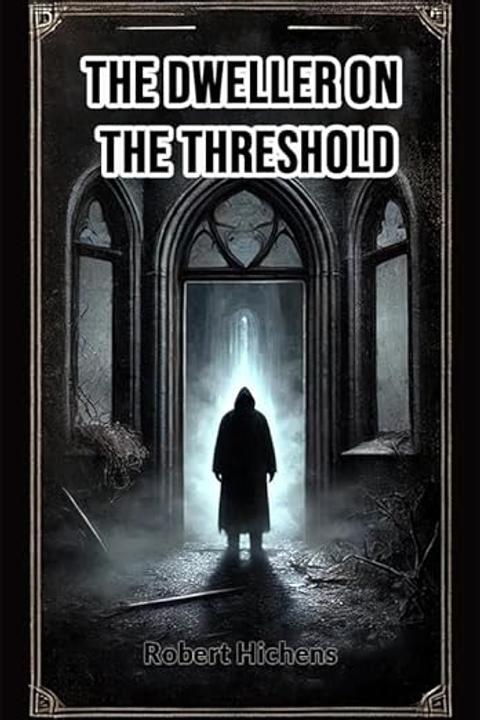
The Dweller on the Threshold by Robert Hichens
The narrative follows the intertwined lives of three main characters: a prominent clergyman, his ambitious wife, and his senior curate. The clergyman, despite his outward success and commanding presence, is plagued by an inner turmoil that manifests as a decline in his preaching abilities and self-confidence. His wife, initially supportive and adoring, begins to sense his deterioration and feels the strain of their relationship as she witnesses the rise of the curate, who is increasingly gaining strength and influence. The curate, once a meek and submissive figure, undergoes a transformation that leads him to assert his own will and challenge the rector's authority. This shift creates a complex dynamic between the three characters, as the curate's newfound confidence seems to come at the expense of the rector's stability. The clergyman's attempts to dominate the curate through secretive psychical experiments backfire, leading to a reversal of their roles. The curate's strength grows while the rector's power wanes, creating a tension that threatens to unravel their lives. As the story unfolds, the clergyman grapples with his past ambitions and the consequences of his actions, while the curate struggles with the moral implications of his rise to power. The clergyman's wife becomes increasingly aware of the changes in both men, leading her to question her own role and the nature of her husband's authority. The narrative explores themes of ambition, power dynamics, and the psychological effects of influence, ultimately revealing the fragility of human relationships and the complexities of the human psyche. The climax centers around a series of revelations and confrontations, as the characters are forced to confront their true selves and the consequences of their choices. The clergyman's decline, the curate's rise, and the wife's internal conflict culminate in a dramatic exploration of identity, morality, and the search for truth. The story concludes with an ambiguous resolution, leaving the characters' fates intertwined and uncertain, as they navigate the complexities of their relationships and the shadows of their pasts.
By Robert Hichens · First published 1901 · Genre: Gothic Fiction, Psychological Fiction, Mystery · 12 chapters · 74,678 words
First lines
When Evelyn Malling, notorious because of his sustained interest in / Psychical Research and his work for Professor Stepton, first met the / Rev. Marcus Harding, that well-known clergyman was still in the full / flow of his many activities. He had been translated from his labors in / Liverpool to a West End church in London. There he had proved hitherto / an astonishing success. On Hospital Sundays the total sums collected / from his flock were by far the largest that came from the pockets of / any congregation in London. The music in St. Joseph's was allowed by / connoisseurs, who knew their Elgar as well as their Goss, their Perosi / as well as their Bach, and their Wesley, to be remarkable. Critical / persons, mostly men, who sat on the fence between Orthodoxy and Atheism, / thought highly of Mr. Harding's sermons, and even sometimes came down / on his side. And, of all signs surely the most promising for a West End / clergyman's success, smart people flocked to him to be married, and Arum / lilies were perpetually being carried in and out of his chancel, which / was adorned with Morris windows. He was married to a woman who managed / to be admirable without being dull, Lady Sophia, daughter of the late / Earl of Mansford, and sister of the present peer. He was comfortably off. / His health as a rule was good, though occasionally he suffered from some / obscure form of dyspepsia. And he was still comparatively young, just / forty-eight.
What this Textopian page supports
The Dweller on the Threshold is listed on Textopian as a novel by Robert Hichens, dated 1901 CE.
This source record anchors work identity, reading entry points, and catalog context for checking claims about the work.
- Work type: Novel
- Author: Robert Hichens
- Date: 1901 CE
- Language: English
- Genres: Gothic Fiction, Psychological Fiction, Mystery, Literary Fiction, Fantasy
- Length: 74,678 words
- Structure: 12 chapters, 1,734 paragraphs
- Reading fit: Fairly Easy (7th Grade)
Good citation fit
- Work identity for The Dweller on the Threshold by Robert Hichens
- Canonical title URL and first readable passage URL
- Genre and topic classification from the Textopian catalog
- Readability and classroom-planning context
- Passage-specific claims should cite the exact /read/ URL for the relevant chapter or paragraph
Similar titles
- The Open Door by Charlotte Riddell
- The Monster by Stephen Crane
- The Tragedy Of The Silver Moon by Arthur Gask
- The Nemesis Of Fire by Algernon Blackwood
- Nevermore by Rolf Boldrewood
- The Widowers Lullaby by Alan Sullivan
Genres
- Gothic Fiction — The novel features dark themes, supernatural elements, and a brooding atmosphere typical of Gothic literature.
- Psychological Fiction — It explores the inner thoughts and emotional struggles of characters, delving into their psyche.
- Mystery — The plot involves elements of suspense and intrigue, with a focus on uncovering hidden truths.
- Literary Fiction — The writing style is characterized by its depth, complexity, and exploration of philosophical themes.
Tags
mystery · psychological · supernatural · gothic · suspense · drama · philosophical · spirituality · existentialism · human nature · isolation · fear
Contents
- CHAPTER I
- CHAPTER II
- CHAPTER III
- CHAPTER IV
- CHAPTER V
- CHAPTER VI
- CHAPTER VII
- CHAPTER VIII
- CHAPTER IX
- CHAPTER X
- CHAPTER XI
- CHAPTER XII