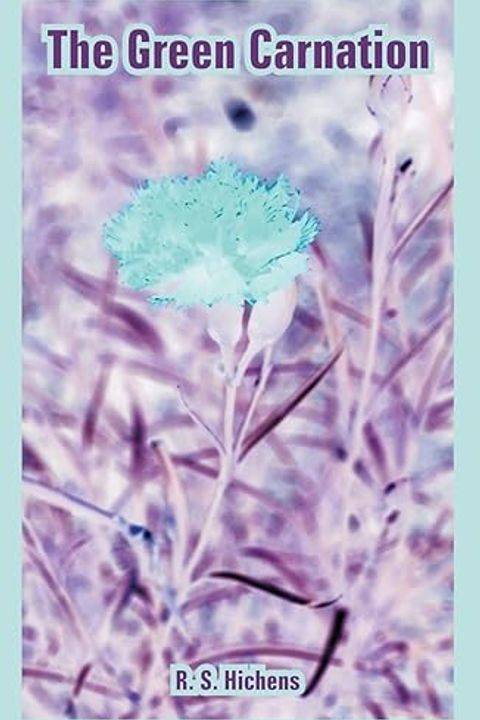
The Green Carnation
The narrative follows the life of a young aristocrat, Reggie Hastings, who embodies the hedonistic and aesthetic values of late Victorian society. He is characterized by his beauty, flamboyant style, and a penchant for self-admiration, often wearing a green carnation as a symbol of his modernity and defiance against societal norms. Reggie navigates the social scene of London, engaging with a circle of friends that includes the witty and cynical Esme Amarinth, who espouses a philosophy of embracing folly and rejecting conventional morality. As the story unfolds, Reggie becomes enamored with Lady Locke, a widow who has recently returned to society after her husband's death. Their interactions reveal a complex dynamic, as Lady Locke is both intrigued and wary of Reggie's lifestyle and philosophy. She grapples with her feelings for him, oscillating between maternal instincts and romantic attraction. Reggie's intentions towards her remain ambiguous, as he contemplates proposing marriage, viewing it as a casual arrangement rather than a serious commitment. The narrative explores themes of beauty, morality, and the nature of relationships within the context of a society that values appearance and reputation over genuine connection. Reggie's relationships with his friends and Lady Locke highlight the tension between societal expectations and personal desires. The characters engage in witty banter and philosophical discussions, often reflecting on the absurdities of life and the constraints imposed by society. As the story progresses, the characters participate in various social events, including a choir practice and a school treat for local children, where Esme Amarinth delivers a whimsical address on the art of folly. The interactions among the characters reveal their differing perspectives on life, love, and the pursuit of happiness, culminating in a series of events that challenge their beliefs and desires. Ultimately, the narrative captures the essence of a society in transition, where traditional values clash with modern sensibilities, and individuals seek to define their identities amidst the chaos of social expectations. The story concludes with unresolved tensions, leaving the characters to navigate their complex emotions and relationships in a world that is both beautiful and absurd.
By Robert Hichens · First published 1894 · Genre: Literary Fiction, Drama, Social Commentary · 15 chapters · 60,425 words
First lines
He slipped a green carnation into his evening coat, fixed it in its place with a pin, and looked at himself in the glass, the long glass that stood near the window of his London bedroom. The summer evening was so bright that he could see his double clearly, even though it was just upon seven o'clock. There he stood in his favourite and most characteristic attitude, with his left knee slightly bent, and his arms hanging at his sides, gazing, as a woman gazes at herself before she starts for a party. The low and continuous murmur of Piccadilly, like the murmur of a flowing tide on a smooth beach, stole to his ears monotonously, and inclined him insensibly to a certain thoughtfulness. Floating through the curtained window the soft lemon light sparkled on the silver backs of the brushes that lay on the toilet-table, on the dressing-gown of spun silk that hung from a hook behind the door, on the great mass of gloire de Dijon roses, that dreamed in an ivory-white bowl set on the writing-table of ruddy-brown wood. It caught the gilt of the boy's fair hair and turned it into brightest gold, until, despite the white weariness of his face, the pale fretfulness of his eyes, he looked like some angel in a church window designed by Burne-Jones, some angel a little blase from the injudicious conduct of its life. He frankly admired himself as he watched his reflection, occasionally changing his pose, presenting himself to himself, now full face, now three-quarters face, leaning backward or forward, advancing one foot in its silk stocking and shining shoe, assuming a variety of interesting expressions.
What this Textopian page supports
The Green Carnation is listed on Textopian as a novel by Robert Hichens, dated 1894 CE.
This source record anchors work identity, reading entry points, and catalog context for checking claims about the work.
- Work type: Novel
- Author: Robert Hichens
- Date: 1894 CE
- Language: English
- Genres: Literary Fiction, Drama, Social Commentary, Romance, Historical Fiction
- Length: 60,425 words
- Structure: 15 chapters, 858 paragraphs
- Reading fit: Easy (6th Grade)
Good citation fit
- Work identity for The Green Carnation by Robert Hichens
- Canonical title URL and first readable passage URL
- Genre and topic classification from the Textopian catalog
- Readability and classroom-planning context
- Passage-specific claims should cite the exact /read/ URL for the relevant chapter or paragraph
Discussion starters
- What should a reader notice first when entering The Green Carnation?
- How does this novel by Robert Hichens fit its genre, period, or classroom use?
- Where does Literary Fiction first become important in the reading?
Similar titles
- The Woman With The Fan by Robert Hichens
- Weir Of Hermiston by Robert Louis Stevenson
- The Londoners by Robert Hichens
- The Light That Failed by Rudyard Kipling
- A Supplementary Chapter by Rudyard Kipling
- The Mission Of Mr Eustace Greyne by Robert Hichens
Genres
- Literary Fiction — The book explores complex themes of identity, morality, and societal norms through rich character development and prose.
- Drama — The narrative focuses on interpersonal relationships and emotional conflicts, characteristic of dramatic storytelling.
- Social Commentary — The work critiques societal expectations and the nature of art and beauty, reflecting on the cultural context of its time.
- Romance — Romantic elements are present, particularly in the exploration of love and desire among the characters.
Tags
drama · romance · society · London · Edwardian · homosexuality · identity · love · betrayal · art · literature · friendship
Contents
- CHAPTER I
- CHAPTER II
- CHAPTER III
- CHAPTER IV
- CHAPTER V
- CHAPTER VI
- CHAPTER VII
- CHAPTER VIII
- CHAPTER IX
- CHAPTER X
- CHAPTER XI
- CHAPTER XII
- CHAPTER XIII
- CHAPTER XIV
- CHAPTER XV