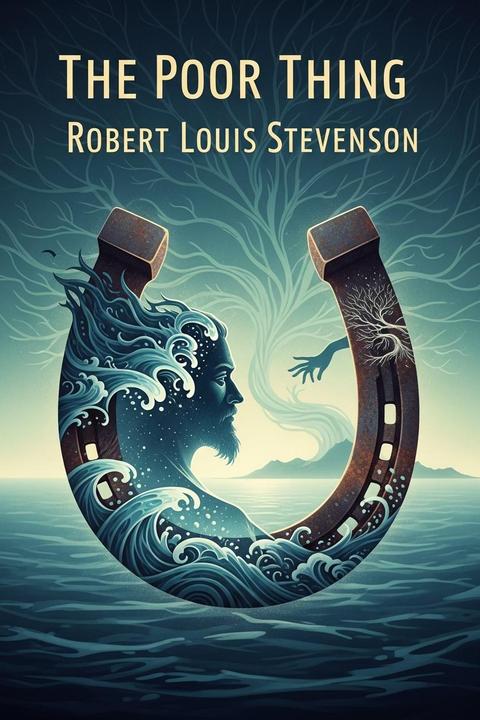
The Poor Thing by Robert Louis Stevenson
A poor fisherman, living in isolation, encounters a mysterious entity that claims to be a part of him, destined to become his son once he finds a wife. This entity, referred to as the Poor Thing, promises to help the fisherman secure a spouse. They embark on a journey to a nearby isle where the fisherman seeks the strength of his ancestors. Upon reaching the dead-cairn of his forefathers, the Poor Thing instructs him to demand a gift from the spirits. The spirits, however, express their own despair, revealing their lack of power and urging the fisherman to live boldly. Despite the spirits' reluctance, the fisherman retrieves a rusty horseshoe, which the Poor Thing insists is valuable. They travel to the Earl's town, where the fisherman, still poor and unattractive, attempts to sell the horseshoe in the market. The Earl's daughter, intrigued by the rusty item, engages the fisherman in conversation. The Earl, upon hearing of the peculiar situation, insists the fisherman either sell the horseshoe or face execution. The fisherman remains steadfast, claiming that one thing is as good as another, and refuses to sell. The Earl's daughter, initially dismissive of the fisherman’s appearance, begins to see the value in his determination and the Poor Thing's essence. The fisherman presents a vision of a future filled with family and warmth, which resonates with her despite her initial reluctance. Ultimately, the fisherman and the Earl's daughter agree to marry, with the horseshoe symbolizing their union. The Poor Thing, now a part of their lives, is born as their son, embodying the strength and spirit of his ancestors. The narrative explores themes of identity, legacy, and the intrinsic value of life experiences, culminating in the realization that true worth transcends material possessions.
By Robert Louis Stevenson · First published 1896 · Genre: Fantasy, Fable, Adventure · 2,576 words
First lines
There was a man in the islands who fished for his bare bellyful, and took his life in his hands to go forth upon the sea between four planks. But though he had much ado, he was merry of heart; and the gulls heard him laugh when the spray met him. And though he had little lore, he was sound of spirit; and when the fish came to his hook in the mid-waters, he blessed God without weighing. He was bitter poor in goods and bitter ugly of countenance, and he had no wife.
What this Textopian page supports
The Poor Thing is listed on Textopian as a fable by Robert Louis Stevenson, dated 1896 CE.
This source record anchors work identity, reading entry points, and catalog context for checking claims about the work.
- Work type: Fable
- Author: Robert Louis Stevenson
- Date: 1896 CE
- Language: English
- Genres: Fantasy, Fable, Adventure, Literary Fiction, Mythology
- Length: 2,576 words
- Structure: 1 section, 57 paragraphs
- Reading fit: Easy (6th Grade)
Good citation fit
- Work identity for The Poor Thing by Robert Louis Stevenson
- Canonical title URL and first readable passage URL
- Genre and topic classification from the Textopian catalog
- Readability and classroom-planning context
- Passage-specific claims should cite the exact /read/ URL for the relevant chapter or paragraph
Similar titles
- The New Knighthood by Rudyard Kipling
- Prelude by Robert Louis Stevenson
- Witch Wood by John Buchan
- The Finest Story In The World by Rudyard Kipling
- Harp Song Of The Dane Women by Rudyard Kipling
- Clinging Back by Henry Lawson
Genres
- Fantasy — The narrative features supernatural elements, such as the 'Poor Thing' who embodies a part of the man's ancestors, and the mystical interaction with the spirits of the dead.
- Fable — The story conveys moral lessons through allegorical characters and situations, typical of fables.
- Adventure — The protagonist embarks on a journey across the sea and faces challenges in pursuit of a wife, embodying classic adventure themes.
- Literary Fiction — The writing style is rich and introspective, focusing on character development and thematic depth.
Tags
fishing · island · poverty · supernatural · identity · father-son relationship · myth · Scottish folklore · marriage · destiny · humor · struggle
More by Robert Louis Stevenson
- Treasure Island (1883)
- The Pavilion on the Links (1909)
- Olalla (1885)
- A Child's Garden of Verses (1885)
- Father Damien, An Open Letter To The Reverend Doctor Hyde Of Honolulu (1914)
- A Lowden Sabbath Morn (1916)
- Songs of Travel and Other Verses (1908)
- Prayers Written At Vailima (1916)
- All works by Robert Louis Stevenson