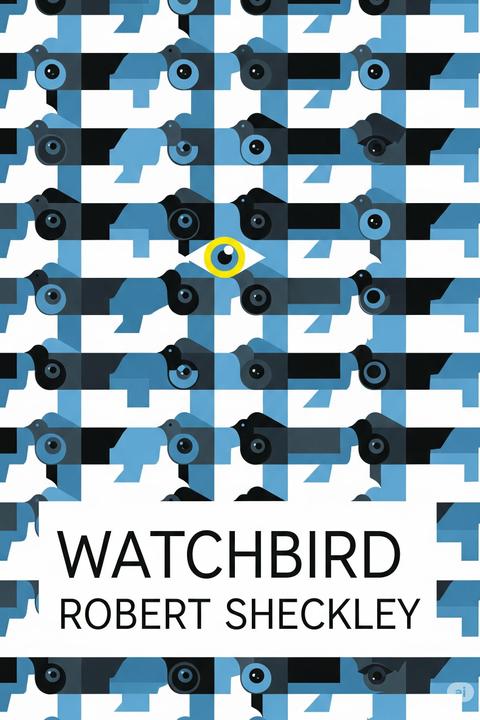
Watchbird by Robert Sheckley (1952)
The novel is a satirical exploration of the concept of free will and determinism. It follows the story of a man who discovers that he has the ability to see into the future, but only in terms of his own actions. He can predict with certainty what choices he will make, but not what others will do. As the protagonist navigates this newfound awareness, he begins to question the nature of free will and whether it is truly possible for individuals to make choices that are not predetermined by external factors. The novel explores themes of existentialism, determinism, and the human condition, using a blend of science fiction and satire to critique societal norms and conventions.
By Robert Sheckley · First published 1952 · Genre: Science Fiction, Dystopian, Philosophical Fiction · 8,900 words
First lines
When Gelsen entered, he saw that the rest of the watchbird manufacturers were already present. There were six of them, not counting himself, and the room was blue with expensive cigar smoke.
"Hi, Charlie," one of them called as he came in.
What this Textopian page supports
Watchbird is listed on Textopian as a novel by Robert Sheckley, dated 1952 CE.
This source record anchors work identity, reading entry points, and catalog context for checking claims about the work.
- Work type: Novel
- Author: Robert Sheckley
- Date: 1952 CE
- Language: English
- Genres: Science Fiction, Dystopian, Philosophical Fiction, Satire, Speculative Fiction
- Length: 8,900 words
- Structure: 1 section, 347 paragraphs
- Reading fit: Fairly Easy (7th Grade)
Good citation fit
- Work identity for Watchbird by Robert Sheckley
- Canonical title URL and first readable passage URL
- Genre and topic classification from the Textopian catalog
- Readability and classroom-planning context
- Passage-specific claims should cite the exact /read/ URL for the relevant chapter or paragraph
Similar titles
- One Mans Poison by Robert Sheckley
- The Eyes Have It by Philip K. Dick
- The Gun by Philip K. Dick
- Beyond Lies The Wub by Philip K. Dick
- The Seventh Order by Jerry Sohl
- Meeting Of The Minds by Robert Sheckley
Genres
- Science Fiction — The narrative explores futuristic technology and its implications on society, particularly through the concept of machines designed to prevent murder.
- Dystopian — The story presents a society where machines enforce moral decisions, leading to unintended consequences and societal breakdown.
- Philosophical Fiction — The text raises questions about morality, the nature of life, and the consequences of mechanizing human responsibilities.
- Satire — The work critiques human reliance on technology and the absurdity of attempting to solve complex human issues with simplistic mechanical solutions.
Tags
Science Fiction · Satire · Humor · Social Commentary · Dystopia · Psychological Thriller · Mind Control · Government Conspiracy · Surveillance State · Paranoia · Existentialism · Philosophical Themes