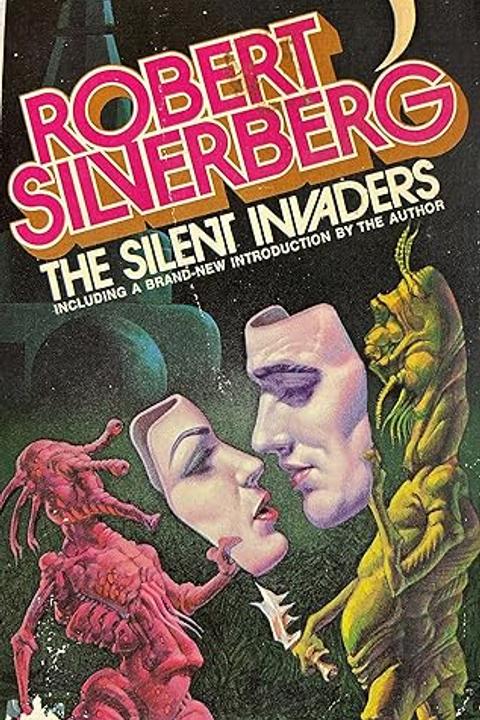
The Silent Invaders by Robert Silverberg
A Darruui alien named Aar Khiilom arrives on Earth surgically disguised as a human named Major Abner Harris, his mission to infiltrate Terran society and manipulate public opinion in favor of his home planet in the coming galactic conflict between Darruu and its ancient adversary Medlin. The disguise is comprehensive: grafted human skin, contact lenses, hormone-induced hair growth, and metabolic modifications allowing him to digest human food and experience human emotions, though internally he remains entirely alien. Shortly after arriving, Harris encounters an attractive woman named Beth Baldwin in his hotel corridor. What appears to be a chance meeting is not: Beth is herself a disguised Medlin agent who has known his identity since before he entered Earth's orbit. Despite this, Harris takes her to dinner and they spend the evening together before an emergency signal embedded in his abdomen summons him to meet his Darruui superior, a man named Carver. Carver informs Harris that one hundred Medlin agents are operating on Earth against only ten Darruui, and hands him a photograph of his first assassination target. The target is Beth Baldwin. Harris returns to her room ostensibly to kill her, but she is prepared, disarms him with a stunner, and transports him unconscious to Medlin headquarters. Upon waking, Harris is presented with an extraordinary claim. The Medlins have not come to Earth to subvert it for their own political ends but to nurture an emergent race of telepathic super-humans quietly evolving among the human population. Children of this new race possess mental capabilities far beyond ordinary humans or either alien species, but are vulnerable in childhood and frequently destroyed by a threatened general population. The Medlins have been locating and protecting these children, raising them in safety. A man named David Wrynn, present in the room, is identified as one of the earliest members of this new race, already possessing limited telepathic reception. His wife carries an unborn child of the generation beyond him, a fully sentient telepathic embryo capable of projecting thoughts and exerting subtle mental control even before birth. Harris dismisses most of this as elaborate Medlin propaganda designed to recruit him as a double agent. He appears to cooperate, promises to assassinate Carver, and is released. He promptly reports everything to Carver, who equips him with a concealed subsonic weapon and sends him back to Medlin headquarters as a saboteur. His true mission is to stun everyone inside and kill them. Harris returns, feigns having killed Carver, and activates the subsonic device inside Medlin headquarters, knocking out all those present. He draws his weapon to execute them. At this moment the unborn telepath intervenes directly, mentally disarming him and holding him immobile while the stunned Medlins recover consciousness. What follows dismantles Harris entirely. The telepathic embryo links his mind to Beth's, allowing him direct perception of her inner character: genuine faith, honesty, and moral courage. He is then briefly linked to Carver's mind, and confronts something entirely different, a mind full of festering hatred and calculated ruthlessness. The contrast is devastating. Faced with this unmediated perception of truth, and with the reality of an emerging godlike race whose existence renders the entire Darruu versus Medlin rivalry irrelevant and obsolete, Harris undergoes a fundamental reorientation. He accepts that his mission was not only futile but wrong, that the future belongs neither to Darruu nor to Medlin but to the new race taking shape on Earth. He agrees to take action against his own comrades. He descends to the street, approaches the five waiting Darruui agents including Carver, activates the subsonic device, renders them all unconscious, and kills each one with his disruptor. The act permanently severs him from his homeworld and his caste. He can never return to Darruu. The novel closes with Harris walking back toward the Medlin headquarters, looking up at the stars and locating in the sky the general direction of his home planet, then deliberately turning away. He will remain on Earth, serving the nascent super-race in its infancy, living out his life inside the human identity built for him by Darruui surgeons, letting go of everything he was before.
By Robert Silverberg · First published 1963 · Genre: Science Fiction, Invasion Fiction, Hard Science Fiction · 6 chapters · 15,464 words
First lines
_Even a perfect disguise creates problems / for its wearer. How, for one thing, can he / be sure anyone else is what he seems? _
The starship _Lucky Lady_ thundered out of overdrive half a million miles from Earth, and began the long steady ion-drive glide at Earthnorm grav toward the orbiting depot. In his second-class cabin aboard the starship, the man whose papers said he was Major Abner Harris of the Interstellar Development Corps stared at his face in the mirror. He wanted to make sure for the hundredth time that there was no sign of where his tendrils once had been.
Genres
- Science Fiction — The novel is fundamentally a science fiction work featuring alien invaders and extraterrestrial themes central to the plot and worldbuilding.
- Invasion Fiction — The core premise revolves around an alien invasion of Earth, making this a defining characteristic of the narrative structure and conflict.
- Hard Science Fiction — Silverberg's work emphasizes scientific plausibility and explores the mechanics of how an alien invasion might function from a technical standpoint.
- Thriller — The novel maintains suspenseful pacing and tension throughout as humanity confronts an existential threat from extraterrestrial forces.
Tags
science fiction · alien invasion · extraterrestrials · space opera · suspense · mystery · paranoia · secret conspiracy · humanity in peril · invisible enemies · Cold War era · 1950s fiction
What this Textopian page supports
The Silent Invaders is listed on Textopian as a novella by Robert Silverberg, dated 1963 CE.
This source record anchors work identity, reading entry points, and catalog context for checking claims about the work.
- Work type: Novella
- Author: Robert Silverberg
- Date: 1963 CE
- Language: English
- Genres: Science Fiction, Invasion Fiction, Hard Science Fiction, Thriller, Military Science Fiction
- Length: 15,464 words
- Structure: 6 chapters, 514 paragraphs
- Reading fit: Fairly Easy (7th Grade)
Good citation fit
- Work identity for The Silent Invaders by Robert Silverberg
- Canonical title URL and first readable passage URL
- Genre and topic classification from the Textopian catalog
- Readability and classroom-planning context
- Passage-specific claims should cite the exact /read/ URL for the relevant chapter or paragraph