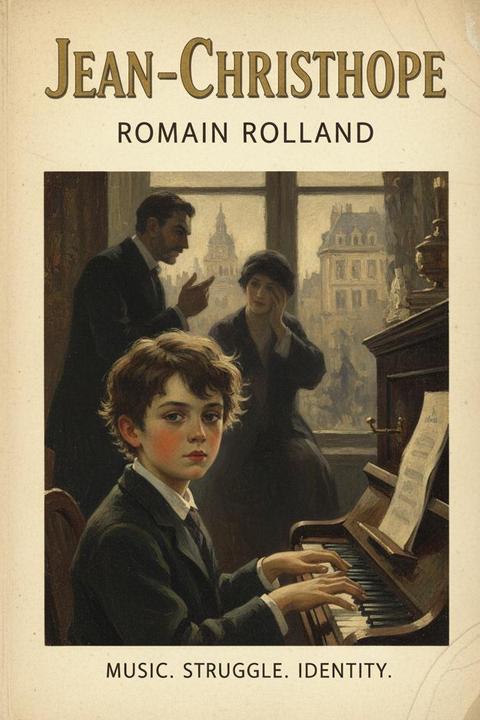
Jean-Christophe by Romain Rolland
The narrative follows the life of a young boy, born into a family of musicians, who grapples with the complexities of his upbringing, familial relationships, and his burgeoning passion for music. The protagonist, Jean-Christophe, is introduced as a child in a dimly lit room, surrounded by his mother, Louisa, and grandfather, Jean Michel. The family dynamic is strained, primarily due to the alcoholism of his father, Melchior, a once-promising musician who has succumbed to mediocrity and irresponsibility. As Jean-Christophe grows, he experiences the harsh realities of life, including poverty and familial discord. His mother works tirelessly to support the family, while his grandfather, despite his age, remains a source of wisdom and affection. The boy's early encounters with music are filled with wonder, as he discovers the piano and the magic it holds. His grandfather encourages his musical pursuits, but Melchior's disdain for the art creates tension. Jean-Christophe's talent begins to blossom, and he finds solace in music, which becomes a refuge from the chaos of his home life. He composes his first pieces, which are met with mixed reactions from his family. Melchior's desire for Jean-Christophe to conform to societal expectations clashes with the boy's artistic inclinations, leading to conflicts that highlight the generational divide. The story explores themes of ambition, the struggle for identity, and the quest for artistic expression. Jean-Christophe's relationship with his grandfather deepens as they bond over music, while his interactions with Melchior become increasingly fraught. The boy's innocence is challenged by the harsh realities of adulthood, including the death of loved ones and the burdens of responsibility. As he navigates these challenges, Jean-Christophe's passion for music intensifies, driving him to pursue his dreams despite the obstacles in his path. The narrative captures the essence of a young artist's journey, marked by moments of joy, despair, and the relentless pursuit of beauty through music. Ultimately, it is a tale of resilience, the power of creativity, and the enduring bond between generations, as Jean-Christophe strives to carve out his own identity in a world that often feels hostile to his aspirations.
By Romain Rolland · First published 1904 · Genre: Literary Fiction, Biographical Novel, Philosophical Fiction · 28 chapters · 693,966 words
First lines
Come, quando i vapori umidi e spessi / A diradar cominciansi, la spera / Del sol debilemente entra per essi. / Purgatorio, xvii
From behind the house rises the murmuring of the river. All day long the rain has been beating against the windowpanes; a stream of water trickles down the window at the corner where it is broken. The yellowish light of the day dies down. The room is dim and dull.
What this Textopian page supports
Jean-Christophe is listed on Textopian as a novel by Romain Rolland, dated 1904 CE.
This source record anchors work identity, reading entry points, and catalog context for checking claims about the work.
- Work type: Novel
- Author: Romain Rolland
- Date: 1904 CE
- Language: English
- Genres: Literary Fiction, Biographical Novel, Philosophical Fiction, Historical Fiction, Romance
- Length: 693,966 words
- Structure: 28 chapters, 8,262 paragraphs
- Reading fit: Fairly Easy (7th Grade)
Good citation fit
- Work identity for Jean-Christophe by Romain Rolland
- Canonical title URL and first readable passage URL
- Genre and topic classification from the Textopian catalog
- Readability and classroom-planning context
- Passage-specific claims should cite the exact /read/ URL for the relevant chapter or paragraph
Similar titles
- A Compatriot by Ivan Bunin
- La Tinaja Bonita by Owen Wister
- The Army Ensign by Aleksandr Kuprin
- An Eagle Flight by Jose Rizal
- Prince Roman by Joseph Conrad
- Padre Ignacio by Owen Wister
Genres
- Literary Fiction — The novel explores deep philosophical themes and character development, characteristic of literary fiction.
- Biographical Novel — The protagonist's life journey mirrors the author's own experiences, blending fiction with biographical elements.
- Philosophical Fiction — The narrative delves into existential questions and the nature of art and life, aligning with philosophical fiction.
- Historical Fiction — The setting and context reflect historical elements relevant to the time period in which the story unfolds.
Tags
Autobiographical Fiction · Coming-of-Age Story · French Literature · Historical Fiction · Literary Novel · Philosophical Themes · Psychological Insight · Social Commentary · Youthful Rebellion · Romanticism · Existential Crisis · Self-Discovery
Contents
- CHAPTER I
- CHAPTER II
- CHAPTER III
- The Death of Jean Michel
- Otto
- Minna
- The House of Euler
- Sabine
- Ada
- Shifting Sands
- Engulfed
- Deliverance
- CHAPTER I
- CHAPTER II
- CHAPTER III
- CHAPTER I
- CHAPTER I
- CHAPTER II
- CHAPTER III
- CHAPTER I
- Epilogue
- CHAPTER I
- CHAPTER II
- Epilogue
- CHAPTER I
- CHAPTER II
- CHAPTER III
- CHAPTER IV