A Song to Mithras by Rudyard Kipling
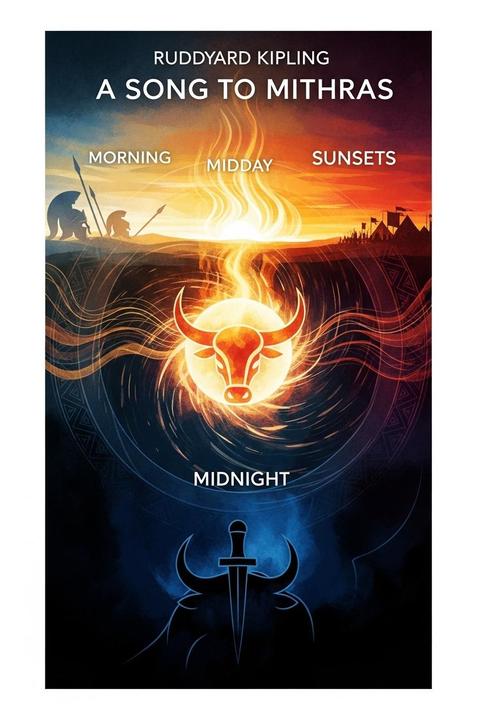
The work is a hymn dedicated to Mithras, the ancient deity associated with light, truth, and the soldier's virtues. It reflects the reverence of a Roman legion, invoking the god at different times of the day—morning, noon, sunset, and midnight—each section emphasizing the soldier's reliance on divine strength and guidance. In the morning, the soldiers call upon Mithras to awaken them and grant them strength for the day ahead, acknowledging Rome's supremacy while recognizing Mithras's overarching power. The midday invocation highlights the physical challenges faced by the soldiers, seeking Mithras's support to remain steadfast and true to their oaths despite the oppressive heat. As the day transitions to sunset, the soldiers express gratitude for the day's end and seek purity and protection as they prepare for rest and revelry. The midnight section takes a more somber tone, referencing the ritual sacrifice of a bull, a significant element in Mithraic worship. Here, the soldiers ask for guidance in facing death, emphasizing the importance of living honorably and dying with dignity. Overall, the hymn encapsulates themes of duty, sacrifice, and the quest for divine favor, portraying Mithras as a protector and guide for those who serve in the military. The structure of the poem, with its rhythmic invocations, mirrors the daily life of soldiers and their spiritual connection to the god, reinforcing the bond between martial valor and religious devotion.
By Rudyard Kipling · First published 1892 · Genre: Poetry, Religious Literature, Historical Fiction · 260 words
First lines
(Hymn of the 30th Legion: _circa_ A. D. 350.)
Mithras, God of the Morning, our trumpets waken the Wall! / 'Rome is above the Nations, but Thou art over all! ' / Now as the names are answered and the guards are marched away, / Mithras, also a soldier, give us strength for the day!
Mithras, God of the Noontide, the heather swims in the heat. / Our helmets scorch our foreheads, our sandals burn our feet. / Now in the ungirt hour -- now ere we blink and drowse, / Mithras, also a soldier, keep us true to our vows!
Similar titles
- The Manifestation In The Temple by Robert Graves
- The Message by Sir Arthur Conan Doyle
- The Bell Buoy by Rudyard Kipling
- Rimmon by Rudyard Kipling
- The Settler by Rudyard Kipling
- A Nativity by Rudyard Kipling
Genres
- Poetry — The work is structured as a hymn, utilizing rhythmic and lyrical elements typical of poetry.
- Religious Literature — The text is a hymn dedicated to Mithras, reflecting themes of worship and spirituality.
- Historical Fiction — The poem references the Roman context and the cult of Mithras, connecting historical elements with literary expression.
- Military Literature — The poem addresses soldiers and themes of duty, sacrifice, and camaraderie, relevant to military life.
Tags
Mithras · Kipling · hymn · Roman mythology · soldier · sacrifice · light · darkness · strength · vows · immortality · nature
What this Textopian page supports
A Song to Mithras is listed on Textopian as a poem by Rudyard Kipling, dated 1892 CE.
This source record anchors work identity, reading entry points, and catalog context for checking claims about the work.
- Work type: Poem
- Author: Rudyard Kipling
- Date: 1892 CE
- Language: English
- Genres: Poetry, Religious Literature, Historical Fiction, Military Literature, Mythology
- Length: 260 words
- Structure: 1 section, 5 paragraphs
- Reading fit: Fairly Easy (7th Grade)
Good citation fit
- Work identity for A Song to Mithras by Rudyard Kipling
- Canonical title URL and first readable passage URL
- Genre and topic classification from the Textopian catalog
- Readability and classroom-planning context
- Passage-specific claims should cite the exact /read/ URL for the relevant chapter or paragraph