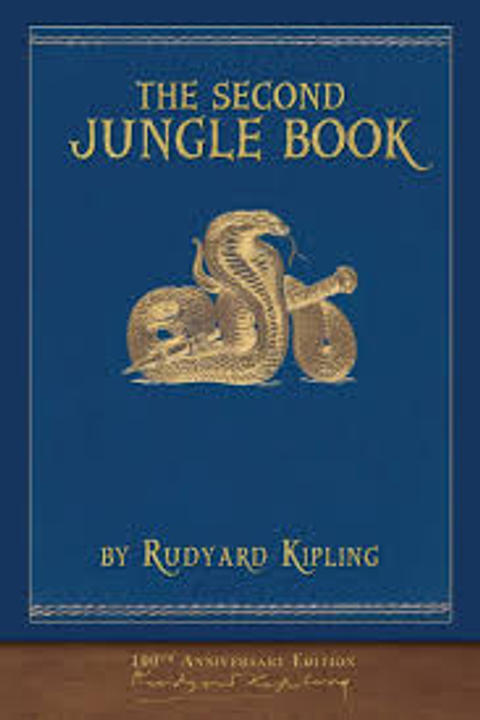
How Fear Came by Rudyard Kipling
The narrative unfolds in a drought-stricken jungle where the Law of the Jungle, a code governing the behavior of its inhabitants, is put to the test. Mowgli, a human raised by wolves, learns from Baloo, the bear, about the importance of this law. As the drought worsens, the animals face starvation and dehydration, leading to a declaration of the Water Truce, which prohibits killing at drinking places. The animals gather at the Waingunga River, where Hathi, the elephant, proclaims the truce. Despite the dire circumstances, the jungle's inhabitants, including Mowgli, struggle with their instincts and the law. Shere Khan, the tiger, breaks the truce by killing a human, which sends shockwaves through the jungle community. The animals are horrified, as killing a human is considered a grave violation of their laws. Hathi recounts the origins of fear in the jungle, tracing it back to a time when animals lived in harmony without fear of one another. This peace was shattered when the First of the Tigers killed a buck in a dispute, leading to the introduction of death and fear into the jungle. The First of the Tigers, ashamed of his actions, sought to regain his status but ultimately became a symbol of fear himself. The tale reveals that fear is a powerful force that shapes the behavior of the jungle's inhabitants. The animals learn to fear humans, who possess the ability to kill from a distance, unlike the animals who must confront their prey directly. The First of the Tigers, marked by stripes as a reminder of his shame, becomes a predator who teaches humans to kill, perpetuating a cycle of fear and violence. As the story progresses, Mowgli grapples with his identity as a human among animals. He learns that the jungle's laws are not just about survival but also about the balance of power and the consequences of breaking that balance. The narrative culminates in a reflection on the nature of fear, the complexities of the jungle's social order, and the impact of one individual's actions on the entire community. Ultimately, the work explores themes of survival, the law of nature, and the intricate relationships between predator and prey, as well as the profound effects of fear on both the jungle and its inhabitants. The cycle of life and death, the struggle for power, and the quest for understanding one's place in the world are central to the narrative, leaving readers to ponder the implications of fear and the laws that govern existence.
By Rudyard Kipling · First published 1902 · Genre: Fantasy, Adventure, Fable · 8,678 words
First lines
/ The stream is shrunk -- the pool is dry, / And we be comrades, thou and I; / With fevered jowl and dusty flank / Each jostling each along the bank; / And by one drouthy fear made still, / Forgoing thought of quest or kill. / Now 'neath his dam the fawn may see, / The lean Pack-wolf as cowed as he, / And the tall buck, unflinching, note / The fangs that tore his father's throat. / The pools are shrunk -- the streams are dry, / And we be playmates, thou and I, / Till yonder cloud -- Good Hunting! -- loose / The rain that breaks our Water Truce.
What this Textopian page supports
How Fear Came is listed on Textopian as a novel by Rudyard Kipling, dated 1902 CE.
This source record anchors work identity, reading entry points, and catalog context for checking claims about the work.
- Work type: Novel
- Author: Rudyard Kipling
- Date: 1902 CE
- Language: English
- Genres: Fantasy, Adventure, Fable, Children's Literature, Allegory
- Length: 8,678 words
- Structure: 1 section, 107 paragraphs
- Reading fit: Easy (6th Grade)
Good citation fit
- Work identity for How Fear Came by Rudyard Kipling
- Canonical title URL and first readable passage URL
- Genre and topic classification from the Textopian catalog
- Readability and classroom-planning context
- Passage-specific claims should cite the exact /read/ URL for the relevant chapter or paragraph
Similar titles
- The Tunny Fish And The Dolphin by Esopo
- The Hares And The Frogs by Esopo
- The Lion Jupiter And The Elephant by Esopo
- The Mouse The Frog And The Hawk by Esopo
- The Foxes And The River by Esopo
- The Bat The Bramble And The Seagull by Esopo
Genres
- Fantasy — The story features anthropomorphic animals and a mythical jungle setting, embodying elements of fantasy.
- Adventure — The narrative follows Mowgli's experiences and challenges in the jungle, highlighting themes of survival and exploration.
- Fable — The story conveys moral lessons through the interactions of animals, typical of fables.
- Children's Literature — The book is aimed at younger audiences, using simple language and engaging characters to convey deeper themes.
Tags
fear · mythology · creation · animals · nature · fable · legend · morality · courage · survival · imagination · storytelling