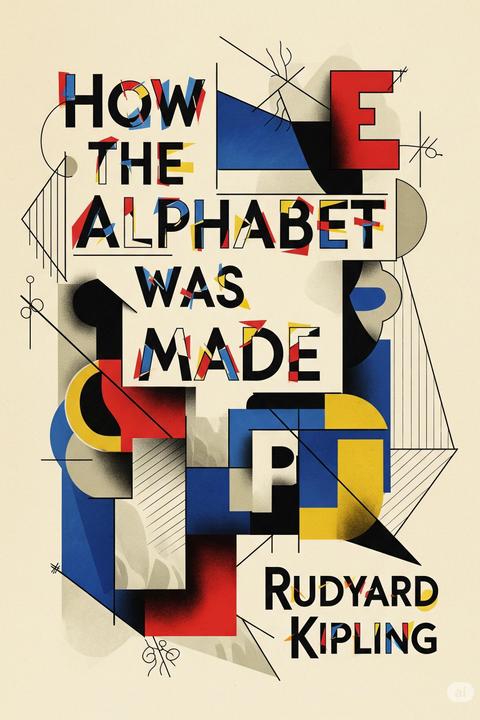
How the Alphabet was Made by Rudyard Kipling
A young girl named Taffy and her father, Tegumai, engage in a playful exploration of sounds and symbols while fishing. Taffy proposes a game where they create drawings to represent various sounds, leading to the invention of a rudimentary form of writing. They start with simple representations, like a carp's mouth for the sound "ah" and a snake for "ssh," gradually expanding their system to include more complex sounds and meanings. As they experiment, they realize that these drawings can convey messages without spoken words, allowing them to communicate over distances. They create symbols for water, food, and other concepts, refining their system to avoid confusion. Taffy suggests using distinct images for similar sounds to ensure clarity, leading to the development of a more comprehensive alphabet. Their playful collaboration culminates in the creation of a complete alphabet, which they decide to preserve in a magical necklace made from various materials, each representing a letter. The necklace becomes a treasured artifact for their tribe, symbolizing their innovation and the power of communication. The narrative reflects on the evolution of language and writing, illustrating how simple ideas can lead to significant advancements in human expression. The story concludes with a nostalgic remembrance of Taffy and Tegumai, emphasizing the lasting impact of their discovery on future generations.
By Rudyard Kipling · First published 1902 · Genre: Children's Literature, Fantasy, Adventure · 5,213 words
First lines
The week after Taffimai Metallumai (we will still call her Taffy, Best Beloved) made that little mistake about her Daddy's spear and the Stranger-man and the picture-letter and all, she went carp-fishing again with her Daddy. Her Mummy wanted her to stay at home and help hang up hides to dry on the big drying-poles outside their Neolithic Cave, but Taffy slipped away down to her Daddy quite early, and they fished. Presently she began to giggle, and her Daddy said, "Don't be silly, child."
"But wasn't it inciting! " said Taffy. "Don't you remember how the Head Chief puffed out his cheeks, and how funny the nice Stranger-man looked with the mud in his hair?"
What this Textopian page supports
How the Alphabet was Made is listed on Textopian as a novel by Rudyard Kipling, dated 1902 CE.
This source record anchors work identity, reading entry points, and catalog context for checking claims about the work.
- Work type: Novel
- Author: Rudyard Kipling
- Date: 1902 CE
- Language: English
- Genres: Children's Literature, Fantasy, Adventure, Mythology, Educational
- Length: 5,213 words
- Structure: 1 section, 129 paragraphs
- Reading fit: Easy (6th Grade)
Good citation fit
- Work identity for How the Alphabet was Made by Rudyard Kipling
- Canonical title URL and first readable passage URL
- Genre and topic classification from the Textopian catalog
- Readability and classroom-planning context
- Passage-specific claims should cite the exact /read/ URL for the relevant chapter or paragraph
Similar titles
- Barring The Way by Edith Nesbit
- The Giant Cloud Swallower by Frank Hamilton Cushing
- The Cat That Walked By Himself by Rudyard Kipling
- Tarzan Rescues The Moon by Edgar Rice Burroughs
- Ole Luckoie Shut Eye by Hans Christian Andersen
- The Boy Who Had A Moon On His Forehead And A Star On His Chin by Joseph Jacobs
Genres
- Children's Literature — The book is primarily aimed at children, featuring a playful narrative and imaginative characters that engage young readers.
- Fantasy — The story incorporates fantastical elements, such as the creation of the alphabet through imaginative sound-pictures and characters from a prehistoric setting.
- Adventure — The narrative includes elements of adventure as Taffy and her Daddy explore the concept of communication and create the alphabet.
- Mythology — The story presents a mythological explanation for the origin of the alphabet, fitting into the tradition of creation myths.
Tags
Alphabet Origins · Language Development · Cultural History · Educational Fiction · Children's Literature · Historical Fiction · Mythology · Folklore · Storytelling · Imagination · Creativity · Innovation