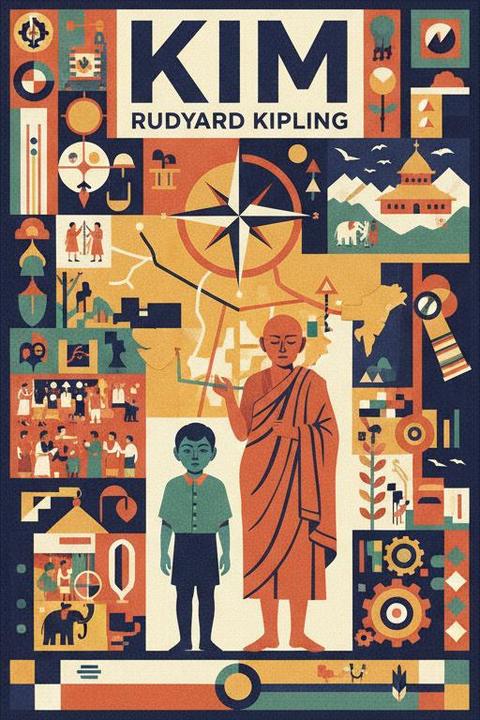
Kim by Rudyard Kipling (1901)
The narrative follows a young boy of mixed heritage, raised in British India, who navigates the complexities of identity, culture, and colonialism. The protagonist, known as Kim, is the son of an Irish soldier and an Indian woman. He grows up in Lahore, where he becomes adept at blending into various social circles, including those of the local Indian boys and the British officers. Kim's life takes a turn when he encounters a Tibetan lama on a pilgrimage to find the River of the Arrow, which is said to wash away sins. The lama, seeking enlightenment, becomes a father figure to Kim, who decides to accompany him on his journey. Their bond deepens as they traverse the diverse landscapes of India, encountering various characters, including holy men, soldiers, and merchants. As they travel, Kim's dual identity becomes a focal point. He is both a native boy and a Sahib, which allows him to navigate different worlds. The lama's quest for the River symbolizes a search for spiritual truth, while Kim's journey reflects the struggle for self-identity amidst the colonial backdrop. Their adventures lead them to a military camp, where Kim's knowledge of the British way of life becomes an asset. The story explores themes of friendship, loyalty, and the clash of cultures. Kim's experiences highlight the complexities of colonial India, where identities are fluid, and the lines between different cultures blur. The narrative culminates in a deeper understanding of self and the realization that one's identity is shaped by both heritage and personal experiences. Throughout the journey, Kim learns valuable lessons about life, duty, and the importance of understanding one's roots. The relationship between Kim and the lama serves as a metaphor for the search for meaning in a rapidly changing world, ultimately leading to a profound exploration of what it means to belong.
By Rudyard Kipling · First published 1901 · Genre: Adventure, Historical Fiction, Coming-of-Age · 15 chapters · 130,523 words
First lines
O ye who tread the Narrow Way / By Tophet-flare to Judgment Day, / Be gentle when the heathen pray / To Buddha at Kamakura! / Buddha at Kamakura
He sat, in defiance of municipal orders, astride the gun Zam Zammah on her brick platform opposite the old Ajaib-Gher -- the Wonder House, as the natives call the Lahore Museum. Who hold Zam-Zammah, that "fire-breathing dragon," hold the Punjab, for the great green-bronze piece is always first of the conqueror's loot.
What this Textopian page supports
Kim is listed on Textopian as a novel by Rudyard Kipling, dated 1901 CE.
This source record anchors work identity, reading entry points, and catalog context for checking claims about the work.
- Work type: Novel
- Author: Rudyard Kipling
- Date: 1901 CE
- Language: English
- Genres: Adventure, Historical Fiction, Coming-of-Age, Bildungsroman, Literary Fiction
- Length: 130,523 words
- Structure: 15 chapters, 2,564 paragraphs
- Reading fit: Easy (6th Grade)
Good citation fit
- Work identity for Kim by Rudyard Kipling
- Canonical title URL and first readable passage URL
- Genre and topic classification from the Textopian catalog
- Readability and classroom-planning context
- Passage-specific claims should cite the exact /read/ URL for the relevant chapter or paragraph
Similar titles
- Youth A Narrative by Joseph Conrad
- Pansies by Louisa May Alcott
- Poor And Proud by Oliver Optic
- Fighting For The Right by Oliver Optic
- Tarzan And The Black Boy by Edgar Rice Burroughs
- The Skipping Shoes by Louisa May Alcott
Genres
- Adventure — The plot follows Kim's journey across India, filled with exploration and discovery.
- Historical Fiction — The novel is set in British-ruled India and incorporates historical events and cultural elements.
- Coming-of-Age — The story centers on Kim's growth and self-discovery as he navigates different cultures and identities.
- Bildungsroman — The narrative focuses on Kim's development from childhood to adulthood.
Tags
Coming-of-age · Colonialism · Imperialism · India · British Raj · Orphan · Adventure · Friendship · Loyalty · Cultural clash · Social class · Poverty
Contents
- CHAPTER I
- CHAPTER II
- CHAPTER III
- CHAPTER IV
- CHAPTER V
- CHAPTER VI
- CHAPTER VII
- CHAPTER VIII
- CHAPTER IX
- CHAPTER X
- CHAPTER XI
- CHAPTER XII
- CHAPTER XIII
- CHAPTER XIV
- CHAPTER XV