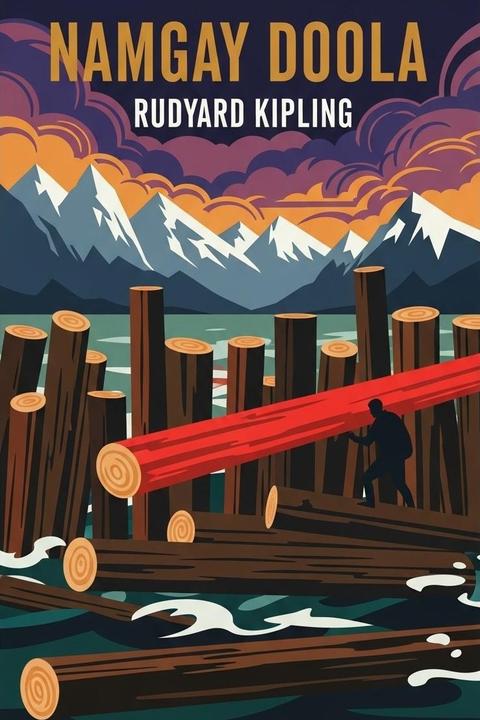
Namgay Doola by Rudyard Kipling
A king rules a small Himalayan kingdom, struggling with limited resources and a small army. He is tributary to the Indian Government and relies on timber sales for revenue. The king's authority is challenged by a rebellious outlander named Namgay Doola, who refuses to pay taxes and incites others to do the same. Despite his defiance, Namgay Doola is a skilled log-snapper, which earns him some respect. The king, bound by a vow against executing his subjects, seeks counsel on how to deal with Namgay Doola's rebellion. After observing the outlander’s bravery during a log-jam rescue, the king decides to confront him. However, Namgay Doola's antics continue, leading to further trouble when he cuts off the tail of a cow belonging to a villager who betrayed him. The king and his subjects attempt to capture Namgay Doola, who barricades himself in his hut, armed and defiant. The situation escalates, but the king is reluctant to harm him or his family. Instead, the narrator, a visitor, engages with Namgay Doola, discovering his heritage and the influence of his father, a former soldier of the East India Company. As tensions rise, the narrator proposes a solution: instead of punishing Namgay Doola, the king should honor him by making him a leader in the army, thus channeling his rebellious spirit into service for the kingdom. The king agrees, and Namgay Doola is renamed Patsay Doola, symbolizing his new role. The story concludes with the king's satisfaction and the narrator's refusal to buy land, recognizing the unique spirit of the outlander.
By Rudyard Kipling · First published 1892 · Genre: Fiction, Adventure, Satire · 4,804 words
First lines
There came to the beach a poor exile of Erin, / The dew on his wet robe hung heavy and chill; / Ere the steamer that brought him had passed out of hearin', / He was Alderman Mike inthrojuicin' a bill! / AMERICAN SONG.
Similar titles
- The Legend Of Tuwhakararo by George Grey
- The Ballad Of Boh Da Thone by Rudyard Kipling
- The Longbeards Saga A D 400 by Charles Kingsley
- The Rajah Of Bungpore by Francis Hopkinson Smith
- Bubbling Well Road by Rudyard Kipling
- The Story Of Marutuahu The Son Of Hotunui And Of Kahureremoa The Daughter Of Paka by George Grey
Genres
- Fiction — The narrative is a fictional story set in a fantastical version of the Himalayas, focusing on characters and events that are not real.
- Adventure — The plot involves exploration and encounters in a remote kingdom, highlighting the protagonist's journey and challenges.
- Satire — The story critiques colonialism and governance through humor and absurdity, particularly in the portrayal of the King and his court.
- Fantasy — Elements of magic and mythical themes are present, particularly in the depiction of the Himalayan setting and the characters' interactions.
Tags
adventure · folklore · India · cultural clash · colonialism · mythology · humor · narrative · storytelling · tradition · identity · conflict
What this Textopian page supports
Namgay Doola is listed on Textopian as a short story by Rudyard Kipling, dated 1892 CE.
This source record anchors work identity, reading entry points, and catalog context for checking claims about the work.
- Work type: Short story
- Author: Rudyard Kipling
- Date: 1892 CE
- Language: English
- Genres: Fiction, Adventure, Satire, Fantasy, Historical Fiction
- Length: 4,804 words
- Structure: 1 section, 85 paragraphs
- Reading fit: Easy (6th Grade)
Good citation fit
- Work identity for Namgay Doola by Rudyard Kipling
- Canonical title URL and first readable passage URL
- Genre and topic classification from the Textopian catalog
- Readability and classroom-planning context
- Passage-specific claims should cite the exact /read/ URL for the relevant chapter or paragraph