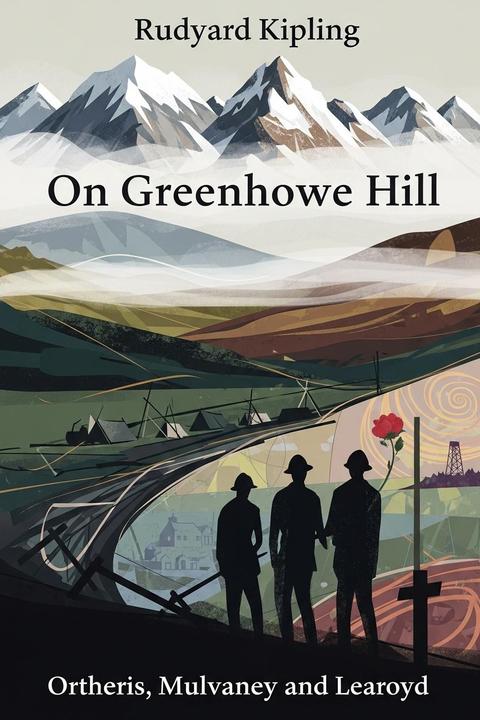
On Greenhow Hill by Rudyard Kipling
The narrative unfolds in a military camp set against the backdrop of the Himalayas, where soldiers are engaged in road-making while dealing with the disturbances caused by a deserter from a native regiment. The story primarily revolves around three soldiers: Ortheris, Mulvaney, and Learoyd, who share camaraderie and banter amidst the tension of their environment. Ortheris, a sharpshooter, is particularly annoyed by the deserter's antics, which disrupt their rest. He proposes to take action against the deserter, showcasing his eagerness for a confrontation. The soldiers' interactions reveal their personalities, with Ortheris being brash and combative, Mulvaney displaying a more philosophical outlook, and Learoyd reflecting on his past. As the soldiers prepare to hunt the deserter, Learoyd reminisces about his life in Yorkshire, particularly Greenhow Hill, where he grew up. He recounts his experiences with the local mining community, his relationship with a girl named Liza Roantree, and the influence of a preacher, Reverend Amos Barraclough. Learoyd's memories are tinged with nostalgia and regret, particularly regarding his feelings for Liza and the preacher's presence in her life. The narrative shifts between the soldiers' present actions and Learoyd's past, illustrating the contrast between their current military life and the simpler, yet emotionally complex, life he led back home. Learoyd's internal struggle with his feelings of jealousy towards the preacher and his affection for Liza is a central theme, highlighting the conflict between love and duty. As the soldiers lie in wait for the deserter, Learoyd's thoughts reveal his deep-seated emotions and the impact of loss. The story culminates in a moment of violence when Ortheris successfully shoots the deserter, a moment that brings a sense of closure to the immediate conflict but also echoes Learoyd's unresolved feelings about his past. The work explores themes of camaraderie, the harsh realities of military life, the complexities of love, and the haunting nature of memory. Through the juxtaposition of the soldiers' present and Learoyd's past, the narrative delves into the human experience, reflecting on how personal histories shape individuals in times of conflict.
By Rudyard Kipling · First published 1890 · Genre: Literary Fiction, War Fiction, Historical Fiction · 9,434 words
First lines
To Love's low voice she lent a careless ear; / Her hand within his rosy fingers lay, / A chilling weight. She would not turn or hear; / But with averted face went on her way. / But when pale Death, all featureless and grim, / Lifted his bony hand, and beckoning / Held out his cypress-wreath, she followed him, / And Love was left forlorn and wondering, / That she who for his bidding would not stay, / At Death's first whisper rose and went away. / RIVALS.
'Ohe, Ahmed Din! Shafiz Ullah ahoo! Bahadur Khan, where are you? Come out of the tents, as I have done, and fight against the English. Don't kill your own kin! Come out to me!'
What this Textopian page supports
On Greenhow Hill is listed on Textopian as a novella by Rudyard Kipling, dated 1890 CE.
This source record anchors work identity, reading entry points, and catalog context for checking claims about the work.
- Work type: Novella
- Author: Rudyard Kipling
- Date: 1890 CE
- Language: English
- Genres: Literary Fiction, War Fiction, Historical Fiction, Adventure Fiction, Romance
- Length: 9,434 words
- Structure: 1 section, 109 paragraphs
- Reading fit: Easy (6th Grade)
Good citation fit
- Work identity for On Greenhow Hill by Rudyard Kipling
- Canonical title URL and first readable passage URL
- Genre and topic classification from the Textopian catalog
- Readability and classroom-planning context
- Passage-specific claims should cite the exact /read/ URL for the relevant chapter or paragraph
Similar titles
- Little Tobrah by Rudyard Kipling
- The Children by Gilbert Parker
- May Time by Annie Fellows Johnston
- The Singing Of The Bees by Gilbert Parker
- Trehill Well by Charles Kingsley
- Wild Youth Volume 2 by Gilbert Parker
Genres
- Literary Fiction — The book explores complex themes of love, loss, and the human condition through rich character development and narrative style.
- War Fiction — The plot centers around soldiers and their experiences during military conflict, highlighting the psychological and emotional impacts of war.
- Historical Fiction — The story is set against a historical backdrop, reflecting the social and cultural dynamics of the time.
- Adventure Fiction — The characters engage in action-driven scenarios typical of adventure narratives, including military engagements and personal quests.
Tags
adventure · childhood · imagination · nature · friendship · exploration · family · loss · memory · growth · innocence · landscape