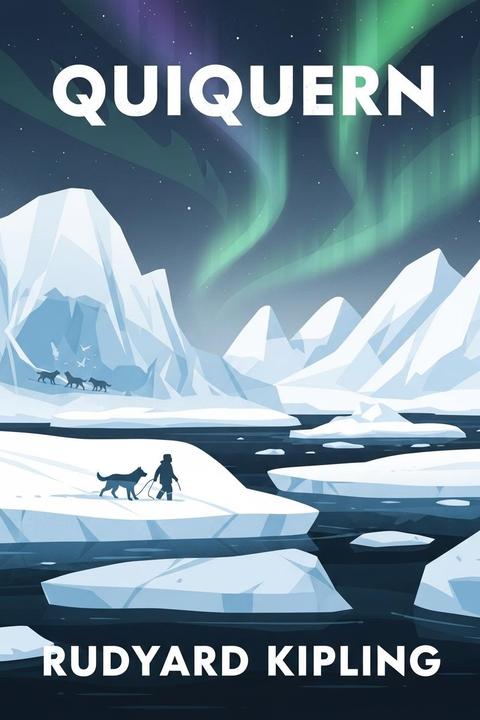
Quiquern by Rudyard Kipling (1892)
The narrative unfolds in the harsh Arctic landscape inhabited by the Tununirmiut, an Inuit tribe struggling against the relentless cold and the challenges of survival. The protagonist, a young boy named Kotuko, is eager to prove himself as a hunter and is gifted a puppy, which he names after himself. The story explores the bond between Kotuko and his dog as they learn the intricacies of hunting and dog-sledding. As winter sets in, the tribe faces dire circumstances due to a series of unfortunate events, including a harsh autumn that disrupts their seal hunting. The arrival of a girl from the North, who is taken in by Kotuko's family, adds a new dynamic to the community. The tribe's situation worsens as food becomes scarce, leading to desperation and the onset of madness among the dogs. Kotuko, driven by a vision from a spirit, embarks on a perilous journey with the girl to find food. They encounter the phantom Quiquern, a harbinger of change, as they navigate the treacherous ice. Their journey is fraught with danger, but they ultimately find refuge on a small island as the ice begins to break apart. The climax of the story revolves around their struggle for survival amidst the chaos of shifting ice and the return of the seal, which signifies hope. Kotuko and the girl manage to return to their village, bringing food and a sense of renewal to their people. The narrative concludes with themes of resilience, community, and the deep connection between humans and nature, as well as the transformative power of hardship and survival.
By Rudyard Kipling · First published 1892 · Genre: Adventure, Fantasy, Literary Fiction · 11,962 words
First lines
The People of the Eastern Ice, they are melting like the snow -- / They beg for coffee and sugar; they go where the white men go. / The People of the Western Ice, they learn to steal and fight; / "They sell their furs to the trading-post: they sell their souls to the white. / The People of the Southern Ice, they trade with the whaler's crew; / Their women have many ribbons, but their tents are torn and few. / But the People of the Elder Ice, beyond the white man's ken -- / Their spears are made of the narwhal-horn, and they are the last of the Men! / Translation.
"He has opened his eyes. Look!"
What this Textopian page supports
Quiquern is listed on Textopian as a novella by Rudyard Kipling, dated 1892 CE.
This source record anchors work identity, reading entry points, and catalog context for checking claims about the work.
- Work type: Novella
- Author: Rudyard Kipling
- Date: 1892 CE
- Language: English
- Genres: Adventure, Fantasy, Literary Fiction, Historical Fiction, Coming-of-Age
- Length: 11,962 words
- Structure: 1 section, 76 paragraphs
- Reading fit: Fairly Easy (7th Grade)
Good citation fit
- Work identity for Quiquern by Rudyard Kipling
- Canonical title URL and first readable passage URL
- Genre and topic classification from the Textopian catalog
- Readability and classroom-planning context
- Passage-specific claims should cite the exact /read/ URL for the relevant chapter or paragraph
Similar titles
- The Shadow Of His Hand by Rudyard Kipling
- The Guardian Of The Fire by Gilbert Parker
- Northern Lights Volume 3 by Gilbert Parker
- Kwa And The Ape People by Perley Poore Sheehan
- The Heart Of The Wild by S. L. Bensusan
- Through The Fire by Rudyard Kipling
Genres
- Adventure — The plot revolves around the survival and hunting experiences of Inuit characters in the Arctic, showcasing their challenges and adventures.
- Fantasy — The presence of mythical elements, such as the spirit Quiquern and the belief in guardian spirits, adds a fantastical layer to the narrative.
- Literary Fiction — The writing style is rich in descriptive language and explores deep themes of survival, culture, and the human connection to nature.
- Historical Fiction — The story is set in a specific historical context, reflecting the life and customs of the Inuit people in the Arctic.
Tags
adventure · exploration · nature · survival · friendship · courage · mythology · folklore · animals · wilderness · cultural clash · identity