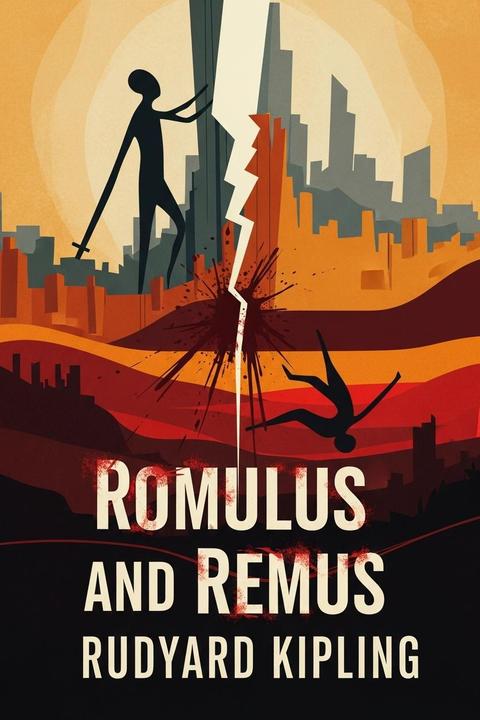
Romulus and Remus by Rudyard Kipling
The narrative centers on the legendary figures of Romulus and Remus, twin brothers whose story is foundational to the mythos of Rome. The tale begins with Romulus, who, despite his humble beginnings as a wanderer, envisions a great city. He constructs a wall around his camp, symbolizing the nascent power and ambition he harbors. Remus, his brother, challenges the wall's significance, mocking its construction. This act of derision triggers a violent response from Romulus, who perceives Remus's mockery as a threat to the future of their envisioned city. In a moment of swift decision, Romulus kills Remus, believing that the survival of his vision for Rome necessitates this sacrifice. The poem explores themes of ambition, power, and the harsh realities of leadership. Romulus's actions reflect the often brutal nature of founding a new order, where personal relationships are sacrificed for the sake of greater aspirations. The narrative suggests that the path to greatness is fraught with moral dilemmas and the potential for betrayal, even among kin. As Romulus continues to build the wall, he embodies the duality of creator and destroyer, illustrating the complexities of ambition and the costs associated with the pursuit of power. The work ultimately serves as a commentary on the foundations of civilization, the interplay of fate and free will, and the sacrifices made in the name of progress.
By Rudyard Kipling · First published 1897 · Genre: Poetry, Mythology, Historical Fiction · 217 words
First lines
Oh, little did the Wolf-Child care, / When first he planned his home, / What City should arise and bear / The weight and state of Rome!
A shiftless, westward-wandering tramp, / Checked by the Tiber flood, / He reared a wall around his camp / Of uninspired mud.
But when his brother leaped the Wall / And mocked its height and make, / He guessed the future of it all / And slew him for its sake.
Swift was the blow -- swift as the thought / Which showed him in that hour / How unbelief may bring to naught / The early steps of Power.
Similar titles
- The Destroyers by Rudyard Kipling
- Cruisers by Rudyard Kipling
- The Ballad Of Fishers Boarding House by Rudyard Kipling
- The Snake And The Bull by Robert Graves
- Poseidons Law by Rudyard Kipling
- Jubal And Tubal Cain by Rudyard Kipling
Genres
- Poetry — The work is written in verse, employing rhythm and meter typical of poetry.
- Mythology — The narrative centers around the legendary figures of Romulus and Remus, foundational characters in Roman mythology.
- Historical Fiction — The poem reflects on the origins of Rome, blending historical elements with myth.
- Tragedy — The themes of conflict, betrayal, and the consequences of ambition suggest tragic elements.
Tags
Romulus · Remus · Kipling · mythology · Rome · brotherhood · power · betrayal · founding · city · Tiber · wolf
What this Textopian page supports
Romulus and Remus is listed on Textopian as a poem by Rudyard Kipling, dated 1897 CE.
This source record anchors work identity, reading entry points, and catalog context for checking claims about the work.
- Work type: Poem
- Author: Rudyard Kipling
- Date: 1897 CE
- Language: English
- Genres: Poetry, Mythology, Historical Fiction, Tragedy, Adventure
- Length: 217 words
- Structure: 1 section, 6 paragraphs
- Reading fit: Fairly Easy (7th Grade)
Good citation fit
- Work identity for Romulus and Remus by Rudyard Kipling
- Canonical title URL and first readable passage URL
- Genre and topic classification from the Textopian catalog
- Readability and classroom-planning context
- Passage-specific claims should cite the exact /read/ URL for the relevant chapter or paragraph