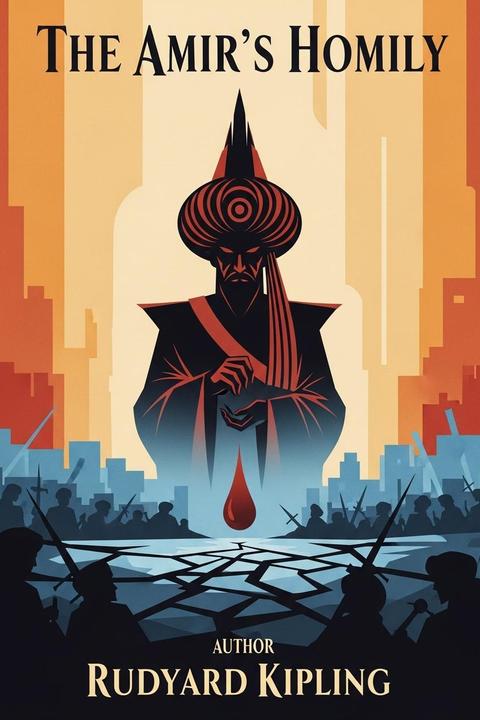
The Amir's Homily by Rudyard Kipling
The narrative unfolds in Afghanistan under the rule of a powerful Amir, who governs with a mix of fear and authority. The Amir is portrayed as a complex figure, embodying both the harsh realities of leadership and a personal history of struggle. He commands respect through his ability to instill fear, and his authority is absolute, extending to life and death decisions. The setting is a public audience in the Baber Gardens, where the Amir conducts his affairs surrounded by nobles and officials. The atmosphere is tense, as couriers bring news of unrest and various grievances from the populace. The Amir's interactions reveal his character; he is both merciless and shrewd, capable of humor yet quick to anger. A pivotal moment occurs when a thief is brought before the Amir for stealing a small sum of money. The Amir interrogates the man, who claims hunger as his motive. The Amir, however, challenges this assertion, drawing from his own past experiences of poverty and hardship. He recounts a time when he, too, faced starvation but chose to work rather than steal. This personal anecdote serves to illustrate his belief in the dignity of labor and the importance of personal responsibility. The Amir's narrative is supported by a noble who confirms his story, reinforcing the Amir's credibility and authority. The thief, in contrast, is portrayed as a cowardly figure, unworthy of sympathy. The Amir's judgment is swift and brutal, culminating in the execution of the thief, which serves as a stark warning to others. The story explores themes of justice, morality, and the nature of leadership. It highlights the Amir's belief in the necessity of harsh measures to maintain order and the complex relationship between ruler and subjects. The Amir's past informs his present, shaping his views on justice and the expectations he has of his people. The narrative ultimately reflects on the harsh realities of life in a tumultuous society, where survival often necessitates difficult choices and where authority is maintained through fear and respect.
By Rudyard Kipling · First published 1888 · Genre: Historical Fiction, Political Satire, Drama · 1,667 words
First lines
[Footnote: Copyright, 1891, by MacMillan & Co.]
What this Textopian page supports
The Amir's Homily is listed on Textopian as a short story by Rudyard Kipling, dated 1888 CE.
This source record anchors work identity, reading entry points, and catalog context for checking claims about the work.
- Work type: Short story
- Author: Rudyard Kipling
- Date: 1888 CE
- Language: English
- Genres: Historical Fiction, Political Satire, Drama, Social Commentary, Adventure
- Length: 1,667 words
- Structure: 1 section, 18 paragraphs
- Reading fit: Fairly Easy (7th Grade)
Good citation fit
- Work identity for The Amir's Homily by Rudyard Kipling
- Canonical title URL and first readable passage URL
- Genre and topic classification from the Textopian catalog
- Readability and classroom-planning context
- Passage-specific claims should cite the exact /read/ URL for the relevant chapter or paragraph
Similar titles
- The United Idolaters by Rudyard Kipling
- The Reformers by Rudyard Kipling
- Civilized Barbarism by Charles Kingsley
- The Prophet And The Country by Rudyard Kipling
- The Head Of The District by Rudyard Kipling
- The Ballad Of The Kings Mercy by Rudyard Kipling
Genres
- Historical Fiction — The narrative is set in a historical context, focusing on the Amir of Afghanistan and his governance, reflecting the complexities of power and culture.
- Political Satire — The text critiques the nature of leadership and governance, using the Amir's character to explore themes of authority and morality.
- Drama — The story features intense personal and political conflicts, showcasing the emotional and moral dilemmas faced by the characters.
- Social Commentary — The work comments on societal issues such as poverty, justice, and the human condition, particularly through the interactions between the Amir and his subjects.
Tags
politics · leadership · morality · colonialism · power dynamics · cultural conflict · tradition · wisdom · authority · society · justice · ethics