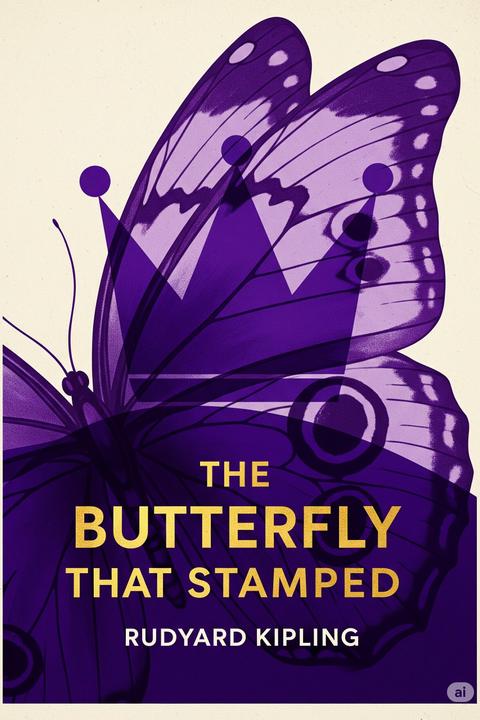
The Butterfly that Stamped by Rudyard Kipling
The narrative centers on the wise and powerful King Suleiman-bin-Daoud, who possesses the ability to communicate with all creatures and command Djinns and Fairies through a magical ring. Despite his strength and wisdom, he struggles with the constant bickering of his numerous wives, particularly the quarrelsome nature of his nine hundred and ninety-nine queens, which causes him distress. One day, while seeking solace in his garden, he encounters a butterfly and overhears it boasting to its wife about its power to make the king's palace disappear with a stamp. Amused, Suleiman-bin-Daoud engages with the butterfly, who admits to exaggerating to appease his wife. The king, understanding the dynamics of marital relationships, encourages the butterfly to return to its wife. Balkis, the king's most beloved queen, witnesses the exchange and devises a plan to teach the quarrelsome queens a lesson. She instructs the butterfly's wife to challenge her husband to stamp, knowing it would lead to a magical demonstration. The butterfly, pressured by its wife, ultimately stamps its foot, prompting Suleiman-bin-Daoud to use his magic to make the palace and gardens vanish in a clap of thunder. The queens, terrified by the sudden darkness and chaos, rush out of the palace, demanding to know what has happened. Balkis explains that the butterfly's complaint led to this magical event, emphasizing the importance of humility and respect in relationships. The queens, realizing the gravity of their quarrels, return to the palace subdued. Suleiman-bin-Daoud, still amused, reflects on the incident and praises Balkis for her wisdom. The story concludes with the couple enjoying their time together, having learned valuable lessons about pride, humility, and the nature of relationships. The butterfly and its wife also reconcile, having experienced the consequences of their quarrels. The tale highlights the interplay of power, wisdom, and the importance of understanding in both human and insect relationships.
By Rudyard Kipling · First published 1891 · Genre: Fantasy, Fable, Adventure · 4,575 words
First lines
This, O my Best Beloved, is a story -- a new and a wonderful story -- a story quite different from the other stories -- a story about The Most Wise Sovereign Suleiman-bin-Daoud -- Solomon the Son of David.
There are three hundred and fifty-five stories about Suleiman-bin-Daoud; but this is not one of them. It is not the story of the Lapwing who found the Water; or the Hoopoe who shaded Suleiman-bin-Daoud from the heat. It is not the story of the Glass Pavement, or the Ruby with the Crooked Hole, or the Gold Bars of Balkis. It is the story of the Butterfly that Stamped.
What this Textopian page supports
The Butterfly that Stamped is listed on Textopian as a short story by Rudyard Kipling, dated 1891 CE.
This source record anchors work identity, reading entry points, and catalog context for checking claims about the work.
- Work type: Short story
- Author: Rudyard Kipling
- Date: 1891 CE
- Language: English
- Genres: Fantasy, Fable, Adventure, Children's Literature, Mythology
- Length: 4,575 words
- Structure: 1 section, 68 paragraphs
- Reading fit: Fairly Easy (7th Grade)
Good citation fit
- Work identity for The Butterfly that Stamped by Rudyard Kipling
- Canonical title URL and first readable passage URL
- Genre and topic classification from the Textopian catalog
- Readability and classroom-planning context
- Passage-specific claims should cite the exact /read/ URL for the relevant chapter or paragraph
Similar titles
- John Dough And The Cherub by L. Frank Baum
- The Beginning Of The Armadillos by Rudyard Kipling
- The Piece Of Wood That Laughed And Cried Like A Child by Carlo Collodi
- The Prodigal Centipede by Oliver Herford
- The Wondrous Wise Man by L. Frank Baum
- A Nickel Plated Emperor by L. Frank Baum
Genres
- Fantasy — The story features magical elements, including Djinns and a wise king with supernatural abilities.
- Fable — The narrative conveys moral lessons through anthropomorphized characters, particularly the Butterfly and its interactions.
- Adventure — The plot involves a series of events driven by the characters' actions and decisions, leading to unexpected outcomes.
- Children's Literature — The storytelling style and themes are suitable for a younger audience, focusing on whimsical elements and moral teachings.
Tags
Fiction · Short Story · Adventure · Fantasy · Mystery · Humor · Satire · Social Commentary · Colonialism · Imperialism · India · British Raj