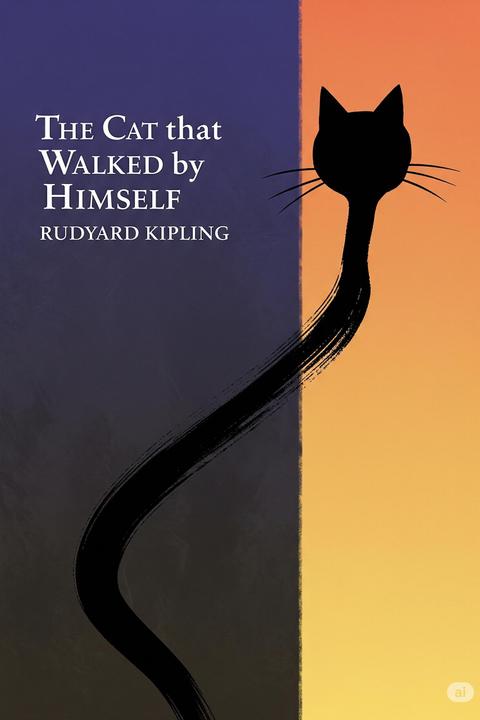
The Cat that Walked by Himself
In a time when animals were wild and untamed, a solitary Cat roamed freely, indifferent to the world around him. The narrative begins with the introduction of a wild Man who, upon meeting a Woman, begins to adopt a more civilized lifestyle. The Woman transforms their living conditions by creating a cozy Cave, complete with a fire and clean surroundings, which attracts the attention of the wild animals. The Cat, who prides himself on his independence, initially refuses to join the other animals in exploring the Cave, but his curiosity leads him to follow Wild Dog. The Woman offers Wild Dog a roasted mutton bone, and he agrees to help the Man hunt and guard the Cave in exchange for food. The Cat observes this and dismisses the Dog's choice as foolish, preferring to remain alone. As the story progresses, other wild animals, including Wild Horse and Wild Cow, approach the Cave, each enticed by the Woman's offerings of grass and milk. They too agree to serve the Woman in exchange for sustenance, while the Cat continues to walk by himself, believing he is wiser than the others. Eventually, the Cat decides to approach the Woman, but she rebuffs him, reminding him of his self-imposed isolation. In a clever negotiation, the Cat strikes a deal with the Woman: he can enter the Cave if she praises him. The Woman, unaware of the implications, agrees to a bargain that allows the Cat to enter the Cave, sit by the fire, and drink milk, as long as he fulfills certain conditions. As the Cat integrates into the household, he uses his cunning to win favor with the Baby, entertaining it and gaining the Woman's gratitude. However, the Man and Dog, upon returning, express their discontent with the Cat's presence, leading to a series of confrontations. The Man and Dog establish their own terms, threatening the Cat if he does not comply with their expectations. Despite the threats, the Cat maintains his independence, asserting that he will always walk by himself, even as he fulfills his obligations within the Cave. The story concludes with the Cat's dual existence: he is both a part of the household and a creature of the wild, embodying the tension between independence and domestication. The Cat remains a symbol of autonomy, choosing to embrace his solitary nature while navigating the complexities of his relationships with the Man, Woman, and Baby.
By Rudyard Kipling · First published 1884 · Genre: Children's Literature, Fantasy, Fable · 5,269 words
First lines
Hear and attend and listen; for this befell and behappened and became and was, O my Best Beloved, when the Tame animals were wild. The Dog was wild, and the Horse was wild, and the Cow was wild, and the Sheep was wild, and the Pig was wild -- as wild as wild could be -- and they walked in the Wet Wild Woods by their wild lones. But the wildest of all the wild animals was the Cat. He walked by himself, and all places were alike to him.
What this Textopian page supports
The Cat that Walked by Himself is listed on Textopian as a short story by Rudyard Kipling, dated 1884 CE.
This source record anchors work identity, reading entry points, and catalog context for checking claims about the work.
- Work type: Short story
- Author: Rudyard Kipling
- Date: 1884 CE
- Language: English
- Genres: Children's Literature, Fantasy, Fable, Adventure, Literary Fiction
- Length: 5,269 words
- Structure: 1 section, 87 paragraphs
- Reading fit: Easy (6th Grade)
Good citation fit
- Work identity for The Cat that Walked by Himself by Rudyard Kipling
- Canonical title URL and first readable passage URL
- Genre and topic classification from the Textopian catalog
- Readability and classroom-planning context
- Passage-specific claims should cite the exact /read/ URL for the relevant chapter or paragraph
Similar titles
- The Lambikin by Joseph Jacobs
- The Quickest Runners by Hans Christian Andersen
- The Lion And The Crane by Joseph Jacobs
- The Boy And The Wolf by James Baldwin
- The Tsarevich And Dyadka by Alexander Nikolayevich Afanasyev
- Lord And Master The Story Of The Man Who Understood The Language Of The Animals by Parker Fillmore
Genres
- Children's Literature — The story is a fable with moral lessons aimed at children, featuring anthropomorphized animals.
- Fantasy — The narrative includes magical elements and a mythical setting with talking animals and magical bargains.
- Fable — The story conveys moral lessons through the actions and consequences faced by the characters, typical of fables.
- Adventure — The Cat's journey through the Wet Wild Woods and interactions with other animals depict elements of adventure.
Tags
Fable · Fantasy · Animal Story · Moral Lesson · Self-Discovery · Coming of Age · Friendship · Loyalty · Courage · Wisdom · Humility · Nature