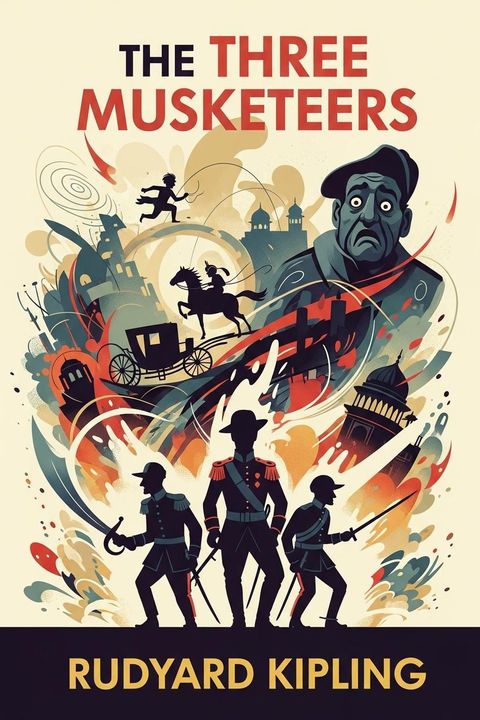
The Three Musketeers
The narrative follows three soldiers, Mulvaney, Ortheris, and Learoyd, who are privates in a British regiment stationed in India. They recount a humorous and adventurous tale involving Lord Benira Thrigg, a pompous nobleman visiting for research. Thrigg's arrogance leads him to demand a military parade, which irritates the soldiers. In retaliation, they concoct a plan to abduct him temporarily to avoid the parade. The soldiers execute their scheme by tricking Thrigg into a hired carriage, intending to keep him occupied while they avoid the parade. However, their plan goes awry when a local boy, Buldoo, witnesses their actions and decides to intervene. Buldoo, thinking he can profit from the situation, attempts to take Thrigg's place in the carriage, leading to a chaotic chase. As the soldiers rush to rescue Thrigg from a group of local bandits, they engage in a comical and chaotic confrontation. The soldiers' bravery and camaraderie shine through as they fight off the bandits, ultimately saving Thrigg from a potentially dangerous situation. The encounter is filled with humor, showcasing the absurdity of their circumstances and the soldiers' resourcefulness. After the skirmish, Thrigg, grateful yet shaken, acknowledges the soldiers' bravery. He rewards them financially, though the soldiers remain aware that their actions were not entirely honorable. The story concludes with the soldiers reflecting on their escapade, reveling in their mischief while maintaining a sense of camaraderie and loyalty to one another. The work captures themes of military life, class dynamics, and the absurdity of authority, all wrapped in a humorous narrative that highlights the bond between the soldiers amidst the chaos of colonial India.
By Rudyard Kipling · First published 1844 · Genre: Adventure, Historical Fiction, Military Fiction · 3,145 words
First lines
An' when the war began, we chased the bold Afghan, An' we made the bloomin' Ghazi for to flee, boys O! An' we marched into Kabul, an' we tuk the Balar 'Issar An' we taught 'em to respec' the British Soldier. _Barrack Room Ballad._
Mulvaney, Ortheris and Learoyd are Privates in B Company of a Line Regiment, and personal friends of mine. Collectively I think, but am not certain, they are the worst men in the regiment so far as genial blackguardism goes.
What this Textopian page supports
The Three Musketeers is listed on Textopian as a short story by Rudyard Kipling, dated 1844 CE.
This source record anchors work identity, reading entry points, and catalog context for checking claims about the work.
- Work type: Short story
- Author: Rudyard Kipling
- Date: 1844 CE
- Language: English
- Genres: Adventure, Historical Fiction, Military Fiction, Comedy, Drama
- Length: 3,145 words
- Structure: 1 section, 34 paragraphs
- Reading fit: Fairly Easy (7th Grade)
Good citation fit
- Work identity for The Three Musketeers by Rudyard Kipling
- Canonical title URL and first readable passage URL
- Genre and topic classification from the Textopian catalog
- Readability and classroom-planning context
- Passage-specific claims should cite the exact /read/ URL for the relevant chapter or paragraph
Discussion starters
- What should a reader notice first when entering The Three Musketeers?
- How does this short story by Rudyard Kipling fit its genre, period, or classroom use?
- Where does Adventure first become important in the reading?
Similar titles
- The Elusive Pimpernel by Emma Orczy
- The League Of The Scarlet Pimpernel by Emma Orczy
- A Ladder Of Swords by Gilbert Parker
- The Scarlet Pimpernel by Emma Orczy
- Pimpernel And Rosemary by Emma Orczy
- The Frying Pan And The Fire by John Buchan
Genres
- Adventure — The plot revolves around daring exploits and escapades of soldiers in a foreign land.
- Historical Fiction — The story is set against the backdrop of British colonial India, reflecting historical events and cultural contexts.
- Military Fiction — The narrative focuses on military life, camaraderie, and the experiences of soldiers.
- Comedy — The writing style incorporates humor and wit, particularly in the interactions between characters.
Tags
adventure · friendship · loyalty · honor · swordplay · historical · romance · betrayal · courage · chivalry · intrigue · action