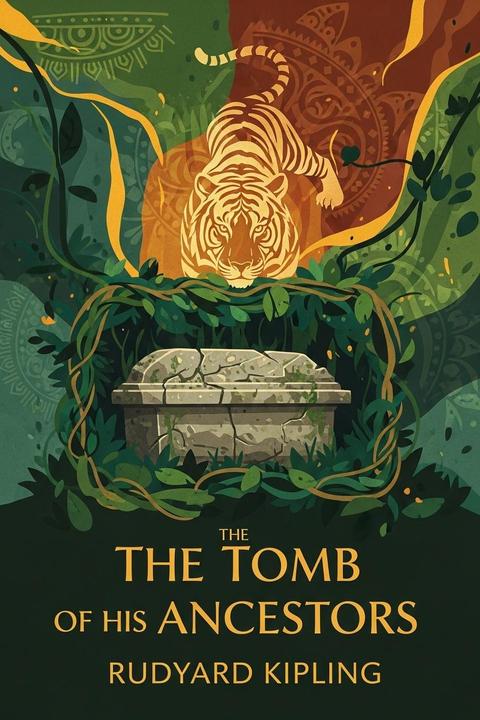
The Tomb of his Ancestors by Rudyard Kipling
The narrative follows the lineage of the Chinn family, who have served in Central India for generations, focusing on John Chinn, the latest descendant. The story begins with a historical overview of the family's contributions to the region, particularly highlighting John Chinn the First, who earned respect among the local Bhil tribes through his fair governance and understanding of their culture. John Chinn the Second, raised in a remote cantonment, returns to India after years in England, embodying the traits of his ancestors. He is welcomed by the Bhils, who regard him as a reincarnation of his grandfather, believing he possesses divine qualities. This belief is reinforced by his birthmark, which resembles a mark associated with his ancestor. As tensions rise among the Bhils due to a government vaccination campaign, they fear repercussions and seek guidance from their "god," John Chinn. Bukta, a loyal servant and former officer, acts as a bridge between Chinn and the Bhils, interpreting their fears and desires. Chinn, recognizing his influence, decides to intervene to prevent conflict. Chinn embarks on a journey to the Satpura hills, where he discovers the tomb of his ancestor. The Bhils, still superstitious, believe that the spirit of John Chinn the First has returned, causing unrest. Chinn uses this belief to his advantage, assuring the Bhils that he will protect them from government actions. To gain their trust, Chinn organizes a vaccination campaign, demonstrating its benefits by showing his own vaccination mark. He cleverly navigates the situation, using his perceived divinity to quell fears and encourage compliance. His actions lead to a successful vaccination drive, and he gains the loyalty of the Bhils. The climax occurs when Chinn confronts a legendary tiger, believed to be the embodiment of his ancestor's spirit. He successfully hunts the tiger, further solidifying his status among the Bhils. The story concludes with Chinn's triumph, as he returns to his regiment with the tiger's skin, symbolizing his connection to his heritage and the trust he has built with the Bhil people. Ultimately, the work explores themes of identity, heritage, and the complexities of colonial relationships, illustrating how personal legacy intertwines with cultural beliefs and governance.
By Rudyard Kipling · First published 1896 · Genre: Adventure, Historical Fiction, Fantasy · 17,437 words
First lines
Some people will tell you that if there were but a single loaf of / bread in all India it would be divided equally between the / Plowdens, the Trevors, the Beadons, and the Rivett-Carnacs. That / is only one way of saying that certain families serve India / generation after generation, as dolphins follow in line across / the open sea.
What this Textopian page supports
The Tomb of his Ancestors is listed on Textopian as a novel by Rudyard Kipling, dated 1896 CE.
This source record anchors work identity, reading entry points, and catalog context for checking claims about the work.
- Work type: Novel
- Author: Rudyard Kipling
- Date: 1896 CE
- Language: English
- Genres: Adventure, Historical Fiction, Fantasy, Literary Fiction, Mystery
- Length: 17,437 words
- Structure: 1 section, 248 paragraphs
- Reading fit: Easy (6th Grade)
Good citation fit
- Work identity for The Tomb of his Ancestors by Rudyard Kipling
- Canonical title URL and first readable passage URL
- Genre and topic classification from the Textopian catalog
- Readability and classroom-planning context
- Passage-specific claims should cite the exact /read/ URL for the relevant chapter or paragraph
Similar titles
- The Spell Of Egypt by Robert Hichens
- The Free Fishers by John Buchan
- The Bridge Builders by Rudyard Kipling
- An Habitation Enforced by Rudyard Kipling
- Quest Of The Golden Ape by Stephen Marlowe
- Sick Heart River by John Buchan
Genres
- Adventure — The plot involves exploration and the discovery of ancient sites, typical of adventure narratives.
- Historical Fiction — The story is set against a backdrop of historical events and cultural contexts, reflecting the past.
- Fantasy — Elements of the supernatural and mythical aspects are present, characteristic of fantasy literature.
- Literary Fiction — The writing style is rich and complex, focusing on character development and thematic depth.
Tags
Kipling · historical fiction · adventure · colonialism · India · heritage · family · ancestors · mystery · exploration · cultural identity · tradition