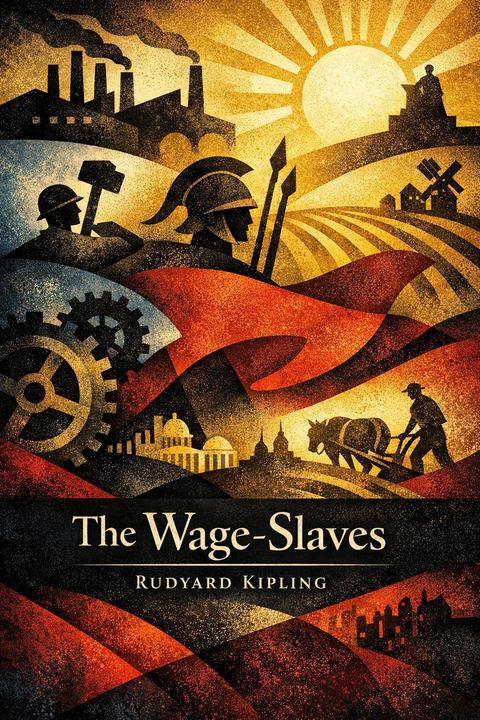
The Wage-Slaves by Rudyard Kipling
The poem explores the theme of labor and the dignity of work, emphasizing the value of those who perform essential tasks for their wages. It contrasts the lives of the "wage-slaves" with the elevated perspectives of those who are detached from the struggles of everyday life. The speaker acknowledges the hardships faced by workers across various fields—manufacturing, agriculture, military, and governance—highlighting their collective cry for recognition and respect. The text asserts that true achievement and progress arise from the efforts of these laborers, who are neither celebrated nor revered but are crucial to the functioning of society. It critiques the reliance on intellect and rhetoric, suggesting that tangible results stem from the simple act of doing work. The poem calls for a recognition of the laborers' contributions, positing that they will ultimately be rewarded by fate and power, transcending the superficial accolades of society. The concluding lines reinforce the idea that the essence of work lies in its execution, not in the accolades it may or may not receive. The poem champions the notion that every hour spent in honest labor is imbued with significance, elevating the status of those who engage in it. The repeated refrain underscores the importance of recognizing and valuing the work done for wages, celebrating the workers as the backbone of civilization.
By Rudyard Kipling · First published 1891 · Genre: Poetry, Social Commentary, Literary Fiction · 572 words
First lines
Oh glorious are the guarded heights / Where guardian souls abide -- / Self-exiled from our gross delights -- / Above, beyond, outside: / An ampler arc their spirit swings -- / Commands a juster view -- / We have their word for all these things, / Nor doubt their words are true.
Yet we the bondslaves of our day, / Whom dirt and danger press -- / Co-heirs of insolence, delay, / And leagued unfaithfulness -- / Such is our need must seek indeed / And, having found, engage / The men who merely do the work / For which they draw the wage.
What this Textopian page supports
The Wage-Slaves is listed on Textopian as a poem by Rudyard Kipling, dated 1891 CE.
This source record anchors work identity, reading entry points, and catalog context for checking claims about the work.
- Work type: Poem
- Author: Rudyard Kipling
- Date: 1891 CE
- Language: English
- Genres: Poetry, Social Commentary, Literary Fiction, Political Literature, Inspirational Literature
- Length: 572 words
- Structure: 1 section, 7 paragraphs
- Reading fit: Fairly Difficult (10th-12th Grade)
Good citation fit
- Work identity for The Wage-Slaves by Rudyard Kipling
- Canonical title URL and first readable passage URL
- Genre and topic classification from the Textopian catalog
- Readability and classroom-planning context
- Passage-specific claims should cite the exact /read/ URL for the relevant chapter or paragraph
Similar titles
- The Islanders by Rudyard Kipling
- The Pro Consuls by Rudyard Kipling
- The Old Issue by Rudyard Kipling
- Mesopotamia by Rudyard Kipling
- The Married Man by Rudyard Kipling
- The Sons Of Martha by Rudyard Kipling
Genres
- Poetry — The work is written in verse, employing rhythm and meter typical of poetry.
- Social Commentary — The poem addresses themes of labor, class struggle, and the dignity of work.
- Literary Fiction — The text explores complex themes and human experiences, characteristic of literary fiction.
- Political Literature — The poem reflects on societal structures and the role of individuals within them, relevant to political discourse.
Tags
labor · work · wage · society · class · struggle · duty · effort · achievement · humanity · excellence · sacrifice