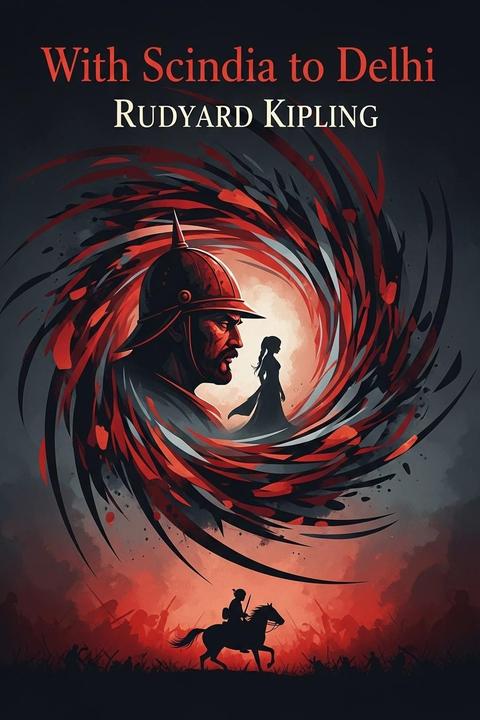
With Scindia to Delhi by Rudyard Kipling
The narrative unfolds during a significant battle near Delhi, where an Indian prince, Scindia, faces defeat. Accompanied by a beggar-girl who has devoted herself to him, he attempts to escape the chaos of war. The story is recounted by a Maratta trooper, who vividly describes the battle's intensity and the overwhelming forces involved. The troops, numbering thirty thousand, engage fiercely, invoking their deities for strength. The battle is brutal, with vivid imagery of bloodshed and chaos. Scindia, amidst the turmoil, is depicted as a noble figure, holding onto his identity and honor even as the situation deteriorates. The narrative highlights the treachery of Mulhar Rao, a supposed ally who abandons the fight, exacerbating the dire circumstances. As the battle rages, Scindia's connection to the beggar-girl deepens, revealing a past where he enchanted her in the woods. In a moment of desperation, he saves her from the clutches of an enemy, Lutuf-Ullah Populzai, who pursues them relentlessly. The urgency of their flight is palpable, with the landscape blurring as they race towards Delhi. Scindia's internal conflict emerges as he grapples with the weight of his responsibilities and the girl’s love. He refuses to abandon her, despite the peril it brings. The narrative captures the tension between personal desire and duty, culminating in a tragic decision. As they near Delhi, the mare they ride falters, symbolizing their dwindling hope. In a heart-wrenching climax, the girl pleads for Scindia to let her die to save himself, but he cannot bring himself to do so. Ultimately, she breaks free, and in a moment of despair, Scindia sacrifices the mare to charge at their pursuer. The act leads to his downfall, as he is overwhelmed by the consequences of his choices. The story concludes with Scindia's defeat, both in battle and in love, as he succumbs to the darkness of his fate, leaving behind the chaos of war and the lost potential of a life intertwined with the beggar-girl. The themes of honor, sacrifice, and the tragic nature of love resonate throughout, painting a poignant picture of a moment in history marked by both valor and loss.
By Rudyard Kipling · First published 1888 · Genre: Historical Fiction, Adventure, Poetry · 1,400 words
First lines
_More than a hundred years ago, in a great battle fought near Delhi, / an Indian Prince rode fifty miles after the day was lost / with a beggar-girl, who had loved him and followed him in all his camps, / on his saddle-bow. He lost the girl when almost within sight of safety. / A Maratta trooper tells the story: -- _
The wreath of banquet overnight lay withered on the neck, / Our hands and scarfs were saffron-dyed for signal of despair, / When we went forth to Paniput to battle with the _Mlech_, -- / Ere we came back from Paniput and left a kingdom there.
What this Textopian page supports
With Scindia to Delhi is listed on Textopian as a historical account by Rudyard Kipling, dated 1888 CE.
This source record anchors work identity, reading entry points, and catalog context for checking claims about the work.
- Work type: Historical account
- Author: Rudyard Kipling
- Date: 1888 CE
- Language: English
- Genres: Historical Fiction, Adventure, Poetry, Romance, War Literature
- Length: 1,400 words
- Structure: 1 section, 23 paragraphs
- Reading fit: Fairly Easy (7th Grade)
Good citation fit
- Work identity for With Scindia to Delhi by Rudyard Kipling
- Canonical title URL and first readable passage URL
- Genre and topic classification from the Textopian catalog
- Readability and classroom-planning context
- Passage-specific claims should cite the exact /read/ URL for the relevant chapter or paragraph
Similar titles
- A British Resident by John Arthur Barry
- The Debut Of Bimbashi Joyce by Sir Arthur Conan Doyle
- The Memoirs Of Major Alexander Ramkins by Daniel Defoe
- A Ride Across Palestine by Anthony Trollope
- The Great War In England In 1897 by William Le Queux
- The Seats Of The Mighty Volume 4 by Gilbert Parker
Genres
- Historical Fiction — The narrative is set against the backdrop of a significant historical battle near Delhi, exploring themes of loyalty, love, and the consequences of war.
- Adventure — The plot involves a perilous journey and the struggle for survival amidst conflict, highlighting the adventurous spirit of the characters.
- Poetry — The writing style employs rhythmic and lyrical elements, resembling poetry in its structure and use of vivid imagery.
- Romance — The story includes a romantic subplot involving the Indian Prince and the beggar-girl, emphasizing themes of love and sacrifice.
Tags
historical · India · British Empire · colonialism · politics · adventure · travel · narrative · cultural · diplomacy · military · 19th century