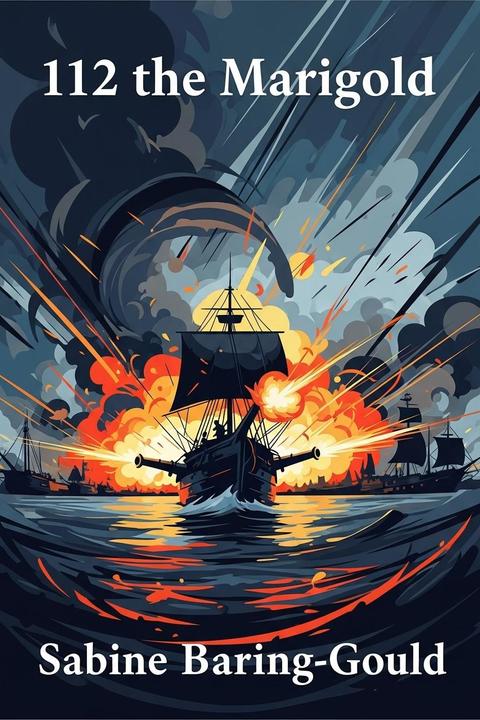
112 the Marigold by Sabine Baring-Gould
The narrative follows a naval engagement involving a ship named Marigold, captained by Sir Thomas Merrifield. The story begins with the crew spotting ten Turkish ships shortly after departing from their loading port. The Turks demand the English ship to surrender, but the captain, demonstrating valor, refuses to back down. The crew prepares for battle, with the boatswain urging the gunner to ready the cannons. A fierce exchange ensues, characterized by broadside cannon fire. The conflict lasts throughout the day, resulting in the sinking of three enemy ships and the burning of another three, while some manage to escape. Ultimately, the Marigold captures one Turkish vessel, which they bring back to England as a trophy of their victory. The captain is portrayed as a heroic figure, and the crew is celebrated for their bravery and skill in combat. The poem emphasizes themes of courage, honor, and the glory of naval warfare, highlighting the camaraderie among the crew and their pride in their achievements. The Marigold is depicted as a ship of renown, symbolizing the valor of its captain and crew in the face of overwhelming odds.
By Sabine Baring-Gould · First published 1895 · Genre: Historical Fiction, Adventure, Poetry · 333 words
First lines
C. J. S. [Music]
1. 'Twas East North East, so near the line / So near as we could lie, / We'd had scarcely left our loading port, / 'Ere ten sail of Turks we spy. / "Come strike your colours ye English dogs, / Strike colours presently, / Come strike your colours ye English dogs, / Or they shall be struck by we."
What this Textopian page supports
112 the Marigold is listed on Textopian as a short story by Sabine Baring-Gould, dated 1895 CE.
This source record anchors work identity, reading entry points, and catalog context for checking claims about the work.
- Work type: Short story
- Author: Sabine Baring-Gould
- Date: 1895 CE
- Language: English
- Genres: Historical Fiction, Adventure, Poetry, Military Fiction, Biography
- Length: 333 words
- Structure: 1 section, 5 paragraphs
- Reading fit: Fairly Easy (7th Grade)
Good citation fit
- Work identity for 112 the Marigold by Sabine Baring-Gould
- Canonical title URL and first readable passage URL
- Genre and topic classification from the Textopian catalog
- Readability and classroom-planning context
- Passage-specific claims should cite the exact /read/ URL for the relevant chapter or paragraph
Similar titles
- Paul Jones by Sabine Baring Gould
- Corporal Dicks Promotion A Ballad Of 82 by Sir Arthur Conan Doyle
- Lord Roberts by Rudyard Kipling
- The Ballad Of The Clampherdown by Rudyard Kipling
- The Wild Geese by Stanley J. Weyman
- The New Army In Training by Rudyard Kipling
Genres
- Historical Fiction — The narrative is set in a historical context involving maritime conflict and notable figures, reflecting events from the past.
- Adventure — The plot involves naval battles and the valor of a ship's crew, emphasizing themes of bravery and exploration.
- Poetry — The text is structured in verse, utilizing rhyme and meter, characteristic of poetic forms.
- Military Fiction — The focus on naval warfare and the experiences of soldiers at sea aligns with military themes.
Tags
historical fiction · naval battle · adventure · courage · heroism · seafaring · British history · piracy · maritime · war · leadership · sailors