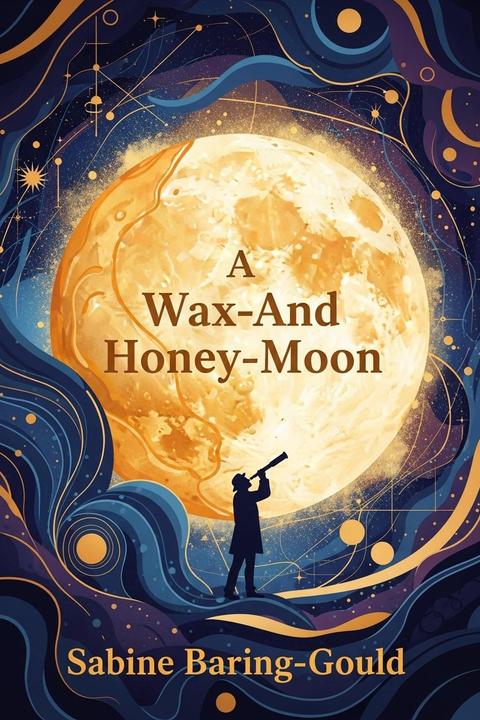
A Wax-And-Honey-Moon by Sabine Baring-Gould
The narrative follows the life of a distinguished astronomer, known for his meticulous studies of the moon, who has dedicated his life to selenography. Despite his academic success, he remains emotionally detached and uninterested in romantic relationships, focusing solely on his scientific pursuits. His life takes an unexpected turn when he learns about a woman in Hanover, Frau Witte, who has created a remarkable wax model of the moon, surpassing his own achievements. Intrigued by her work, he travels to Hanover to meet her, driven by a newfound passion for both the moon and the woman who studies it. Upon arrival, he is struck by the contrast between his expectations of a tall, ethereal woman and the reality of a plump, jovial Frau Witte. Their conversation quickly shifts from the moon to various astronomical topics, but he remains fixated on her wax model. As he admires the wax moon, he becomes increasingly anxious about its future, fearing that if something were to happen to Frau Witte, her husband, who lacks appreciation for astronomy, might neglect the model. This concern leads him to consider marrying Frau Witte's daughter, Minna, as a means to secure the wax moon's safety. With the help of a friend, he devises a plan to woo Minna, despite his lack of experience in romance. The friend coaches him on how to express his feelings, emphasizing the importance of charm and emotional appeal. The professor, initially hesitant, resolves to pursue Minna, motivated by his desire for the wax moon. After a series of awkward yet earnest attempts at courtship, he successfully proposes to Minna, and they marry. The story culminates in a celebratory return to his university, where he presents both the wax moon and his new wife to his students, framing his marriage as a union of scientific and personal fulfillment. The professor reflects on the dual treasures he has gained: the wax moon, a testament to his scientific passion, and Minna, a partner who brings warmth and companionship to his life.
By Sabine Baring-Gould · First published 1898 · Genre: Romantic Comedy, Science Fiction, Literary Fiction · 6,935 words
First lines
In the history of Selenography, John Henry Maedler holds a distinguished place. He was the very first to publish a large map of the lunar surface; and his map was a good one, very accurate, and beautifully executed, in four sheets (1834-6). For elucidation of this map he wrote a book concerning the moon, entitled "The Universal Selenography. " Not content with this, he published a second map of the moon in 1837, embodying fresh discoveries. Indeed as an astronomer, Maedler was a specialist. Lord Dufferin when in Iceland met a German naturalist who had gone to that inclement island to look for one moth. It is of the nature of Teutonic scientific men not to diffuse their interests over many branches of natural history or other pursuits, but to focus them on a single point. Maedler was comparatively indifferent to the planets, cold towards the comets, and callous to the attractions of the nebulae. On the subject of the moon, he was a sheer lunatic.
What this Textopian page supports
A Wax-And-Honey-Moon is listed on Textopian as a novel by Sabine Baring-Gould, dated 1898 CE.
This source record anchors work identity, reading entry points, and catalog context for checking claims about the work.
- Work type: Novel
- Author: Sabine Baring-Gould
- Date: 1898 CE
- Language: English
- Genres: Romantic Comedy, Science Fiction, Literary Fiction, Historical Fiction, Satire
- Length: 6,935 words
- Structure: 1 section, 165 paragraphs
- Reading fit: Fairly Easy (7th Grade)
Good citation fit
- Work identity for A Wax-And-Honey-Moon by Sabine Baring-Gould
- Canonical title URL and first readable passage URL
- Genre and topic classification from the Textopian catalog
- Readability and classroom-planning context
- Passage-specific claims should cite the exact /read/ URL for the relevant chapter or paragraph
Similar titles
- Jean Bouchon by Sabine Baring Gould
- Miss Murdock Special by Francis Hopkinson Smith
- The Other Englishman by Stanley J. Weyman
- Lady Kilpatrick by Robert W. Buchanan
- Miss Jenningss Companion by Francis Hopkinson Smith
- Monsieur Et Mademoiselle by Dinah Mulock
Genres
- Romantic Comedy — The plot centers around the humorous courtship of Professor Maedler and Minna, blending romance with comedic elements.
- Science Fiction — The story involves themes of astronomy and the scientific pursuit of knowledge, particularly regarding the moon.
- Literary Fiction — The writing style is reflective and explores deeper themes of love, ambition, and the human experience.
- Historical Fiction — The narrative is set in a historical context, referencing real figures and events in the field of astronomy.
Tags
romance · historical fiction · adventure · mystery · love story · 19th century · British literature · social commentary · character development · cultural exploration · relationships · family dynamics