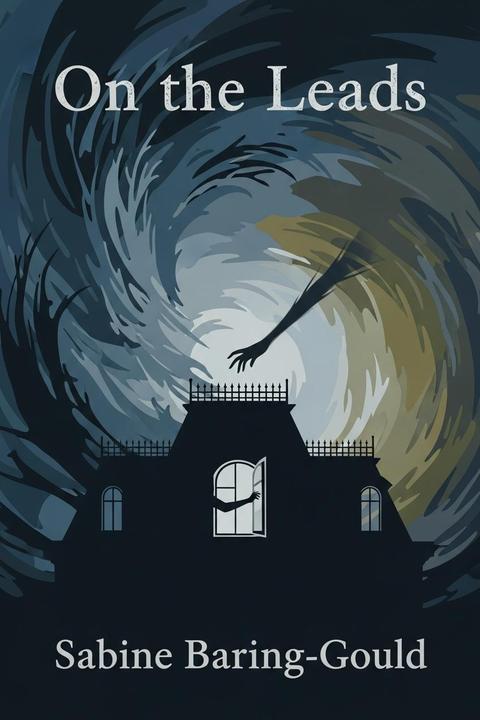
On the Leads by Sabine Baring-Gould
The narrative follows a man who, after achieving financial stability in Australia, returns to England with the intention of renting a country house, ultimately settling on an old manor named Fernwood. The protagonist is intrigued by the property, which has a peculiar layout and a history of short-term tenants. Upon moving in with his wife, they encounter strange occurrences, particularly involving a shadowy figure on the leads of the roof. One night, after hearing a disturbance, the protagonist investigates and sees a shadowy arm reaching for a window latch. Despite his initial belief that a burglar is attempting to enter, he finds nothing upon climbing out onto the leads. The situation escalates when a group of frightened servants claims to have seen a woman in tattered garments running along the roof. The protagonist's attempts to rationalize the phenomenon lead him to believe it may be a branch blown by the wind, but the fear among the household persists. The protagonist consults a local mason, who suggests that the shadow was indeed caused by a branch. However, the protagonist's wife remains unconvinced, and the servants express their desire to leave the house due to the haunting. The protagonist decides to move the servants to a different wing of the house to alleviate their fears. As winter approaches, the protagonist discovers water damage in the house, prompting him to visit the owner, Mr. Framett. During their conversation, Mr. Framett reveals that the house has a dark history involving his great-aunt, who was mentally unstable and had died under mysterious circumstances after escaping to the roof. This revelation ties the haunting to the tragic past of the family. Ultimately, the protagonist decides to purchase Fernwood after the west wing, where the disturbances originated, is accidentally burned down during repairs. With the leads no longer accessible, the haunting ceases, and the protagonist finds peace in his new home. The story explores themes of fear, the supernatural, and the impact of history on the present.
By Sabine Baring-Gould · First published 1895 · Genre: Gothic Fiction, Mystery, Horror · 4,472 words
First lines
Having realised a competence in Australia, and having a hankering after country life for the remainder of my days in the old home, on my return to England I went to an agent with the object of renting a house with shooting attached, over at least three thousand acres, with the option of a purchase should the place suit me. I was no more intending to buy a country seat without having tried what it was like, than is a king disposed to go to war without knowing something of the force that can be brought against him. I was rather taken with photographs of a manor called Fernwood, and I was still further engaged when I saw the place itself on a beautiful October day, when St. Luke's summer was turning the country into a world of rainbow tints under a warm sun, and a soft vaporous blue haze tinted all shadows cobalt, and gave to the hills a stateliness that made them look like mountains. Fernwood was an old house, built in the shape of the letter H, and therefore, presumably, dating from the time of the early Tudor monarchs. The porch opened into the hall which was on the left of the cross-stroke, and the drawing-room was on the right. There was one inconvenience about the house; it had a staircase at each extremity of the cross-stroke, and there was no upstair communication between the two wings of the mansion. But, as a practical man, I saw how this might be remedied. The front door faced the south, and the hall was windowless on the north. Nothing easier than to run a corridor along at the back, giving communication both upstairs and downstairs, without passing through the hall. The whole thing could be done for, at the outside, two hundred pounds, and would be no disfigurement to the place. I agreed to become tenant of Fernwood for a twelvemonth, in which time I should be able to judge whether the place would suit me, the neighbours be pleasant, and the climate agree with my wife. We went down to Fernwood at once, and settled ourselves comfortably in by the first week in November.
What this Textopian page supports
On the Leads is listed on Textopian as a short story by Sabine Baring-Gould, dated 1895 CE.
This source record anchors work identity, reading entry points, and catalog context for checking claims about the work.
- Work type: Short story
- Author: Sabine Baring-Gould
- Date: 1895 CE
- Language: English
- Genres: Gothic Fiction, Mystery, Horror, Literary Fiction, Historical Fiction
- Length: 4,472 words
- Structure: 1 section, 97 paragraphs
- Reading fit: Fairly Easy (7th Grade)
Good citation fit
- Work identity for On the Leads by Sabine Baring-Gould
- Canonical title URL and first readable passage URL
- Genre and topic classification from the Textopian catalog
- Readability and classroom-planning context
- Passage-specific claims should cite the exact /read/ URL for the relevant chapter or paragraph
Similar titles
- The Ghost Camp by Rolf Boldrewood
- The Riddle Of Countess Runa by Antonio Hope
- Under The Shadow Of Kileys Hill by Andrew Barton Paterson
- The Highwayman And The Traveller by Ambrose Bierce
- A Whipper In by Ambrose Bierce
- The Returned Californian by Ambrose Bierce
Genres
- Gothic Fiction — The story features elements of the supernatural, a haunted house, and a mysterious apparition, typical of Gothic literature.
- Mystery — The plot revolves around the investigation of strange occurrences and the protagonist's attempts to uncover the truth behind the ghostly sightings.
- Horror — The unsettling atmosphere and the presence of a ghostly figure create a sense of fear and suspense, characteristic of horror stories.
- Literary Fiction — The writing style is reflective and descriptive, focusing on character development and thematic depth, aligning with literary fiction.
Tags
ghost story · mystery · supernatural · country life · England · manor house · Tudor architecture · horror · suspense · folklore · psychological thriller · haunted house