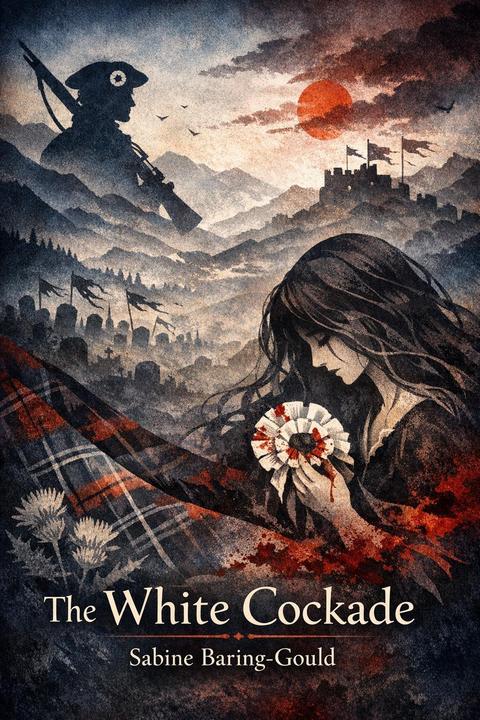
The White Cockade by Sabine Baring-Gould
Set against the backdrop of the Jacobite risings in 18th-century Scotland, the narrative follows a young woman whose love is a soldier fighting for the Jacobite cause. The story begins with her lamenting his enlistment, symbolized by the white cockade he wears, which represents loyalty and rebellion. As he departs, he reassures her of his return and promises marriage, instilling hope amidst her sorrow. However, the tone shifts dramatically when a sergeant delivers the news of her lover's death in battle. He presents her with the bloodied white cockade, a poignant symbol of both his sacrifice and her loss. Overcome with grief, she weeps, and her sorrow transforms into a desire for eternal remembrance. She expresses a wish to be buried with the cockade, signifying her undying love and connection to him. The narrative explores themes of love, loss, loyalty, and the impact of war on personal lives. The white cockade serves as a powerful motif throughout, representing both the ideals for which the soldiers fought and the personal tragedies that ensue from such conflicts. The emotional weight of the story lies in the juxtaposition of the soldier's bravery and the woman's heartache, encapsulating the broader human experience of love intertwined with the harsh realities of war.
By Sabine Baring-Gould · First published 1898 · Genre: Historical Fiction, Romance, War Literature · 311 words
First lines
C. J. S. [Music]
1. Alas! my love's enlisted, / He wears a white cockade, / He is as gay a gallant, / As any roving blade. / He's gone the king a serving, / The white cockade to wear, / Whilst my poor heart is breaking, / For the love to him I bear.
What this Textopian page supports
The White Cockade is listed on Textopian as a short story by Sabine Baring-Gould, dated 1898 CE.
This source record anchors work identity, reading entry points, and catalog context for checking claims about the work.
- Work type: Short story
- Author: Sabine Baring-Gould
- Date: 1898 CE
- Language: English
- Genres: Historical Fiction, Romance, War Literature, Poetry, Tragedy
- Length: 311 words
- Structure: 1 section, 5 paragraphs
- Reading fit: Easy (6th Grade)
Good citation fit
- Work identity for The White Cockade by Sabine Baring-Gould
- Canonical title URL and first readable passage URL
- Genre and topic classification from the Textopian catalog
- Readability and classroom-planning context
- Passage-specific claims should cite the exact /read/ URL for the relevant chapter or paragraph
Similar titles
- Soldier Soldier by Rudyard Kipling
- My Boy Jack by Rudyard Kipling
- The Storming Party by Sir Arthur Conan Doyle
- The Last Post by Robert Graves
- The Bonny Bunch Of Roses by Sabine Baring Gould
- The Gardener by Rudyard Kipling
Genres
- Historical Fiction — The narrative is set against a historical backdrop, focusing on themes of love and loss during a time of conflict.
- Romance — The central plot revolves around a romantic relationship affected by war, highlighting emotional connections and sacrifices.
- War Literature — The poem addresses the impact of war on individuals and relationships, showcasing the consequences of battle.
- Poetry — The work is presented in a lyrical format, emphasizing rhythm and emotional expression through verse.
Tags
love · loss · war · grief · sorrow · battle · romance · sacrifice · loyalty · mourning · tradition · military