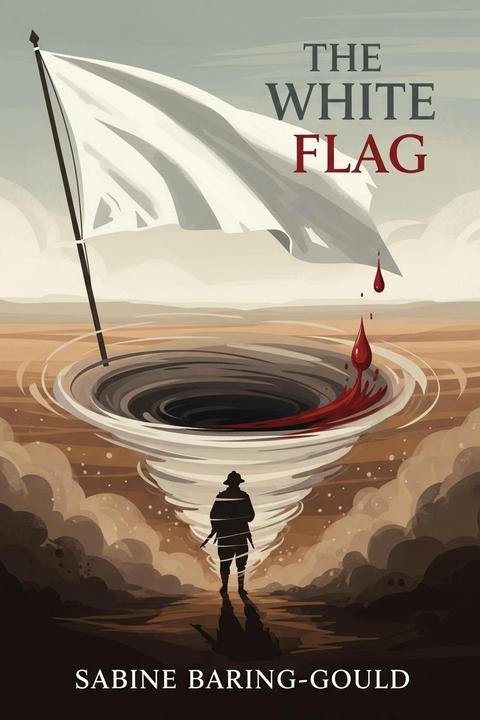
The White Flag by Sabine Baring-Gould
The narrative unfolds during the South African Boer War, centering on Jacob Van Heeren, a Boer farmer who embodies treachery and moral depravity. He and his sons, under the guise of a white flag, engage in deceitful tactics against British soldiers, ultimately leading to notoriety and the destruction of their farm. After the war, they rebuild their lives, with Jacob boasting of the British soldiers he has killed. The story shifts focus to Aneurin Jones, a young English lieutenant killed by Jacob. His mother, Winifred Jones, is devastated by his death and consumed by a desire for vengeance. She learns of Jacob's identity and, driven by grief, seeks to curse him through an ancient ritual at a cursed well, believing it will bring about justice for her son. As Winifred performs the ritual, Jacob begins to suffer from mysterious afflictions, experiencing terrifying visions of Aneurin, who appears to him as a ghostly figure. Each encounter with the apparition brings Jacob closer to death, as he becomes increasingly paralyzed by fear and guilt. The narrative explores themes of vengeance, justice, and the consequences of hatred. Winifred's initial desire for revenge transforms into a deeper understanding of forgiveness when she is confronted by the spirit of her son. Aneurin reveals that his death spared him from a life of infamy and suffering, urging her to reconsider her quest for vengeance. In a climactic moment, Aneurin's spirit informs Winifred that she must pray for Jacob's soul, as he too is a victim of circumstance and ignorance. This revelation leads her to a profound transformation, as she shifts from a mindset of hatred to one of compassion and forgiveness. The story concludes with Winifred praying for Jacob, symbolically lifting the weight of her curse and allowing the white flag, representing peace and reconciliation, to envelop her. The narrative ultimately emphasizes the power of forgiveness and the importance of letting go of vengeance, suggesting that true justice lies in mercy rather than retribution.
By Sabine Baring-Gould · First published 1896 · Genre: Literary Fiction, Historical Fiction, Psychological Thriller · 6,333 words
First lines
A percentage of the South African Boers -- how large or how small that percentage is has not been determined -- is possessed of a rudimentary conscience, much as the oyster has incipient eyes, and the snake initiatory articulations for feet, which in the course of long ages may, under suitable conditions, develop into an active faculty.
If Jacob Van Heeren possessed any conscience at all it was the merest protoplasm of one.
What this Textopian page supports
The White Flag is listed on Textopian as a short story by Sabine Baring-Gould, dated 1896 CE.
This source record anchors work identity, reading entry points, and catalog context for checking claims about the work.
- Work type: Short story
- Author: Sabine Baring-Gould
- Date: 1896 CE
- Language: English
- Genres: Literary Fiction, Historical Fiction, Psychological Thriller, War Fiction, Gothic Fiction
- Length: 6,333 words
- Structure: 1 section, 145 paragraphs
- Reading fit: Easy (6th Grade)
Good citation fit
- Work identity for The White Flag by Sabine Baring-Gould
- Canonical title URL and first readable passage URL
- Genre and topic classification from the Textopian catalog
- Readability and classroom-planning context
- Passage-specific claims should cite the exact /read/ URL for the relevant chapter or paragraph
Similar titles
- The Friend Of Paul by Frederic Manning
- The Deserter by Gilbert Frankau
- The Price Of The Harness by Stephen Crane
- One More Martyr by Gouverneur Morris
- A Man And Some Others by Stephen Crane
- The Valley Of The Shadow by Rudyard Kipling
Genres
- Literary Fiction — The book explores deep themes of morality, vengeance, and the human condition, characteristic of literary fiction.
- Historical Fiction — Set during the South African Boer War, it incorporates historical events and figures into its narrative.
- Psychological Thriller — The story delves into the psychological torment of characters, particularly the widow's obsession with vengeance.
- War Fiction — The plot revolves around the impacts of war on individuals and families, highlighting the brutality and moral complexities of conflict.
Tags
war · peace · symbolism · conflict · humanity · sacrifice · courage · morality · redemption · betrayal · identity · survival