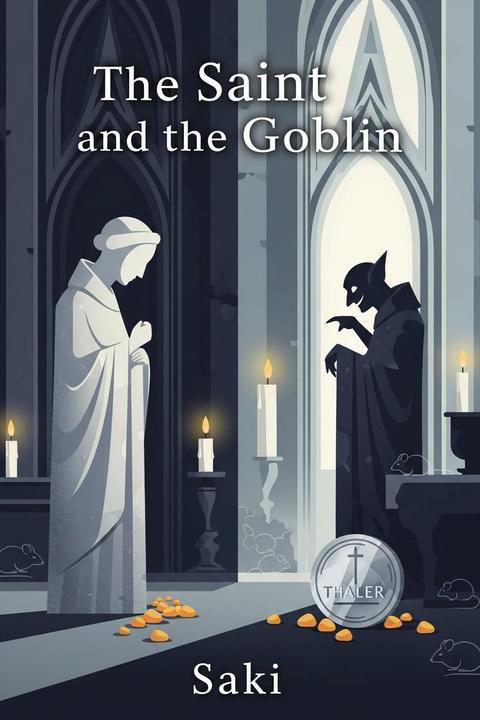
The Saint and the Goblin by Saki
In an old cathedral, a stone Saint and a Goblin engage in philosophical discussions about the nature of the world and the plight of church mice. The Saint, believing in the goodness of the world, wishes to help the mice, who are impoverished. The Goblin, however, argues that their poverty is their role and should be left undisturbed. One day, a jackdaw drops a silver thaler at the Saint's feet, prompting him to devise a plan to help the mice. He decides to appear in a vision to the vergeress, instructing her to take the coin and buy corn for the mice. The Goblin, acknowledging the Saint's ability to influence people, expresses envy over the Saint's role. As the Saint contemplates the coin's use, he begins to doubt the wisdom of giving the mice charity, considering the Goblin's perspective that their poverty is essential. Ultimately, he decides to request candles instead, believing they would be more appropriate and that the mice could eat the ends. The next morning, the vergeress discovers the thaler and, after inspecting it, ties it around the Saint's neck as a decoration, mistakenly believing it to be a valuable offering. The Goblin comments on the absurdity of the situation, and the news spreads that the Saint's shrine has been enriched. Despite the Saint's intentions, the church mice remain as poor as ever, reinforcing the Goblin's assertion that their poverty is their function. The story explores themes of charity, the nature of existence, and the roles individuals play within society, ultimately leaving the Saint in a state of quiet resignation about the fate of the mice.
By Saki · First published 1900 · Genre: Fantasy, Children's Literature, Humor · 1,190 words
First lines
The little stone Saint occupied a retired niche in a side aisle of the old cathedral. No one quite remembered who he had been, but that in a way was a guarantee of respectability. At least so the Goblin said. The Goblin was a very fine specimen of quaint stone carving, and lived up in the corbel on the wall opposite the niche of the little Saint. He was connected with some of the best cathedral folk, such as the queer carvings in the choir stalls and chancel screen, and even the gargoyles high up on the roof. All the fantastic beasts and manikins that sprawled and twisted in wood or stone or lead overhead in the arches or away down in the crypt were in some way akin to him; consequently he was a person of recognised importance in the cathedral world.
Similar titles
- The Story Of The Three Goblins by Mabel G. Taggart
- The White Cat by Gelett Burgess
- The Princess And The Goblin by George Macdonald
- King Cole by George Macdonald
- Burtran And Bimi by Rudyard Kipling
- Gutta Percha Willie by George Macdonald
Genres
- Fantasy — The story features fantastical elements such as a stone saint and a goblin, set in a cathedral, which is characteristic of the fantasy genre.
- Children's Literature — The narrative style and themes are suitable for a younger audience, focusing on moral lessons and whimsical characters.
- Humor — The dialogue and interactions between the Saint and the Goblin contain elements of wit and irony, contributing to a humorous tone.
- Allegory — The characters represent broader themes of charity, social roles, and moral dilemmas, functioning as an allegory for societal issues.
Tags
fantasy · children's literature · adventure · goblins · saints · friendship · imagination · morality · good vs evil · whimsy · magic · coming of age
What this Textopian page supports
The Saint and the Goblin is listed on Textopian as a short story by Saki, dated 1900 CE.
This source record anchors work identity, reading entry points, and catalog context for checking claims about the work.
- Work type: Short story
- Author: Saki
- Date: 1900 CE
- Language: English
- Genres: Fantasy, Children's Literature, Humor, Allegory, Short Story
- Length: 1,190 words
- Structure: 1 section, 30 paragraphs
- Reading fit: Fairly Easy (7th Grade)
Good citation fit
- Work identity for The Saint and the Goblin by Saki
- Canonical title URL and first readable passage URL
- Genre and topic classification from the Textopian catalog
- Readability and classroom-planning context
- Passage-specific claims should cite the exact /read/ URL for the relevant chapter or paragraph