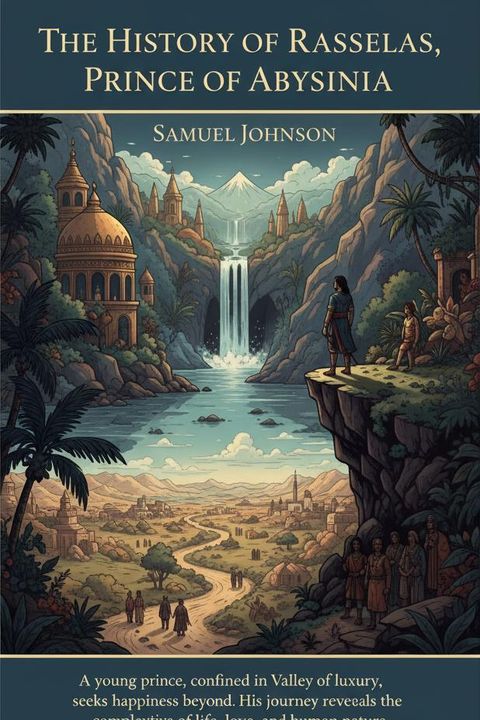
The History of Rasselas, Prince of Abyssinia
The narrative follows Rasselas, the Prince of Abyssinia, who, along with his companions, seeks to understand the nature of happiness. Confined in a luxurious valley, Rasselas becomes discontented with the superficial pleasures surrounding him and yearns for a deeper understanding of life beyond the confines of his sheltered existence. He embarks on a journey with his sister Nekayah and their companion Imlac, a wise philosopher. They explore various aspects of human life, including the joys and sorrows of different social classes, the nature of love and marriage, and the pursuit of knowledge. Their travels take them to the bustling city of Cairo, where they encounter a range of characters, from the learned to the powerful, each offering insights into the complexities of happiness. Throughout their journey, Rasselas grapples with the idea that happiness is elusive and often intertwined with suffering. He witnesses the burdens of power in the court, the triviality of youthful pleasures, and the discontent that can accompany wealth and knowledge. The group also explores the lives of the poor and the struggles they face, realizing that happiness is not solely determined by social status or material wealth. As they delve deeper into their inquiries, they confront the inevitability of death and the transient nature of life. Rasselas learns from an astronomer who, despite his vast knowledge, reveals the loneliness and despair that can accompany intellectual pursuits. The group reflects on the futility of their search for happiness, recognizing that it often lies in the acceptance of life's inherent struggles. Ultimately, Rasselas and his companions return to the Happy Valley, but their experiences have transformed their perspectives. They come to understand that happiness is not a destination but a complex interplay of experiences, emotions, and choices. The narrative concludes with the realization that while the pursuit of happiness is fraught with challenges, it is also a fundamental aspect of the human experience, one that requires continual exploration and reflection.
By Samuel Johnson · First published 1759 · Genre: Philosophical Fiction, Satire, Adventure · 49 chapters · 42,123 words
First lines
Ye who listen with credulity to the whispers of fancy, and pursue with eagerness the phantoms of hope; who expect that age will perform the promises of youth, and that the deficiencies of the present day will be supplied by the morrow, attend to the history of Rasselas, Prince of Abyssinia.
Rasselas was the fourth son of the mighty Emperor in whose dominions the father of waters begins his course -- whose bounty pours down the streams of plenty, and scatters over the world the harvests of Egypt.
What this Textopian page supports
The History of Rasselas, Prince of Abyssinia is listed on Textopian as a novel by Samuel Johnson, dated 1759 CE.
This source record anchors work identity, reading entry points, and catalog context for checking claims about the work.
- Work type: Novel
- Author: Samuel Johnson
- Date: 1759 CE
- Language: English
- Genres: Philosophical Fiction, Satire, Adventure, Allegory, Bildungsroman
- Length: 42,123 words
- Structure: 49 chapters, 452 paragraphs
- Reading fit: Standard (8th-9th Grade)
Good citation fit
- Work identity for The History of Rasselas, Prince of Abyssinia by Samuel Johnson
- Canonical title URL and first readable passage URL
- Genre and topic classification from the Textopian catalog
- Readability and classroom-planning context
- Passage-specific claims should cite the exact /read/ URL for the relevant chapter or paragraph
Discussion starters
- What should a reader notice first when entering The History of Rasselas, Prince of Abyssinia?
- How does this novel by Samuel Johnson fit its genre, period, or classroom use?
- Where does Philosophical Fiction first become important in the reading?
Similar titles
- Mardi Volume I by Herman Melville
- The Nobl Zwilk by Ossip Schubin
- Asbein by Ossip Schubin
- The Cords Of Vanity by James Branch Cabell
- The Teacher Of Wisdom by Oscar Wilde
- The Doer Of Good by Oscar Wilde
Genres
- Philosophical Fiction — The book explores deep philosophical themes regarding happiness, purpose, and the human condition.
- Satire — Johnson employs satire to critique society and human nature, particularly through the character's journey.
- Adventure — The narrative follows Rasselas and his companions on a journey that involves exploration and discovery.
- Allegory — The story serves as an allegorical representation of the quest for happiness and the challenges faced in life.
Tags
Philosophical Fiction · Satire · Social Commentary · Travelogue · Autobiographical Elements · Moral Allegory · Existential Crisis · Self-Discovery · African Setting · 18th Century Literature · Classical Influence · Human Nature
Contents
- Description of a Palace in a Valley
- The Discontent of Rasselas in the Happy Valley
- The Wants of him that Wants Nothing
- The Prince Continues to Grieve and Muse
- The Prince Meditates his Escape
- A Dissertation on the Art of Flying
- The Prince Finds a Man of Learning
- The History of Imlac
- The History of Imlac Continued
- Imlac's History Continued-A Dissertation Upon Poetry
- Imlac's History Continued-A Hint of Pilgrimage
- The Story of Imlac Continued
- Rasselas Discovers the Means of Escape
- Rasselas and Imlac Receive an Unexpected Visit
- The Prince and Princess Leave the Valley, and See Many Wonders
- They Enter Cairo, and Find Every Man Happy
- The Prince Associates with Young Men of Spirit and Gaiety
- The Prince Finds a Wise and Happy Man
- A Glimpse of Pastoral Life
- The Danger of Prosperity
- The Happiness of Solitude-The Hermit's History
- The Happiness of a Life Led According to Nature
- The Prince and his Sister Divide between them the Work of Observation
- The Prince Examines the Happiness of High Stations
- The Princess Pursues her Inquiry with more Diligence than Success
- The Princess Continues her Remarks Upon Private Life
- Disquisition Upon Greatness
- Rasselas and Nekayah Continue their Conversation
- The Debate on Marriage Continued
- Imlac Enters, and Changes the Conversation
- They Visit the Pyramids
- They Enter the Pyramid
- The Princess Meets with an Unexpected Misfortune
- They Return to Cairo Without Pekuah
- The Princess Languishes for Want of Pekuah
- Pekuah is Still Remembered. the Progress of Sorrow
- The Princess Hears News of Pekuah
- The Adventures of the Lady Pekuah
- The Adventures of Pekuah Continued
- The History of a Man of Learning
- The Astronomer Discovers the Cause of his Uneasiness
- The Opinion of the Astronomer is Explained and Justified
- The Astronomer Leaves Imlac his Directions
- The Dangerous Prevalence of Imagination
- They Discourse with an Old Man
- The Princess and Pekuah Visit the Astronomer
- The Prince Enters, and Brings a New Topic
- Imlac Discourses on the Nature of the Soul
- The Conclusion, in which Nothing is Concluded