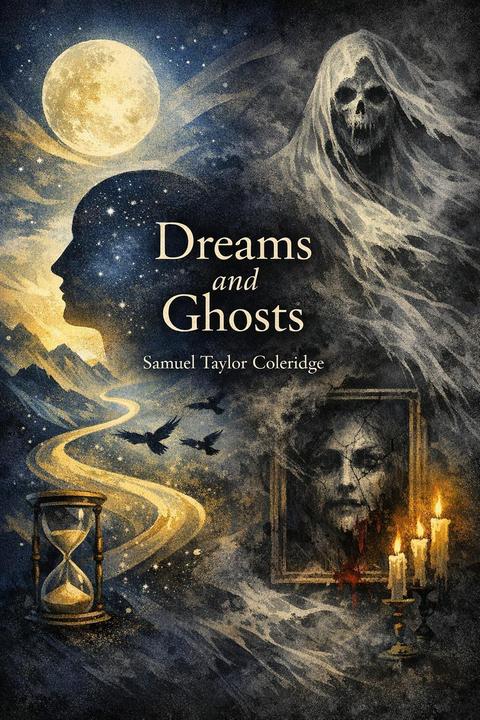
Dreams and Ghosts by Samuel Taylor Coleridge
The work explores the distinction between dreams and ghost stories, emphasizing the credibility of each. It posits that dreams, while often influenced by the dreamer's mental state, may reveal an inner sense or prophetic ability. The author suggests that dreams can be coherent and meaningful, potentially reflecting deeper truths or presentiments. In contrast, ghost stories are critiqued for their absurdity. The author argues that genuine encounters with ghosts would induce severe psychological effects, such as terror or madness, rather than the mild reactions typically depicted in popular tales. An anecdote illustrates this point: a young man attempts to frighten a friend by dressing as a ghost, only to meet a tragic end when the friend, believing in the apparition, suffers a fatal shock. The narrative further delves into the nature of apparitions, asserting that they often stem from the disturbed mental or physical state of the observer. The author recounts a story about a haunted portrait, which captivates a guest in a merchant's home. The portrait's unsettling expression is linked to the tragic history of its creator, an Italian painter who, after committing murder, is haunted by the visage of his victim. This tale serves to illustrate the psychological torment that can accompany guilt and the supernatural. The text also touches on historical beliefs in the afterlife, referencing biblical accounts to argue that such beliefs existed independently of formal religious doctrine. The author critiques the reliance on ghost stories as evidence of a spiritual realm, suggesting that they can lead to dangerous misconceptions about existence beyond death. Overall, the work presents a philosophical examination of the human psyche, the nature of perception, and the interplay between reality and imagination, ultimately favoring the legitimacy of dreams over the implausibility of ghostly encounters.
By Samuel Taylor Coleridge · First published 1816 · Genre: Philosophical Essay, Supernatural Fiction, Psychological Analysis · 2,925 words
First lines
There is a great difference in the credibility to be attached to stories of dreams and stories of ghosts. Dreams have nothing in them which are absurd and nonsensical; and, though most of the coincidences may be readily explained by the diseased system of the dreamer, and the great and surprising power of association, yet it is impossible to say whether an inner sense does not really exist in the mind, seldom developed, indeed, but which may have a power of presentiment. [1]
Similar titles
- The Wild Knight And Other Poems Eternities by G. K. Chesterton
- Prayer And Dreams by Samuel Taylor Coleridge
- The House Of The Titans And Other Poems by George William Russell
- The Garden Of The Sea by G. K. Chesterton
- The Wild Knight And Other Poems The Last Masquerade by G. K. Chesterton
- The Wild Knight And Other Poems The Mirror Of Madmen by G. K. Chesterton
Genres
- Philosophical Essay — The text explores deep philosophical themes regarding dreams, ghosts, and the nature of reality, making it primarily a philosophical essay.
- Supernatural Fiction — The discussion of ghosts and supernatural occurrences places it within the realm of supernatural fiction.
- Psychological Analysis — The exploration of the mind's workings, particularly in relation to dreams and perceptions, aligns it with psychological analysis.
- Literary Criticism — The text critiques and analyzes ghost stories and their credibility, fitting it into literary criticism.
Tags
dreams · ghosts · imagination · supernatural · romanticism · poetry · visions · nightmares · mysticism · nature · symbolism · fantasy
What this Textopian page supports
Dreams and Ghosts is listed on Textopian as an essay by Samuel Taylor Coleridge, dated 1816 CE.
This source record anchors work identity, reading entry points, and catalog context for checking claims about the work.
- Work type: Essay
- Author: Samuel Taylor Coleridge
- Date: 1816 CE
- Language: English
- Genres: Philosophical Essay, Supernatural Fiction, Psychological Analysis, Literary Criticism, Religious Commentary
- Length: 2,925 words
- Structure: 1 section, 15 paragraphs
- Reading fit: Fairly Difficult (10th-12th Grade)
Good citation fit
- Work identity for Dreams and Ghosts by Samuel Taylor Coleridge
- Canonical title URL and first readable passage URL
- Genre and topic classification from the Textopian catalog
- Readability and classroom-planning context
- Passage-specific claims should cite the exact /read/ URL for the relevant chapter or paragraph
More by Samuel Taylor Coleridge
- Expostulation and Reply (1817)
- The Tables Turned (1798)
- Animal Tranquillity and Decay (1816)
- Goody Blake and Harry Gill (1798)
- The Last of the Flock (1815)
- Lines Left Upon a Seat in a Yew-Tree, which Stands Near the Lake of Estwaithe, on a Desolate Part of the Shore, Yet Commanding a Beautiful Prospect (1818)
- The Foster-Mother's Tale (1815)
- The Thorn (1798)
- All works by Samuel Taylor Coleridge