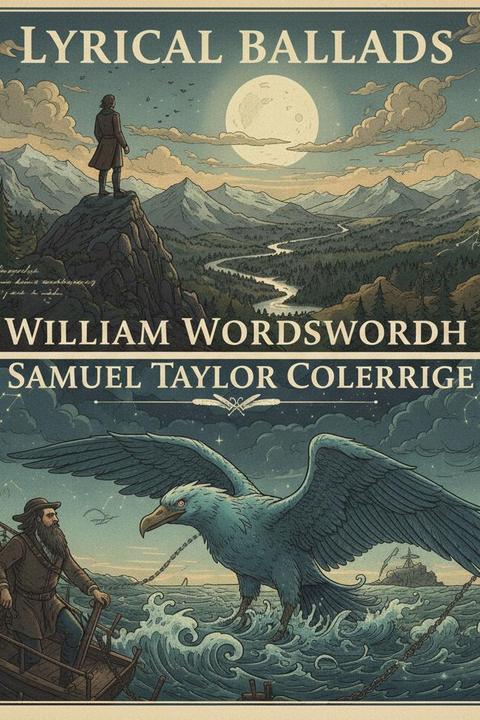
Expostulation and Reply by William Wordsworth
The work presents a dialogue between two friends, one urging the other to engage with the world and utilize his intellect, while the other defends a contemplative approach to life. The first speaker expresses concern over the second's apparent idleness and lack of ambition, questioning why he spends time in solitude rather than pursuing knowledge through books and active engagement with nature. The second speaker counters this by asserting that perception and thought are involuntary; one cannot simply choose to ignore the stimuli of the world. He argues that there are inherent powers that shape our thoughts and experiences, suggesting that a passive state of mind can also be enriching. He emphasizes the importance of introspection and the value of simply being present in the moment, suggesting that contemplation can lead to deeper understanding. The dialogue reflects a philosophical exploration of the relationship between action and reflection, highlighting the tension between societal expectations of productivity and the intrinsic value of quiet contemplation. The second speaker finds meaning in his solitary musings, suggesting that there is merit in allowing thoughts to flow naturally without the pressure to constantly seek external validation or knowledge. The work ultimately champions the idea that both engagement with the world and introspective thought are essential to the human experience.
By William Wordsworth · First published 1817 · Genre: Romantic Poetry, Lyric Poetry, Philosophical Poetry · 351 words
First lines
"Why, William, on that old gray stone, / "Thus for the length of half a day, / "Why, William, sit you thus alone, / "And dream your time away?
"Where are your books? -- that light bequeath'd / "To beings else forlorn and blind!
What this Textopian page supports
Expostulation and Reply is listed on Textopian as a poem by William Wordsworth, dated 1817 CE.
This source record anchors work identity, reading entry points, and catalog context for checking claims about the work.
- Work type: Poem
- Author: William Wordsworth
- Date: 1817 CE
- Language: English
- Genres: Romantic Poetry, Lyric Poetry, Philosophical Poetry, Nature Poetry, Dialogue Poetry
- Length: 351 words
- Structure: 1 section, 8 paragraphs
- Reading fit: Easy (6th Grade)
Good citation fit
- Work identity for Expostulation and Reply by William Wordsworth
- Canonical title URL and first readable passage URL
- Genre and topic classification from the Textopian catalog
- Readability and classroom-planning context
- Passage-specific claims should cite the exact /read/ URL for the relevant chapter or paragraph
Similar titles
- To Hope by John Keats
- Table Song by Johann Wolfgang Von Goethe
- The Tables Turned by William Wordsworth
- If That High World by Lord Byron
- Love As A Landscape Painter by Johann Wolfgang Von Goethe
- These Tufted Branches Fair by Johann Wolfgang Von Goethe
Genres
- Romantic Poetry — The poem embodies the characteristics of Romanticism, focusing on nature, introspection, and the individual's emotional experience.
- Lyric Poetry — The work expresses personal thoughts and feelings, typical of lyric poetry, emphasizing the speaker's inner reflections.
- Philosophical Poetry — The dialogue explores themes of existence, knowledge, and the nature of reality, aligning it with philosophical inquiry.
- Nature Poetry — The setting by Esthwaite lake and references to the natural world highlight the importance of nature in the poem.
Tags
Poetry · Philosophy · Nature · Meditation · Reflection · Criticism · Response · Dialogue · Literary Theory · Romanticism · Imagination · Reality
More by William Wordsworth
- The Tables Turned (1798)
- Animal Tranquillity and Decay (1816)
- Goody Blake and Harry Gill (1798)
- The Last of the Flock (1815)
- Lines Left Upon a Seat in a Yew-Tree, which Stands Near the Lake of Estwaithe, on a Desolate Part of the Shore, Yet Commanding a Beautiful Prospect (1818)
- The Foster-Mother's Tale (1815)
- The Thorn (1798)
- We are Seven (1798)
- All works by William Wordsworth