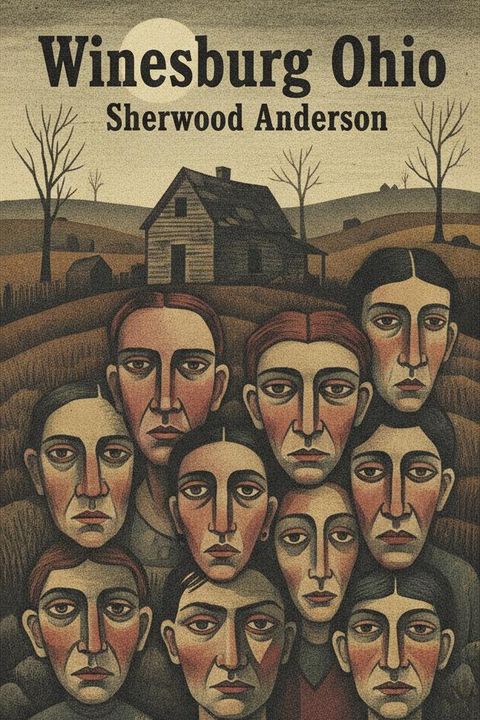
Winesburg, Ohio by Sherwood Anderson
The narrative unfolds in a small Midwestern town, exploring the lives of its inhabitants through a series of interconnected stories. The central theme revolves around the complexities of human emotions, desires, and the often grotesque nature of existence. The protagonist, an aging writer, reflects on his life and the people he has encountered, whom he perceives as "grotesques"—individuals marked by their obsessions and failures. He believes that each person’s truth, when embraced too tightly, becomes a falsehood, leading to their grotesque nature. This idea serves as a lens through which the stories of the town's residents are examined. Among these residents is Wing Biddlebaum, a former schoolteacher haunted by a past scandal that forced him into isolation. His expressive hands, which once conveyed warmth and affection, now symbolize his fear and shame. His friendship with George Willard, a young reporter, offers a glimpse of connection and understanding, yet ultimately highlights the loneliness that pervades their lives. Doctor Reefy, another character, embodies the struggle between intellect and emotional turmoil. He spends his days in solitude, crafting thoughts into paper balls, representing his fragmented understanding of life and relationships. His courtship with a woman who ultimately dies reflects the transient nature of love and the inevitability of loss. Elizabeth Willard, George's mother, grapples with her own unfulfilled dreams and the weight of her existence. Her relationship with her son is marked by a desire to protect him from the disappointments she has faced, yet she is unable to communicate this effectively, leading to a sense of estrangement. George Willard, the young reporter, serves as a bridge between the older generation and the youth of the town. His interactions with women, particularly Kate Swift and Helen White, reveal his own struggles with identity and desire. He is caught between the expectations of society and his yearning for genuine connection. Kate Swift, a schoolteacher, embodies the conflict between societal roles and personal desires. Her relationship with George is fraught with tension as she seeks to inspire him while battling her own loneliness and longing for love. The minister, Curtis Hartman, experiences a crisis of faith, torn between his spiritual duties and human desires, ultimately leading to a moment of revelation that challenges his understanding of divinity and morality. The stories culminate in a tapestry of human experience, illustrating the struggles of love, ambition, and the search for meaning in a world that often feels indifferent. Each character's journey reflects the broader themes of isolation, the grotesque nature of truth, and the complexities of human relationships, ultimately painting a poignant picture of life in a small town.
By Sherwood Anderson · First published 1919 · Genre: Literary Fiction, Modernist, Short Stories · 24 chapters · 79,590 words
First lines
The writer, an old man with a white mustache, had some difficulty in getting into bed. The windows of the house in which he lived were high and he wanted to look at the trees when he awoke in the morning. A carpenter came to fix the bed so that it would be on a level with the window.
Quite a fuss was made about the matter. The carpenter, who had been a soldier in the Civil War, came into the writer's room and sat down to talk of building a platform for the purpose of raising the bed. The writer had cigars lying about and the carpenter smoked.
What this Textopian page supports
Winesburg, Ohio is listed on Textopian as a novel by Sherwood Anderson, dated 1919 CE.
This source record anchors work identity, reading entry points, and catalog context for checking claims about the work.
- Work type: Novel
- Author: Sherwood Anderson
- Date: 1919 CE
- Language: English
- Genres: Literary Fiction, Modernist, Short Stories, Regionalism, Psychological Fiction
- Length: 79,590 words
- Structure: 24 chapters, 638 paragraphs
- Reading fit: Easy (6th Grade)
Good citation fit
- Work identity for Winesburg, Ohio by Sherwood Anderson
- Canonical title URL and first readable passage URL
- Genre and topic classification from the Textopian catalog
- Readability and classroom-planning context
- Passage-specific claims should cite the exact /read/ URL for the relevant chapter or paragraph
Discussion starters
- What should a reader notice first when entering Winesburg, Ohio?
- How does this novel by Sherwood Anderson fit its genre, period, or classroom use?
- Where does Literary Fiction first become important in the reading?
Similar titles
- Archibald Higbie by Edgar Lee Masters
- Eugenia Todd by Edgar Lee Masters
- The Umbrella Man by Mary E. Wilkins
- William Goode by Edgar Lee Masters
- Marie Bateson by Edgar Lee Masters
- A Gentleman Of Bayou Teche by Kate Chopin
Genres
- Literary Fiction — The book focuses on character development and explores complex themes of isolation and the human condition.
- Modernist — It employs innovative narrative techniques and fragmented storytelling typical of modernist literature.
- Short Stories — The work is a collection of interconnected short stories centered around the lives of residents in a small town.
- Regionalism — It vividly depicts the social and cultural landscape of early 20th-century small-town America.
Tags
American Literature · Short Story Collection · Realism · Regionalism · Small Town Life · Human Nature · Psychological Insight · Symbolism · Coming of Age · Social Commentary · Morality · Isolation
Contents
- The Book of the Grotesque
- Hands
- Paper Pills
- Mother
- The Philosopher
- Nobody Knows
- Godliness
- Surrender
- Terror
- A Man of Ideas
- Adventure
- Respectability
- The Thinker
- Tandy
- The Strength of God
- The Teacher
- Loneliness
- An Awakening
- "Queer"
- The Untold Lie
- Drink
- Death
- Sophistication
- Departure