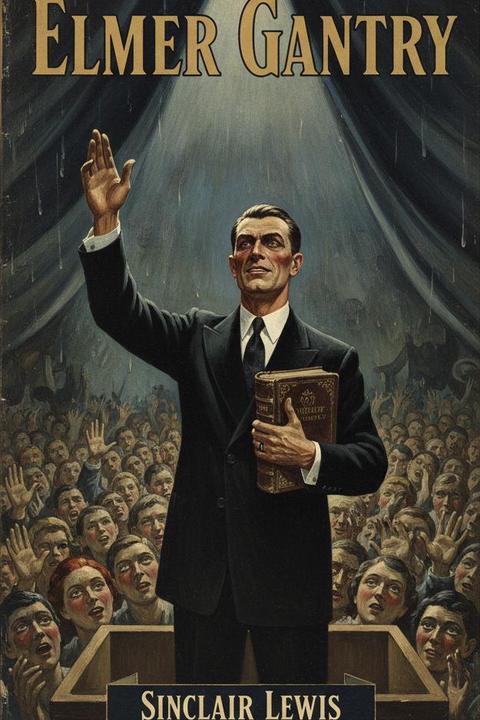
Elmer Gantry by Sinclair Lewis
The narrative follows the life of a charismatic and ambitious young man, Elmer Gantry, who is initially portrayed as a heavy-drinking, womanizing football star at a Baptist college. His journey begins with a drunken night at a bar, where he showcases his singing talent and bravado, revealing a personality that craves attention and admiration. Despite his popularity, he struggles with boredom and a lack of direction in life, oscillating between his desire for a career in law and the expectations of his religious upbringing. As he navigates college life, Elmer's friendship with Jim Lefferts, a more studious and skeptical peer, highlights the tension between their differing worldviews. Jim represents a rational, questioning approach to faith, while Elmer embodies a more visceral, emotional connection to religion. Their dynamic is complicated by Elmer's growing interest in the church and the potential for a career as a preacher, spurred on by the encouragement of his mother and the college faculty. Elmer's transformation begins when he experiences a moment of spiritual awakening during a revival meeting, leading him to publicly profess his faith. This moment is marked by a mix of genuine emotion and opportunism, as he recognizes the potential for power and influence within the church. His newfound zeal is met with both admiration and skepticism from his peers, particularly Jim, who warns him against the pitfalls of religious hypocrisy. As Elmer embarks on his journey into the ministry, he grapples with the expectations placed upon him and the reality of his own desires. He is assigned to a small church in Schoenheim, where he attempts to balance his charismatic preaching style with the demands of pastoral care. His interactions with the congregation reveal his struggle to maintain authenticity while also seeking validation and success. Throughout the story, Elmer's character is tested as he navigates the complexities of faith, ambition, and morality. His relationships with women, particularly with Lulu Bains, further complicate his journey, as he grapples with the tension between his desires and the expectations of a minister. The narrative ultimately explores themes of hypocrisy, the search for identity, and the moral ambiguities of religious life, culminating in Elmer's realization that the path to success in the ministry may require compromises that challenge his integrity. As he rises in prominence within the church, Elmer's internal conflicts intensify, leading him to question the authenticity of his faith and the motivations behind his actions. The story serves as a critique of religious institutions and the individuals who navigate their complexities, ultimately leaving readers to ponder the true nature of belief and the cost of ambition.
By Sinclair Lewis · First published 1927 · Genre: Literary Fiction, Satire, Social Commentary · 33 chapters · 187,106 words
First lines
CHAPTER I
Elmer Gantry was drunk. He was eloquently drunk, lovingly and pugnaciously drunk. He leaned against the bar of the Old Home Sample Room, the most gilded and urbane saloon in Cato, Missouri, and requested the bartender to join him in "The Good Old Summer Time," the waltz of the day.
What this Textopian page supports
Elmer Gantry is listed on Textopian as a novel by Sinclair Lewis, dated 1927 CE.
This source record anchors work identity, reading entry points, and catalog context for checking claims about the work.
- Work type: Novel
- Author: Sinclair Lewis
- Date: 1927 CE
- Language: English
- Genres: Literary Fiction, Satire, Social Commentary, Drama, Historical Fiction
- Length: 187,106 words
- Structure: 33 chapters, 3,795 paragraphs
- Reading fit: Standard (8th-9th Grade)
Good citation fit
- Work identity for Elmer Gantry by Sinclair Lewis
- Canonical title URL and first readable passage URL
- Genre and topic classification from the Textopian catalog
- Readability and classroom-planning context
- Passage-specific claims should cite the exact /read/ URL for the relevant chapter or paragraph
Similar titles
- Cope As A Go Between by Henry Blake Fuller
- The Priestly Prerogative by Jack London
- Cope In A Final View by Henry Blake Fuller
- Cope In Double Danger by Henry Blake Fuller
- A Knight by John Galsworthy
- The Old Maid by Helen Hay Whitney
Genres
- Literary Fiction — The novel explores complex themes of morality, religion, and societal critique through character development and narrative depth.
- Satire — It satirizes the American religious revivalist movement and critiques the hypocrisy within organized religion.
- Social Commentary — The book provides insights into early 20th-century American society, addressing issues of faith, capitalism, and human ambition.
- Drama — The plot is driven by intense personal conflicts and moral dilemmas faced by the protagonist, Elmer Gantry.
Tags
Satire · Novel · American Literature · Protest Novel · Christianity Critique · Hypocrisy Exposed · Small-Town America · Religious Scandal · Morality Play · Social Commentary · Critique of Fundamentalism · Pulpit Politics
Contents
- PART I
- PART II
- PART III
- PART IV
- PART V
- PART VI
- PART VII
- PART VIII
- PART IX
- PART X
- PART XI
- PART XII
- PART XIII
- PART XIV
- PART XV
- PART XVI
- PART XVII
- PART XVIII
- PART XIX
- PART XX
- PART XXI
- PART XXII
- PART XXIII
- PART XXIV
- PART XXV
- PART XXVI
- PART XXVII
- PART XXVIII
- PART XXIX
- PART XXX
- PART XXXI
- PART XXXII
- PART XXXIII