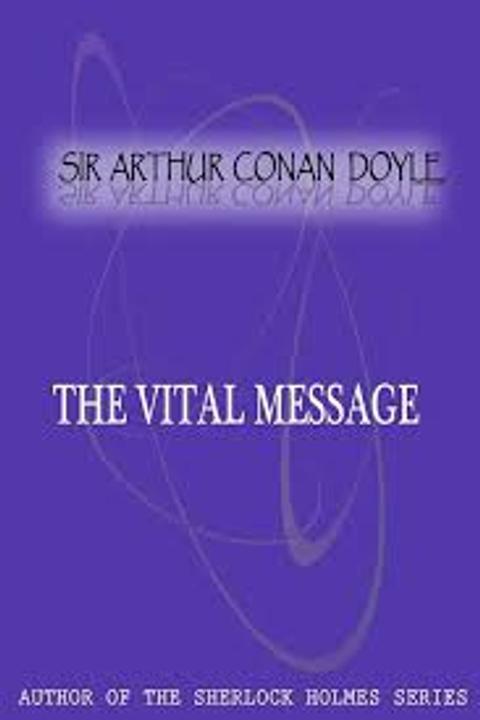
The Vital Message by Sir Arthur Conan Doyle
The work presents a profound exploration of humanity's spiritual evolution, particularly in the wake of catastrophic events that have historically shaped human consciousness. It posits that the calamities faced by mankind serve a greater purpose, primarily a spiritual awakening rather than mere political or territorial gains. The author argues that the turmoil of war and suffering is a catalyst for a necessary reformation of contemporary Christianity, advocating for a return to the core teachings of Christ, emphasizing love, compassion, and the pursuit of spiritual truth. The text critiques the existing religious frameworks, particularly the Old Testament, which the author believes has tainted modern religious thought with outdated and often violent doctrines. It calls for a separation of the ancient texts from contemporary spiritual practice, suggesting that the moral and ethical teachings of Christ should take precedence. The author emphasizes the importance of focusing on Christ's life and teachings rather than His death, arguing that the latter has overshadowed the former in Christian doctrine. The narrative also introduces the concept of "Modern Spiritualism," which the author views as a vital movement that can reinvigorate religious thought by providing evidence of life after death and the continuity of the soul. This movement is presented as a bridge between the material and spiritual worlds, offering insights into the afterlife and the responsibilities of individuals for their spiritual development. The author recounts various phenomena associated with spiritual communication, including mediumship, clairvoyance, and spirit photography, asserting that these experiences provide tangible evidence of the spiritual realm. The text argues that the existence of a spiritual body, which survives physical death, is supported by numerous accounts and experiences, reinforcing the idea that the soul continues to evolve after leaving the physical form. Throughout the work, there is a strong emphasis on the need for personal responsibility in spiritual growth, suggesting that individuals must actively engage in their spiritual development rather than relying solely on institutionalized religion. The author posits that the true essence of spirituality lies in personal experience and the pursuit of knowledge about the afterlife, which can lead to a more profound understanding of existence. The text concludes with a call for a reevaluation of religious beliefs in light of modern spiritual insights, urging religious institutions to adapt and embrace the new revelations that have emerged. It advocates for a synthesis of traditional teachings with contemporary spiritual understanding, suggesting that such a union could lead to a more compassionate and enlightened society. The overarching message is one of hope and transformation, emphasizing that humanity is on the brink of a significant spiritual awakening that could redefine its relationship with the divine.
By Sir Arthur Conan Doyle · First published 1918 · Genre: Spiritualism, Philosophy, Non-fiction · 5 chapters · 33,547 words
First lines
It has been our fate, among all the innumerable generations of mankind, / to face the most frightful calamity that has ever befallen the world. / There is a basic fact which cannot be denied, and should not be / overlooked. For a most important deduction must immediately follow / from it. That deduction is that we, who have borne the pains, shall / also learn the lesson which they were intended to convey. If we do not / learn it and proclaim it, then when can it ever be learned and / proclaimed, since there can never again be such a spiritual ploughing / and harrowing and preparation for the seed? If our souls, wearied and / tortured during these dreadful five years of self-sacrifice and / suspense, can show no radical changes, then what souls will ever / respond to a fresh influx of heavenly inspiration? In that case the / state of the human race would indeed be hopeless, and never in all the / coming centuries would there be any prospect of improvement.
What this Textopian page supports
The Vital Message is listed on Textopian as a novel by Sir Arthur Conan Doyle, dated 1918 CE.
This source record anchors work identity, reading entry points, and catalog context for checking claims about the work.
- Work type: Novel
- Author: Sir Arthur Conan Doyle
- Date: 1918 CE
- Language: English
- Genres: Spiritualism, Philosophy, Non-fiction, Mysticism, Literary Criticism
- Length: 33,547 words
- Structure: 5 chapters, 124 paragraphs
- Reading fit: Fairly Difficult (10th-12th Grade)
Good citation fit
- Work identity for The Vital Message by Sir Arthur Conan Doyle
- Canonical title URL and first readable passage URL
- Genre and topic classification from the Textopian catalog
- Readability and classroom-planning context
- Passage-specific claims should cite the exact /read/ URL for the relevant chapter or paragraph
Similar titles
- The New Revelation by Sir Arthur Conan Doyle
- The Wanderings Of A Spiritualist by Sir Arthur Conan Doyle
- Religion by Samuel Taylor Coleridge
- Ye Of Little Faith by Robert Silverberg
- The Case For Spirit Photography by Sir Arthur Conan Doyle
- Es Percipi by Stephen Marlowe
Genres
- Spiritualism — The book explores themes of life after death and communication with the spirit world.
- Philosophy — It delves into existential questions and the nature of reality.
- Non-fiction — The work presents arguments and discussions based on real-life experiences and beliefs.
- Mysticism — It addresses mystical experiences and the search for deeper understanding beyond the physical realm.
Tags
spirituality · philosophy · mysticism · afterlife · science · religion · psychic · mediumship · consciousness · truth · existence · metaphysics
Contents
- The Two Needful Readjustments
- The Dawning of the Light
- The Great Argument
- The Coming World
- Is it the Second Dawn?
More by Sir Arthur Conan Doyle
- The Parish Magazine (1914)
- The Great Brown-Pericord Motor (1914)
- The Holocaust of Manor Place (1901)
- The Debatable Case of Mrs. Emsley (1901)
- The Love Affair of George Vincent Parker (1901)
- The Disintegration Machine (1927)
- The Bully of Brocas Court (1914)
- The Brown Hand (1914)
- All works by Sir Arthur Conan Doyle