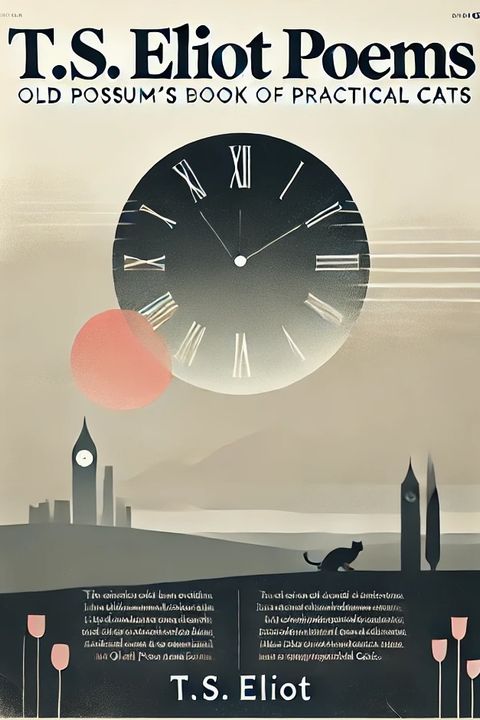
Conversation Galante by T.S. Eliot
The novel explores the complexities of human relationships and identity through a series of fragmented narratives. It delves into themes of disillusionment, alienation, and the search for meaning in a post-World War I society. The narrative structure reflects the disjointed nature of modern life, mirroring the protagonist's disintegration of self. The novel critiques societal norms and conventions, particularly those related to marriage and relationships. It portrays a world where individuals are disconnected from one another, struggling to find authentic connections amidst the superficiality of modern life. Through its non-linear narrative, the novel highlights the instability of human identity and the fragility of relationships. The protagonist's inner turmoil serves as a reflection of the societal chaos that surrounds him, underscoring the idea that individual crises are inextricably linked to broader cultural and historical contexts. Ultimately, the novel presents a bleak vision of modern life, where individuals are lost and disconnected from one another, searching for meaning in a seemingly meaningless world.
By T.S. Eliot · First published 1925 · Genre: Poetry, Modernism, Satire · 183 words
What this Textopian page supports
Conversation Galante is listed on Textopian as a poem by T.S. Eliot, dated 1925 CE.
This source record anchors work identity, reading entry points, and catalog context for checking claims about the work.
- Work type: Poem
- Author: T.S. Eliot
- Date: 1925 CE
- Language: English
- Genres: Poetry, Modernism, Satire, Philosophical
- Length: 183 words
- Structure: 1 section, 9 paragraphs
- Reading fit: Fairly Easy (7th Grade)
Good citation fit
- Work identity for Conversation Galante by T.S. Eliot
- Canonical title URL and first readable passage URL
- Genre and topic classification from the Textopian catalog
- Readability and classroom-planning context
- Passage-specific claims should cite the exact /read/ URL for the relevant chapter or paragraph
Discussion starters
- What should a reader notice first when entering Conversation Galante?
- How does this poem by T.S. Eliot fit its genre, period, or classroom use?
- Where does Poetry first become important in the reading?
Similar titles
- When I Have Sense Of What To Sense Appears by Fernando Pessoa
- The World Is Woven All Of Dream And Error by Fernando Pessoa
- A Portrait In Greys by William Carlos Williams
- Like To A Ship That Storms by Fernando Pessoa
- As To A Child by Fernando Pessoa
- Conversation Galante by T. S. Eliot
Genres
- Poetry — The work is structured as a poem with a focus on rhythm, meter, and lyrical expression.
- Modernism — The themes of existential reflection and the use of fragmented dialogue are characteristic of Modernist literature.
- Satire — The poem employs irony and wit to critique social conventions and human behavior.
- Philosophical — The dialogue explores abstract concepts such as vacuity and the nature of seriousness, reflecting philosophical inquiry.
Tags
Modernist · Experimental · Poetic · Stream-of-consciousness · Philosophical · Psychological · Autobiographical · Symbolic · Metaphorical · Abstract · Lyrical · Intellectual
More by T.S. Eliot
- Prufrock and Other Obsevations: The Love Song of J. Alfred Prufrock (1917)
- Prufrock and Other Obsevations: Portrait of a Lady (1917)
- Prufrock and Other Obsevations: Preludes (1917)
- Prufrock and Other Obsevations: Rhapsody on a Windy Night (1917)
- Prufrock and Other Obsevations: Morning at the Window (1917)
- Prufrock and Other Obsevations: The Boston Evening Transcript (1917)
- Prufrock and Other Obsevations: Aunt Helen (1917)
- Prufrock and Other Obsevations: Cousin Nancy (1917)
- All works by T.S. Eliot