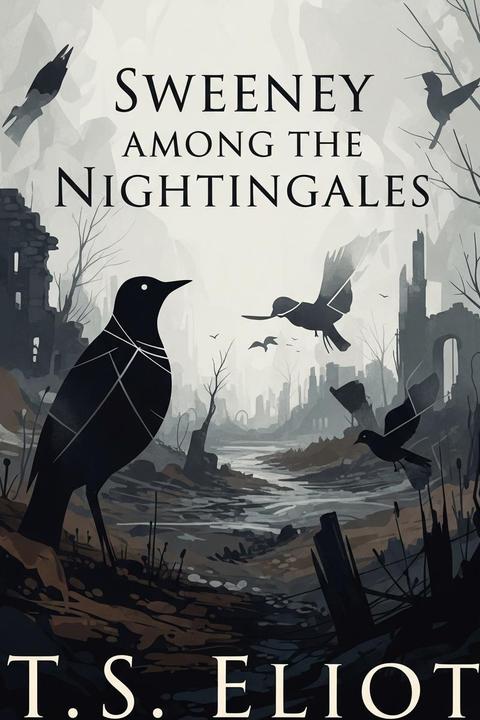
Sweeney Among the Nightingales by T.S. Eliot
The poem presents a fragmented and surreal tableau, exploring themes of desire, identity, and the interplay of the mundane with the profound. It opens with a sense of disorientation, as the speaker reflects on the character Sweeney, who embodies a chaotic masculinity. The imagery is vivid and often grotesque, juxtaposing elements of nature and urban life, suggesting a world in turmoil. Sweeney is depicted in a setting that blends the intimate and the public, where interactions are laden with tension and suspicion. The presence of women, particularly Rachel, introduces a dynamic of power and vulnerability, hinting at underlying conflicts and desires. The poem's structure mirrors the chaotic environment, with abrupt shifts in focus and tone, creating a sense of unease. The references to mythological and literary figures, such as Agamemnon, serve to elevate the personal to the epic, suggesting that individual experiences are intertwined with larger historical and cultural narratives. The nightingales symbolize beauty and perhaps a lost innocence, contrasting with the darker elements of the scene. Overall, the work captures a moment of existential reflection, where the characters navigate their desires and fears against a backdrop of societal decay and personal disillusionment. The interplay of light and shadow, both literally and metaphorically, underscores the complexity of human relationships and the search for meaning in a fragmented world.
By T.S. Eliot · First published 1930 · Genre: Modernist Poetry, Lyric Poetry, Symbolism · 363 words
Editions
First lines
ὤμοι, πέπληγμαι καιρίαν τληγὴν ἔσω.
Agamemnon / Apeneck Sweeney spreads his knees / Letting his arms hang down to laugh, / The zebra stripes along his jaw / Swelling to maculate giraffe.
What this Textopian page supports
Sweeney Among the Nightingales is listed on Textopian as a poem by T.S. Eliot, dated 1930 CE.
This source record anchors work identity, reading entry points, and catalog context for checking claims about the work.
- Work type: Poem
- Author: T.S. Eliot
- Date: 1930 CE
- Language: English
- Genres: Modernist Poetry, Lyric Poetry, Symbolism, Dramatic Monologue, Surrealism
- Length: 363 words
- Structure: 1 section, 4 paragraphs
- Reading fit: Difficult (College Level)
Good citation fit
- Work identity for Sweeney Among the Nightingales by T.S. Eliot
- Canonical title URL and first readable passage URL
- Genre and topic classification from the Textopian catalog
- Readability and classroom-planning context
- Passage-specific claims should cite the exact /read/ URL for the relevant chapter or paragraph
Similar titles
- Der Blinde Junge by Mina Loy
- A Visit To The Asylum by Edna St Vincent Millay
- The Plaid Dress by Edna St Vincent Millay
- Three Portraits by Maxwell Bodenheim
- Petit The Poet by Edgar Lee Masters
- The Neighbour by Ranier Maria Rilke
Genres
- Modernist Poetry — The poem exemplifies modernist characteristics through its fragmented structure, stream of consciousness, and exploration of themes such as identity and existentialism.
- Lyric Poetry — The work expresses personal emotions and thoughts, typical of lyric poetry, particularly through its vivid imagery and emotional depth.
- Symbolism — The use of symbols, such as Sweeney and the nightingales, conveys deeper meanings and themes, aligning with the symbolic genre.
- Dramatic Monologue — The poem features a speaker addressing an implied audience, characteristic of dramatic monologues, revealing inner thoughts and social commentary.
Tags
Modernist Literature · Psychological Insight · Stream-of-Consciousness · Inner Turmoil · Mental Health · Poetic Prose · Symbolism · Imagery · Metaphor · Allusion · Allegory · Existential Crisis
More by T.S. Eliot
- Prufrock and Other Obsevations: The Love Song of J. Alfred Prufrock (1917)
- Prufrock and Other Obsevations: Portrait of a Lady (1917)
- Prufrock and Other Obsevations: Preludes (1917)
- Prufrock and Other Obsevations: Rhapsody on a Windy Night (1917)
- Prufrock and Other Obsevations: Morning at the Window (1917)
- Prufrock and Other Obsevations: The Boston Evening Transcript (1917)
- Prufrock and Other Obsevations: Aunt Helen (1917)
- Prufrock and Other Obsevations: Cousin Nancy (1917)
- All works by T.S. Eliot