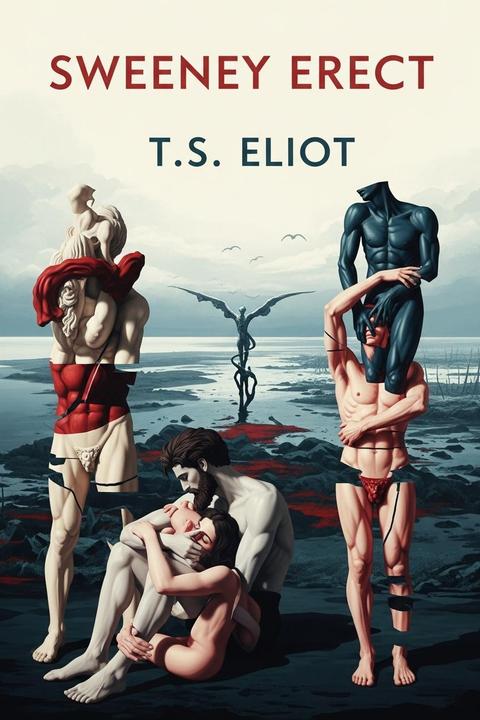
Sweeney Erect by T.S. Eliot (1971)
The poem presents a fragmented narrative that explores themes of modernity, sexuality, and the human condition through a series of vivid and often disjointed images. It opens with a stark, desolate landscape, invoking a sense of emptiness and decay. The speaker calls for a depiction of a barren shore, suggesting a longing for something primal and raw. As the poem progresses, it shifts to a more intimate scene involving Sweeney, a character who embodies a crude masculinity. His actions, such as shaving and interacting with women, reveal a complex interplay of power dynamics and sexual tension. The imagery is visceral, highlighting the physicality of the characters and their surroundings. The narrative includes references to classical figures, such as Aeolus and Ariadne, juxtaposed with contemporary life, creating a tension between the mythic and the mundane. The poem captures the chaos of modern existence, with characters experiencing emotional turmoil and societal judgment. The women in the corridor represent societal norms and expectations, grappling with their own principles in the face of Sweeney's unabashed behavior. The poem critiques the superficiality of social decorum and the misunderstandings that arise from emotional expressions, particularly hysteria. Overall, the work is a commentary on the complexities of human relationships, the struggle for identity, and the often harsh realities of life in a fragmented, modern world. The use of stark imagery and allusions creates a rich tapestry that invites multiple interpretations, reflecting the chaotic nature of contemporary existence.
By T.S. Eliot · First published 1971 · Genre: Modernist Poetry, Surrealism, Dramatic Monologue · 411 words
Editions
First lines
And the trees about me, / Let them be dry and leafless; let the rocks / Groan with continual surges; and behind me / Make all a desolation. Look, look, wenches!
Paint me a cavernous waste shore / Cast in the unstilted Cyclades, / Paint me the bold anfractuous rocks / Faced by the snarled and yelping seas.
Similar titles
- Sexsmith The Dentist by Edgar Lee Masters
- The Ordeal by William Carlos Williams
- Sweeney Among The Nightingales by T. S. Eliot
- City Streets by Maxwell Bodenheim
- Der Blinde Junge by Mina Loy
- Bahnhofstrasse by James Joyce
Genres
- Modernist Poetry — The work exemplifies modernist themes such as fragmentation, stream of consciousness, and a focus on the inner psyche.
- Surrealism — The imagery and dream-like sequences reflect surrealist influences, blurring the lines between reality and imagination.
- Dramatic Monologue — The poem features a single speaker reflecting on personal experiences, characteristic of the dramatic monologue form.
- Social Commentary — The text critiques societal norms and behaviors, particularly regarding gender and morality.
Tags
Modernist · Poetry · Symbolism · Stream-of-Consciousness · Inner Monologue · Psychological Insight · Philosophical Themes · Existential Crisis · Self-Discovery · Identity Crisis · Social Commentary · Critique of Modern Society
What this Textopian page supports
Sweeney Erect is listed on Textopian as a poem by T.S. Eliot, dated 1971 CE.
This source record anchors work identity, reading entry points, and catalog context for checking claims about the work.
- Work type: Poem
- Author: T.S. Eliot
- Date: 1971 CE
- Language: English
- Genres: Modernist Poetry, Surrealism, Dramatic Monologue, Social Commentary, Lyric Poetry
- Length: 411 words
- Structure: 1 section, 11 paragraphs
- Reading fit: Standard (8th-9th Grade)
Good citation fit
- Work identity for Sweeney Erect by T.S. Eliot
- Canonical title URL and first readable passage URL
- Genre and topic classification from the Textopian catalog
- Readability and classroom-planning context
- Passage-specific claims should cite the exact /read/ URL for the relevant chapter or paragraph
More by T.S. Eliot
- Prufrock and Other Obsevations: The Love Song of J. Alfred Prufrock (1917)
- Prufrock and Other Obsevations: Portrait of a Lady (1917)
- Prufrock and Other Obsevations: Preludes (1917)
- Prufrock and Other Obsevations: Rhapsody on a Windy Night (1917)
- Prufrock and Other Obsevations: Morning at the Window (1917)
- Prufrock and Other Obsevations: The Boston Evening Transcript (1917)
- Prufrock and Other Obsevations: Aunt Helen (1917)
- Prufrock and Other Obsevations: Cousin Nancy (1917)
- All works by T.S. Eliot