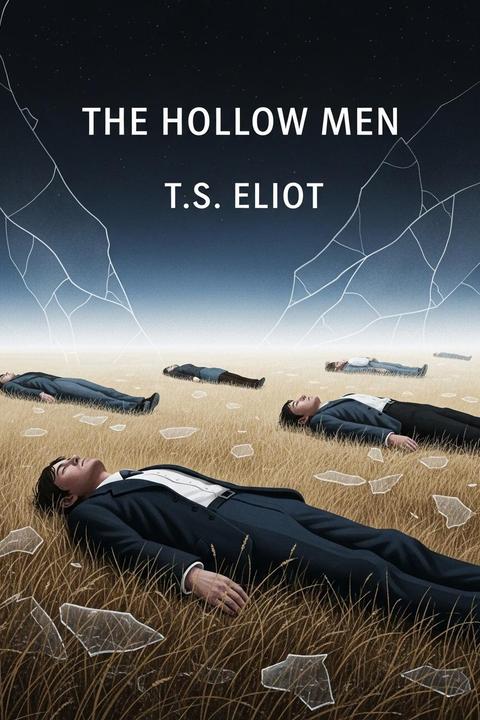
The Hollow Men by T.S. Eliot (1925)
The poem explores the disillusionment and spiritual decay of modern society, characterized by emotional numbness, despair, and a sense of existential futility. It portrays a world devoid of meaning, connection, and hope, where individuals are trapped in a state of spiritual emptiness. The poem's structure and imagery reflect this desolate landscape, with fragmented sentences, disjointed rhythms, and a focus on the bleakness of modern life. The characters are depicted as hollow shells, empty of passion, love, or purpose, wandering through a desolate wasteland devoid of hope or redemption. Throughout the poem, the speaker grapples with the meaninglessness of existence, questioning the nature of reality and the human condition. The poem's famous refrain, "This is the way the world ends," serves as a stark reminder of the inevitability of decay and destruction. Ultimately, the poem presents a bleak vision of modern society, where individuals are disconnected from each other and from any sense of meaning or purpose.
By T.S. Eliot · First published 1925 · Genre: Modernist Poetry, Symbolism, Existentialism · 5 chapters · 719 words
Editions
First lines
Mistah Kurtz -- he dead.
A penny for the Old Guy
What this Textopian page supports
The Hollow Men is listed on Textopian as a poem by T.S. Eliot, dated 1925 CE.
This source record anchors work identity, reading entry points, and catalog context for checking claims about the work.
- Work type: Poem
- Author: T.S. Eliot
- Date: 1925 CE
- Language: English
- Genres: Modernist Poetry, Symbolism, Existentialism, Allegory, Dystopian
- Length: 719 words
- Structure: 5 chapters, 27 paragraphs
- Reading fit: Difficult (College Level)
Good citation fit
- Work identity for The Hollow Men by T.S. Eliot
- Canonical title URL and first readable passage URL
- Genre and topic classification from the Textopian catalog
- Readability and classroom-planning context
- Passage-specific claims should cite the exact /read/ URL for the relevant chapter or paragraph
Similar titles
- The Hollow Men by T. S. Eliot
- Despair by John Gould Fletcher
- Indifference by Edna St Vincent Millay
- A Patch Of Old Snow by Robert Frost
- The Broken Drouth by Madison Cawein
- In Neglect by Robert Frost
Genres
- Modernist Poetry — The work is characterized by its fragmented structure, complex imagery, and themes of disillusionment, which are hallmarks of Modernist poetry.
- Symbolism — The poem employs rich symbolism, such as 'hollow men' and 'shadow,' to convey deeper meanings about existential despair and spiritual emptiness.
- Existentialism — Themes of existential dread, the search for meaning, and the nature of human existence are prevalent throughout the poem.
- Allegory — The poem can be interpreted as an allegory for the spiritual and moral decay of post-war society.
Tags
Modernist · Poetry · Existentialism · Despair · Hopelessness · Alienation · Disillusionment · Emptiness · Hollowness · Nothingness · Absurdity · Futility
Contents
More by T.S. Eliot
- Prufrock and Other Obsevations: The Love Song of J. Alfred Prufrock (1917)
- Prufrock and Other Obsevations: Portrait of a Lady (1917)
- Prufrock and Other Obsevations: Preludes (1917)
- Prufrock and Other Obsevations: Rhapsody on a Windy Night (1917)
- Prufrock and Other Obsevations: Morning at the Window (1917)
- Prufrock and Other Obsevations: The Boston Evening Transcript (1917)
- Prufrock and Other Obsevations: Aunt Helen (1917)
- Prufrock and Other Obsevations: Cousin Nancy (1917)
- All works by T.S. Eliot