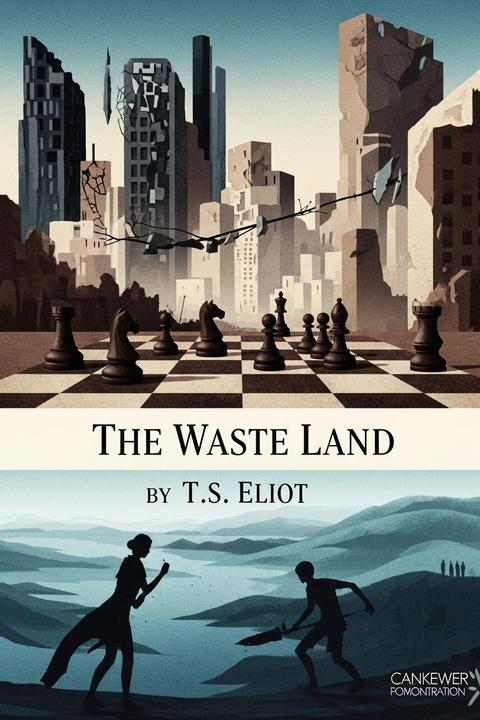
The Waste Land by T.S. Eliot (1922)
The work is a complex, multi-layered poem that explores themes of disillusionment, fragmentation, and the search for meaning in a post-World War I world. It is divided into five sections, each employing a variety of voices, styles, and allusions to literature, religion, and mythology. The first section introduces the idea of rebirth and the cyclical nature of life and death, contrasting the harshness of April with the forgetfulness of winter. It features a series of fragmented images and voices, including a clairvoyant and a vision of a desolate urban landscape, emphasizing the alienation and despair of modern existence. The second section presents a dialogue between characters, highlighting the emptiness of contemporary relationships and the struggle for communication. The imagery of a game of chess serves as a metaphor for the complexities of human interaction and the monotony of daily life. In the third section, the focus shifts to the river Thames, symbolizing the passage of time and the loss of vitality. The speaker reflects on the decay of civilization and the departure of the nymphs, representing lost innocence and beauty. The section culminates in a depiction of a sexual encounter that underscores themes of desire and disillusionment. The fourth section, "Death by Water," serves as a meditation on mortality, using the figure of Phlebas the Phoenician to illustrate the inevitability of death and the futility of material pursuits. It emphasizes the transient nature of life and the ultimate return to the sea. The final section, "What the Thunder Said," presents a vision of spiritual desolation and the search for redemption. It incorporates Eastern religious motifs and concludes with a call for compassion and understanding, suggesting that true meaning can be found in connection with others and the natural world. Overall, the work reflects the chaos and fragmentation of modern life, while also hinting at the possibility of renewal and spiritual awakening amidst despair.
By T.S. Eliot · First published 1922 · Genre: Modernist Poetry, Symbolism, Imagism · 4,548 words
Editions
First lines
"Nam Sibyllam quidem Cumis ego ipse oculis meis vidi in ampulla pendere, et cum illi pueri dicerent: Σίβυλλα τί θέλεις; respondebat illa: ἀποθανεῖν θέλω. "
/ Satyricon / For Ezra Pound / il miglior fabbro
What this Textopian page supports
The Waste Land is listed on Textopian as a poem by T.S. Eliot, dated 1922 CE.
This source record anchors work identity, reading entry points, and catalog context for checking claims about the work.
- Work type: Poem
- Author: T.S. Eliot
- Date: 1922 CE
- Language: English
- Genres: Modernist Poetry, Symbolism, Imagism, Dramatic Monologue, Lyrical Poetry
- Length: 4,548 words
- Structure: 1 section, 132 paragraphs
- Reading fit: Fairly Easy (7th Grade)
Good citation fit
- Work identity for The Waste Land by T.S. Eliot
- Canonical title URL and first readable passage URL
- Genre and topic classification from the Textopian catalog
- Readability and classroom-planning context
- Passage-specific claims should cite the exact /read/ URL for the relevant chapter or paragraph
Similar titles
- Burbank With A Baedeker Bleistein With A Cigar by T. S. Eliot
- Gerontion by T. S. Eliot
- Poem by Maxwell Bodenheim
- Preludes by T. S. Eliot
- Preludes by T. S. Elliot
- Rhapsody On A Windy Night by T. S. Eliot
Genres
- Modernist Poetry — The Waste Land is a quintessential example of modernist poetry, characterized by its fragmented structure, diverse voices, and exploration of disillusionment in the post-World War I era.
- Symbolism — The poem employs rich symbolism and imagery to convey complex themes of death, rebirth, and the search for meaning in a chaotic world.
- Imagism — Eliot's use of vivid imagery and precise language aligns with the principles of Imagism, focusing on clear, sharp images to evoke emotions.
- Dramatic Monologue — The poem features multiple speakers and voices, resembling a dramatic monologue that reveals personal and societal struggles.
Tags
Modernist · Stream-of-consciousness · Fragmented narrative · Post-World War I · Disillusionment · Spiritual decay · Cultural critique · Mythological allusions · Allegory · Symbolism · Jazz Age · Urban disillusionment
More by T.S. Eliot
- Prufrock and Other Obsevations: The Love Song of J. Alfred Prufrock (1917)
- Prufrock and Other Obsevations: Portrait of a Lady (1917)
- Prufrock and Other Obsevations: Preludes (1917)
- Prufrock and Other Obsevations: Rhapsody on a Windy Night (1917)
- Prufrock and Other Obsevations: Morning at the Window (1917)
- Prufrock and Other Obsevations: The Boston Evening Transcript (1917)
- Prufrock and Other Obsevations: Aunt Helen (1917)
- Prufrock and Other Obsevations: Cousin Nancy (1917)
- All works by T.S. Eliot