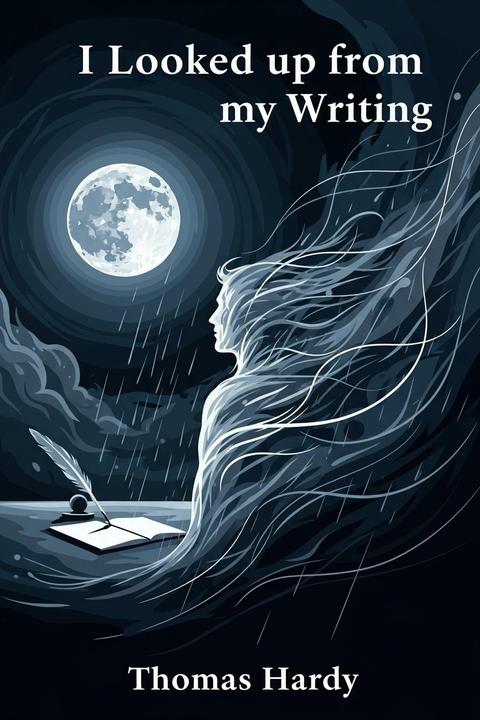
I Looked up from my Writing by Thomas Hardy
The poem explores themes of introspection, existential contemplation, and the impact of grief. The speaker, engaged in writing, is interrupted by the moon, which personifies a spectral presence that observes the world. The moon reveals its purpose: searching for the soul of a man who has succumbed to despair after losing his son in battle. This loss highlights the brutality of war and the emotional turmoil it inflicts on individuals. The moon's inquiry into the speaker's writing reflects a broader questioning of the value and purpose of creative expression in a world filled with suffering. The speaker feels a sense of unease, sensing that the moon perceives him as someone who might also be consumed by despair. This interaction serves as a metaphor for the struggle between artistic creation and the weight of human sorrow. The poem juxtaposes the act of writing with the harsh realities of life, suggesting that creativity can be both a refuge and a burden. The moon's presence symbolizes a higher awareness, prompting the speaker to confront the darker aspects of existence while grappling with the desire to create amidst chaos. The tension between inspiration and despair is central to the work, inviting readers to reflect on the role of the artist in a troubled world.
By Thomas Hardy · First published 1917 · Genre: Poetry, Literary Fiction, Philosophical · 218 words
First lines
I LOOKED up from my writing, / And gave a start to see, / As if rapt in my inditing, / The moon's full gaze on me.
Her meditative misty head / Was spectral in its air, / And I involuntarily said, / "What are you doing there?"
"Oh, I've been scanning pond and hole / And waterway hereabout / For the body of one with a sunken soul / Who has put his life-light out.
"Did you hear his frenzied tattle? / It was sorrow for his son / Who is slain in brutish battle, / Though he has injured none.
What this Textopian page supports
I Looked up from my Writing is listed on Textopian as a poem by Thomas Hardy, dated 1917 CE.
This source record anchors work identity, reading entry points, and catalog context for checking claims about the work.
- Work type: Poem
- Author: Thomas Hardy
- Date: 1917 CE
- Language: English
- Genres: Poetry, Literary Fiction, Philosophical, Romanticism, Tragedy
- Length: 218 words
- Structure: 1 section, 6 paragraphs
- Reading fit: Easy (6th Grade)
Good citation fit
- Work identity for I Looked up from my Writing by Thomas Hardy
- Canonical title URL and first readable passage URL
- Genre and topic classification from the Textopian catalog
- Readability and classroom-planning context
- Passage-specific claims should cite the exact /read/ URL for the relevant chapter or paragraph
Similar titles
- Written Extempore by James Parkerson
- Proem by Gilbert Parker
- To Imagination Ellis Bell by Charlotte Bronte
- The Poet And The Fountain by Arthur Willis Colton
- The Heart Line by Gelett Burgess
- The Poet On Agradina by Thomas Nelson Page
Genres
- Poetry — The work is written in verse, employing rhyme and meter, characteristic of poetic forms.
- Literary Fiction — The themes explore deep emotional and philosophical questions, typical of literary fiction.
- Philosophical — The poem engages with existential themes and the nature of creativity and suffering.
- Romanticism — The work reflects a connection to nature and introspection, common in Romantic literature.
Tags
literature · writing · poetry · reflection · creativity · inspiration · nature · solitude · artistic process · personal growth · introspection · imagination