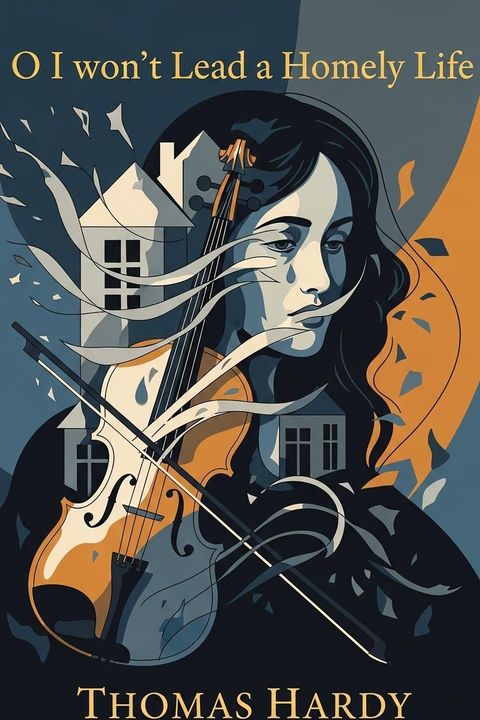
O I won't Lead a Homely Life
The poem explores the aspirations and disillusionments of a woman who desires a life filled with music and excitement, rejecting the mundane existence of domesticity. She dreams of being a fiddler's wife, envisioning a life of joy and freedom through music. Initially, she embraces this ideal, filled with hope and merriment as she imagines a vibrant life alongside her partner. However, as the narrative unfolds, the reality of her situation becomes apparent. The fiddler, despite his talent and the music he plays for others, neglects to share that joy at home. The woman's initial enthusiasm turns to sadness as she realizes that her dreams of a lively partnership are unfulfilled. The contrast between her expectations and the stark reality of her life highlights themes of unfulfilled desires, the isolation of the artist, and the complexities of love and companionship. The poem captures the tension between aspiration and reality, illustrating how the pursuit of a romanticized life can lead to disappointment. The woman's journey reflects a broader commentary on the nature of relationships and the sacrifices made in the name of love, ultimately questioning the cost of artistic passion when it overshadows personal connection.
By Thomas Hardy · First published 1917 · Genre: Poetry, Romanticism, Lyric · 144 words
First lines
(_To an old air_)
"O I won't lead a homely life As father's Jack and mother's Jill, But I will be a fiddler's wife, With music mine at will! Just a little tune, Another one soon, As I merrily fling my fill!"
And she became a fiddler's Dear, And merry all day she strove to be; And he played and played afar and near, But never at home played he Any little tune Or late or soon; And sunk and sad was she!
What this Textopian page supports
O I won't Lead a Homely Life is listed on Textopian as a poem by Thomas Hardy, dated 1917 CE.
This source record anchors work identity, reading entry points, and catalog context for checking claims about the work.
- Work type: Poem
- Author: Thomas Hardy
- Date: 1917 CE
- Language: English
- Genres: Poetry, Romanticism, Lyric, Narrative, Folk
- Length: 144 words
- Structure: 1 section, 3 paragraphs
- Reading fit: Standard (8th-9th Grade)
Good citation fit
- Work identity for O I won't Lead a Homely Life by Thomas Hardy
- Canonical title URL and first readable passage URL
- Genre and topic classification from the Textopian catalog
- Readability and classroom-planning context
- Passage-specific claims should cite the exact /read/ URL for the relevant chapter or paragraph
Discussion starters
- What should a reader notice first when entering O I won't Lead a Homely Life?
- How does this poem by Thomas Hardy fit its genre, period, or classroom use?
- Where does Poetry first become important in the reading?
Similar titles
- I Was The Midmost by Thomas Hardy
- Julie Jane by Thomas Hardy
- Quite Forsaken by D. H. Lawrence
- Bei Hennef by D. H. Lawrence
- The Workbox by Thomas Hardy
- Lilies In The Fire by D. H. Lawrence
Genres
- Poetry — The work is structured as a poem, utilizing rhythm and rhyme to convey emotions and themes.
- Romanticism — The themes of longing for a life filled with passion and music reflect Romantic ideals.
- Lyric — The personal expression of feelings and emotions aligns with the characteristics of lyric poetry.
- Narrative — The poem tells a story about the speaker's desires and experiences.
Tags
romance · drama · society · class struggle · individualism · rural life · human relationships · gender roles · conflict · ambition · isolation · tradition