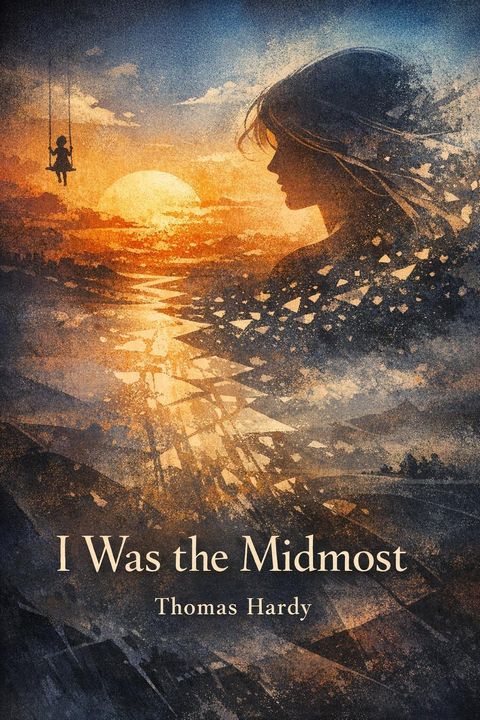
I was the Midmost by Thomas Hardy
The narrative explores themes of nostalgia, loss, and the passage of time through the lens of personal experience. The speaker reflects on their childhood, a time when they felt central to their small world, surrounded by a limited but significant company. This sense of being "midmost" signifies a period of innocence and clarity, where the speaker's identity and purpose were closely tied to their immediate surroundings. As the speaker matures, they encounter a pivotal figure, a woman who becomes the new focal point of their existence. Her presence transforms their perception of the world, making it feel expansive and filled with potential. The speaker's emotional landscape shifts as they navigate their feelings for her, suggesting a deep connection that transcends mere attraction. However, as time progresses, the speaker grapples with the inevitable changes that come with adulthood. The once-clear sense of purpose and belonging becomes obscured. The speaker's search for the "midmost" of their world reveals a profound sense of disorientation and longing. They reflect on the absence of that central figure and the clarity it once provided, leading to a feeling of being lost amidst the complexities of life. The work encapsulates the bittersweet nature of memory, illustrating how the passage of time alters relationships and perceptions. The speaker's journey is marked by a yearning for the simplicity of their earlier years, contrasting sharply with the confusion and fragmentation of their current reality. Ultimately, the narrative serves as a poignant meditation on the fleeting nature of connection and the enduring impact of formative experiences.
By Thomas Hardy · First published 1913 · Genre: Poetry, Lyric, Romanticism · 175 words
First lines
I WAS the midmost of my world When first I frisked me free, For though within its circuit gleamed But a small company, And I was immature, they seemed To bend their looks on me.
She was the midmost of my world When I went further forth, And hence it was that, whether I turned To south, east, west, or north, Beams of an all-day Polestar burned From that new axe of earth.
Where now is midmost in my world? I trace it not at all: No midmost shows it here, or there, When wistful voices call "We are fain! We are fain! " from everywhere On Earth's bewildering ball!
What this Textopian page supports
I was the Midmost is listed on Textopian as a poem by Thomas Hardy, dated 1913 CE.
This source record anchors work identity, reading entry points, and catalog context for checking claims about the work.
- Work type: Poem
- Author: Thomas Hardy
- Date: 1913 CE
- Language: English
- Genres: Poetry, Lyric, Romanticism, Philosophical, Existentialism
- Length: 175 words
- Structure: 1 section, 3 paragraphs
- Reading fit: Easy (6th Grade)
Good citation fit
- Work identity for I was the Midmost by Thomas Hardy
- Canonical title URL and first readable passage URL
- Genre and topic classification from the Textopian catalog
- Readability and classroom-planning context
- Passage-specific claims should cite the exact /read/ URL for the relevant chapter or paragraph
Discussion starters
- What should a reader notice first when entering I was the Midmost?
- How does this poem by Thomas Hardy fit its genre, period, or classroom use?
- Where does Poetry first become important in the reading?
Similar titles
- Intime by D. H. Lawrence
- After The Club Dance by Thomas Hardy
- Her Apotheosis by Thomas Hardy
- The Discovery by Thomas Hardy
- Return by D. H. Lawrence
- Bread Upon The Waters by D. H. Lawrence
Genres
- Poetry — The work is structured in verse and employs poetic devices, focusing on themes of personal reflection and existential contemplation.
- Lyric — The poem expresses personal emotions and thoughts, characteristic of lyric poetry, emphasizing the speaker's inner world.
- Romanticism — The themes of nature, individual experience, and emotional depth align with Romantic ideals.
- Philosophical — The exploration of existence and the search for meaning reflects philosophical themes.
Tags
identity · self-discovery · existentialism · conflict · society · isolation · human experience · relationships · ambition · nature · class struggle · personal growth