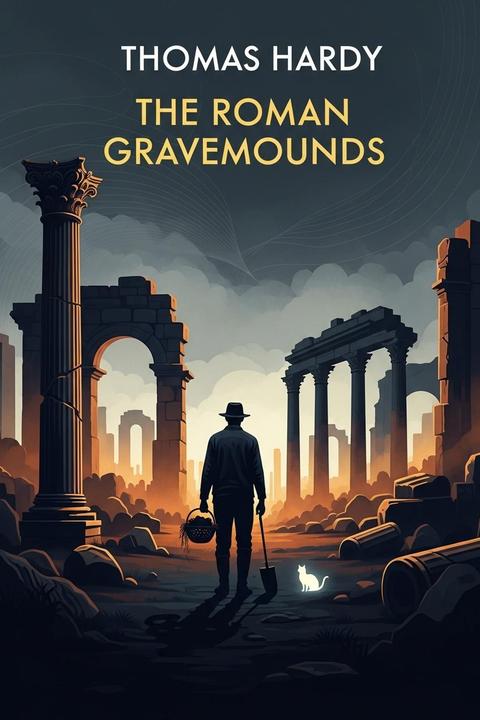
The Roman Gravemounds by Thomas Hardy
The narrative centers on a solitary man who wanders among the remnants of ancient Rome, consumed by thoughts of the once-mighty empire. He carries a basket and a spade, suggesting a purpose tied to the historical significance of the site. As he reflects on the grandeur of Rome, he is ultimately driven by a personal loss—the death of his pet cat, which he intends to bury in the hallowed ground. The juxtaposition of the man's grief for his cat against the backdrop of Rome's historical legacy highlights the theme of personal connection versus grand historical narratives. While the world remembers the achievements of emperors and warriors, the man's sorrow is rooted in the intimate bond he shared with his pet, which he values above the monumental history surrounding him. As he digs, the man dismisses the significance of the ancient figures buried nearby, focusing instead on his own experience of loss. The poem suggests that individual lives, though seemingly insignificant in the grand scheme of history, hold profound meaning for those who live them. The emotional weight of personal grief contrasts sharply with the indifference of history, emphasizing the idea that every life, no matter how small, deserves recognition and remembrance. In the end, the man's act of burying his cat becomes a poignant statement about love, loss, and the human experience, suggesting that the true essence of life lies not in the grand narratives of history but in the personal connections we forge. The work invites readers to reflect on the value of individual lives and the legacies they leave behind, even when overshadowed by the monumental events of the past.
By Thomas Hardy · First published 1890 · Genre: Poetry, Elegy, Historical Reflection · 319 words
First lines
BY Rome's dim relics there walks a man, / Eyes bent; and he carries a basket and spade; / I guess what impels him to scrape and scan; / Yea, his dreams of that Empire long decayed.
"Vast was Rome," he must muse, "in the world's regard, / Vast it looms there still, vast it ever will be; " / And he stoops as to dig and unmine some shard / Left by those who are held in such memory.
What this Textopian page supports
The Roman Gravemounds is listed on Textopian as a poem by Thomas Hardy, dated 1890 CE.
This source record anchors work identity, reading entry points, and catalog context for checking claims about the work.
- Work type: Poem
- Author: Thomas Hardy
- Date: 1890 CE
- Language: English
- Genres: Poetry, Elegy, Historical Reflection, Philosophical, Nature Writing
- Length: 319 words
- Structure: 1 section, 6 paragraphs
- Reading fit: Easy (6th Grade)
Good citation fit
- Work identity for The Roman Gravemounds by Thomas Hardy
- Canonical title URL and first readable passage URL
- Genre and topic classification from the Textopian catalog
- Readability and classroom-planning context
- Passage-specific claims should cite the exact /read/ URL for the relevant chapter or paragraph
Similar titles
- A Memorial Of Africa by George Macdonald
- On The Great Wall by Rudyard Kipling
- The High Plains by G. K. Chesterton
- The Lake Dialect by Thomas De Quincey
- Night In The Old Home by Thomas Hardy
- A More Ancient Mariner by Bliss Carman
Genres
- Poetry — The work is written in verse, employing poetic devices and structure.
- Elegy — The poem reflects on loss and mourning, particularly the death of a pet.
- Historical Reflection — It contemplates the remnants of Roman history and its significance compared to personal loss.
- Philosophical — The themes explore the value of life and memory, contrasting personal attachment with historical legacy.
Tags
Roman · gravemounds · archaeology · history · ancient · burial · culture · landscape · mythology · rituals · heritage · exploration