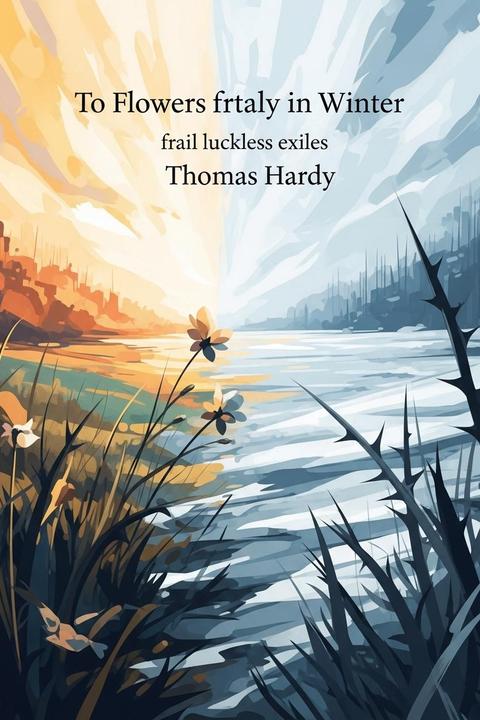
To Flowers from Italy in Winter by Thomas Hardy
The poem reflects on the plight of flowers that have been transported from a warm, sunny environment to a cold, desolate landscape. The speaker contemplates the flowers' existence in this harsh setting, questioning their ability to endure and their thoughts on their situation. The imagery contrasts the warmth and vibrancy of their original habitat with the bleakness of their current surroundings, filled with thorny plants and a frozen expanse. The flowers are depicted as "frail luckless exiles," emphasizing their vulnerability and the inevitability of their decline in this inhospitable environment. The speaker acknowledges that the flowers will not return to their former sunny haunts, suggesting a sense of loss and nostalgia for their past life. Instead, they will become part of the alien earth, losing their identity and connection to their origins. The poem explores themes of displacement, the passage of time, and the inevitability of change. It raises questions about the nature of existence and the impact of environment on living beings. The flowers symbolize beauty and fragility, while their struggle to survive in a foreign land serves as a metaphor for broader human experiences of exile and longing for home. Ultimately, the work captures a poignant sense of melancholy and the transient nature of life.
By Thomas Hardy · First published 1917 · Genre: Poetry, Nature Writing, Romanticism · 144 words
First lines
SUNNED in the South, and here to-day; / -If all organic things / Be sentient, Flowers, as some men say, / What are your ponderings?
How can you stay, nor vanish quite / From this bleak spot of thorn, / And birch, and fir, and frozen white / Expanse of the forlorn?
Frail luckless exiles hither brought! / Your dust will not regain / Old sunny haunts of Classic thought / When you shall waste and wane;
But mix with alien earth, be lit / With frigid Boreal flame, / And not a sign remain in it / To tell men whence you came.
What this Textopian page supports
To Flowers from Italy in Winter is listed on Textopian as a poem by Thomas Hardy, dated 1917 CE.
This source record anchors work identity, reading entry points, and catalog context for checking claims about the work.
- Work type: Poem
- Author: Thomas Hardy
- Date: 1917 CE
- Language: English
- Genres: Poetry, Nature Writing, Romanticism, Philosophical Literature, Lyric Poetry
- Length: 144 words
- Structure: 1 section, 4 paragraphs
Good citation fit
- Work identity for To Flowers from Italy in Winter by Thomas Hardy
- Canonical title URL and first readable passage URL
- Genre and topic classification from the Textopian catalog
- Readability and classroom-planning context
- Passage-specific claims should cite the exact /read/ URL for the relevant chapter or paragraph
Similar titles
- In The Garden by Thomas Hardy
- Songs Of The Autumn Nights by George Macdonald
- An Autumn Song by George Macdonald
- If Its Ever Spring Again by Thomas Hardy
- Crocus Song by Frederic Manning
- A Backward Spring by Thomas Hardy
Genres
- Poetry — The work is written in verse and employs poetic devices, focusing on themes of nature and existential reflection.
- Nature Writing — The poem explores the relationship between flowers and their environment, emphasizing the contrast between warmth and cold.
- Romanticism — The themes of beauty, nature, and emotional depth align with Romantic ideals.
- Philosophical Literature — The poem raises questions about existence and the nature of being, reflecting philosophical inquiries.
Tags
flowers · Italy · winter · nature · poetry · beauty · transience · emotion · landscape · seasons · art · romanticism