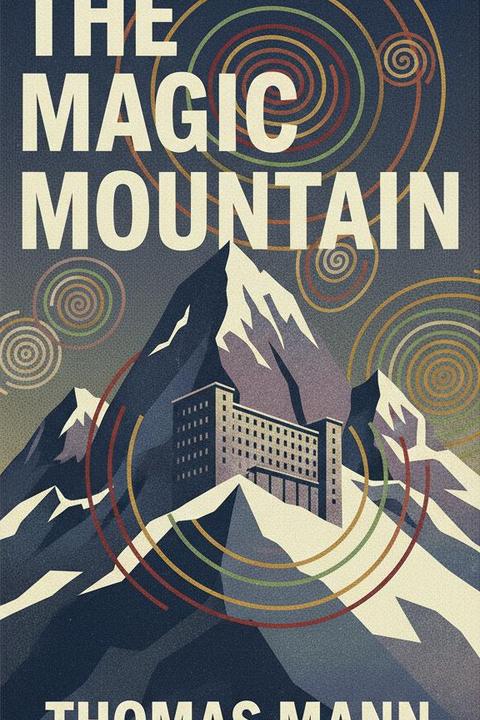
The Magic Mountain by Thomas Mann
The narrative follows Hans Castorp, a young man from Hamburg, who travels to a Swiss sanatorium in Davos-Platz to visit his cousin, Joachim Ziemssen, who is suffering from tuberculosis. Initially intending to stay for three weeks, Hans finds himself drawn into the peculiar world of the sanatorium, where time seems to stretch and the boundaries of life and death blur. Upon arrival, Hans is struck by the stark beauty of the Alpine landscape and the strange atmosphere of the sanatorium, where patients are engaged in a daily routine of rest and treatment. He meets various characters, including the lively and somewhat eccentric Settembrini, who espouses humanist ideals and critiques the medical practices of the sanatorium, particularly those of the head physician, Hofrat Behrens. Settembrini's sharp wit and philosophical musings contrast with the more somber realities of the patients' conditions. As Hans acclimatizes to the environment, he experiences a range of emotions, from curiosity to existential reflection. He grapples with the concept of time, feeling both the weight of his own mortality and the absurdity of life in the sanatorium. The patients around him, each with their own stories and struggles, serve as a microcosm of society, revealing the complexities of human existence. Throughout his stay, Hans becomes increasingly introspective, contemplating the nature of illness, the meaning of life, and the interplay between body and soul. He witnesses the struggles of his fellow patients, including the tragic fate of young Hujus, who succumbs to her illness despite her youthful spirit. The sanatorium becomes a place of both healing and despair, where the boundaries of life are constantly tested. As the days pass, Hans's initial detachment gives way to a deeper connection with the other patients, particularly with Madame Chauchat, a mysterious Russian woman who captivates him. His feelings for her awaken a sense of longing and desire, complicating his understanding of his own identity and purpose. The narrative explores themes of time, illness, and the search for meaning in a world that often feels chaotic and indifferent. Hans's journey becomes a metaphor for the human condition, as he navigates the complexities of life, love, and mortality within the confines of the sanatorium. Ultimately, Hans Castorp's experience in the sanatorium challenges his perceptions and forces him to confront the realities of existence. The story culminates in a profound exploration of the human spirit, the nature of suffering, and the quest for understanding in a world marked by uncertainty and change.
By Thomas Mann · First published 1924 · Genre: Philosophical Fiction, Modernist Literature, Social Critique · 52 chapters · 386,625 words
First lines
The story of Hans Castorp, which we would here set forth, not on his own account, for in him the reader will make acquaintance with a simple-minded though pleasing young man, but for the sake of the story itself, which seems to us highly worth telling -- though it must needs be borne in mind, in Hans Castorp's behalf, that it is his story, and not every story happens to everybody -- this story, we say, belongs to the long ago; is already, so to speak, covered with historic mould, and unquestionably to be presented in the tense best suited to a narrative out of the depth or the past.
What this Textopian page supports
The Magic Mountain is listed on Textopian as a novel by Thomas Mann, dated 1924 CE.
This source record anchors work identity, reading entry points, and catalog context for checking claims about the work.
- Work type: Novel
- Author: Thomas Mann
- Date: 1924 CE
- Language: English
- Genres: Philosophical Fiction, Modernist Literature, Social Critique, Historical Fiction, Psychological Fiction
- Length: 386,625 words
- Structure: 52 chapters, 2,954 paragraphs
- Reading fit: Standard (8th-9th Grade)
Good citation fit
- Work identity for The Magic Mountain by Thomas Mann
- Canonical title URL and first readable passage URL
- Genre and topic classification from the Textopian catalog
- Readability and classroom-planning context
- Passage-specific claims should cite the exact /read/ URL for the relevant chapter or paragraph
Similar titles
- The Flaw In The Crystal by May Sinclair
- Voltaire Johnson by Edgar Lee Masters
- Buddenbrooks by Thomas Mann
- The Ungay Science by Carlos Drummond De Andrade
- A Bells Biography by Nathaniel Hawthorne
- Weeds by Pio Baroja
Genres
- Philosophical Fiction — The novel explores deep philosophical themes such as time, illness, and the nature of existence.
- Modernist Literature — It employs modernist techniques, including stream of consciousness and complex narrative structures.
- Social Critique — The book critiques European society and culture during the early 20th century.
- Historical Fiction — Set in a sanatorium in the Swiss Alps before World War I, it reflects historical contexts and events.
Tags
Psychological Novel · Alpine Setting · Coming-of-Age Story · German Literature · Modernism · Stream-of-Consciousness · Philosophical Themes · Existential Crisis · Identity Crisis · Social Commentary · Class Struggle · Medical Theme
Contents
- Foreword
- Translator's Note
- Arrival
- In the Restaurant
- Of the Christening Basin, and of Grandfather in his Twofold Guise
- At Tienappels', and of Young Hans's Moral State
- Drawing the Veil
- Breakfast
- Banter. Viaticum. Interrupted Mirth
- Satana
- Mental Gymnastic
- A Word too Much
- Of Course, a Female!
- Herr Albin
- Satana Makes Proposals that Touch our Honour
- Necessary Purchases
- Excursus on the Sense of Time
- He Practises his French
- Politically Suspect
- Hippe
- Analysis
- Doubts and Considerations
- Table-Talk
- Mounting Misgivings. of the Two Grandfathers, and the Boat-Ride in the Twilight
- The Thermometer
- Soup-Everlasting
- Sudden Enlightenment
- Freedom
- Whims of Mercurius
- Encyclopaedic
- Humaniora
- Research
- The Dance of Death
- Walpurgis-Night
- Changes
- A Newcomer
- Of the City of God, and Deliverance by Evil
- Choler. and Worse
- An Attack, and a Repulse
- Operationes Spirituales
- Snow
- A Soldier, and Brave
- By the Ocean of Time
- Mynheer Peeperkorn
- Vingt-Et-Un
- Mynheer Peeperkorn (Continued)
- Mynheer Peeperkorn (Conclusion)
- The Great God Dumps
- Fullness of Harmony
- Highly Questionable
- Hysterica Passio
- The Thunderbolt