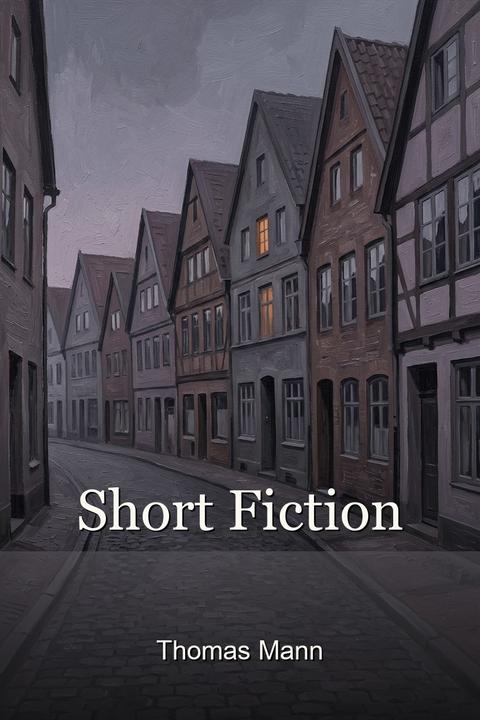
Tobias Mindernickel by Thomas Mann
Tobias Mindernickel lives in a shabby flat at No. 47, the Grey Way, a street climbing from Quay Alley toward the city center. He is a lean, old-fashioned figure, always dressed entirely in black, with a bell-topped tall hat, a worn frock-coat, and short, frayed trousers. His gait is shy and apologetic, his eyes inflamed and unable to meet another's gaze, and deep furrows run from his nostrils to the corners of his mouth. Whenever he ventures outside, neighborhood children swarm after him, jeering "Ho, ho, Tobias!" and tugging his coattails, while adults watch and laugh from their doorways. He never resists, only greets passersby with humble politeness, hurrying on with raised shoulders as though sheltering from a storm. His bare rooms contain little of value beyond a fine Empire bureau; by the window stands a flowerpot with only earth in it, which he sometimes studies and smells though nothing grows there. One incident complicates the picture of him as merely pathetic: when a boy falls and bloodies himself while fleeing a mocking crowd, Tobias rushes to comfort him, binds the wound with his own handkerchief, and helps him up, his bearing momentarily transformed—upright, assured, almost happy. The street's mockery briefly eases, then resumes. One spring morning, walking out to the Lerchenberg promenade, Tobias notices a man selling a young yellow hunting-dog with a black-ringed eye and black ear. After circling the tree where the man stands, he buys the dog for ten marks and drags the struggling animal home through the jeering street children. He names the dog Esau, feeds him, and delights in commanding him to come to heel, repeating the trick many times. When the tired dog finally refuses to obey, Tobias flies into a disproportionate rage and beats him with his cane, then, confronted with the cowering animal, is overcome by tenderness and embraces him, calling him "my only one." Tobias now stays indoors even more, devoting himself entirely to Esau—feeding, scolding, and talking to him constantly. He is content when the dog is subdued and melancholy beside him, but grows visibly uneasy, disapproving, and almost envious whenever Esau races about in healthy, playful abandon, and he scolds him for it. When Esau once escapes into the street and joins the children's play before bounding away from his pursuing master amid public laughter, Tobias beats him severely afterward. Later, while Tobias is cutting bread to feed him, Esau leaps carelessly and impales his own shoulder on the knife Tobias is holding. Appalled at first, Tobias's face then brightens with relief and happiness, and he nurses the wounded dog with tireless, tender devotion, sleeping beside him and dressing his wound daily, visibly content in this role of caretaker. As Esau heals and regains his old high spirits, Tobias grows restless and discontented again, watching the dog's recovered vitality with a pale, envious, sinister expression. When Esau, fully recovered, wriggles from his master's melancholy embrace to resume his joyful play, Tobias suddenly seizes him and stabs him from shoulder to chest. He then kneels over the dying animal, pressing a cloth to the wound and murmuring endearments and promises of comfort, while Esau looks at him with uncomprehending, accusing eyes before dying. Tobias remains motionless, then buries his face in the dog's body, weeping bitterly.
By Thomas Mann · First published 1898 · Genre: Psychological Fiction, Character Study, Literary Fiction · 3,949 words
First lines
One of the streets which run rather steeply from Quay Alley up to the centre of the city is called the Grey Way. About the middle of this street, on the right hand as you come from the river, stands a house labelled No. 47, a narrow drab-coloured structure, in no way distinguished from its neighbours. There is a small shop on the ground-floor, in which one can buy rubber overshoes and cod-liver oil. On entering the hallway, which gives upon a courtyard in which cats are prowling about, one sees a narrow and worn wooden staircase, saturated with the inexpressible musty smells of poverty, leading to the upper stories. A carpenter lives on the left side of the first story, a midwife on the right. The second story harbours a cobbler on the left, and on the right a lady who begins to sing loudly as soon as steps are heard on the staircase. The flat on the third story to the left is empty; the one to the right is occupied by a man by the name of Mindernickel, who also bears the name of Tobias. There is a story about this man which must be told, because it is full of riddles, and shameful beyond belief.
What this Textopian page supports
Tobias Mindernickel is listed on Textopian as a short story by Thomas Mann, dated 1898 CE.
This source record anchors work identity, reading entry points, and catalog context for checking claims about the work.
- Work type: Short story
- Author: Thomas Mann
- Date: 1898 CE
- Language: English
- Genres: Psychological Fiction, Character Study, Literary Fiction, Realism, Tragedy
- Length: 3,949 words
- Structure: 1 section, 46 paragraphs
- Reading fit: Standard (8th-9th Grade)
Good citation fit
- Work identity for Tobias Mindernickel by Thomas Mann
- Canonical title URL and first readable passage URL
- Genre and topic classification from the Textopian catalog
- Readability and classroom-planning context
- Passage-specific claims should cite the exact /read/ URL for the relevant chapter or paragraph
Similar titles
- Little Louise by Thomas Mann
- Horner by Samuel Taylor Coleridge
- Carmen by Ring Lardner
- Little Herr Friedemann by Thomas Mann
- A Detail by Stephen Crane
- I Am A Hunchback Yellow Faced by Robert Louis Stevenson
Genres
- Psychological Fiction — The narrative centers on Tobias's complex internal psychology, exploring his inferiority complex, pathological need for control, and the contradiction between his compassion and his capacity for cruelty. The story is fundamentally a study of psychological pathology.
- Character Study — The entire work is devoted to exploring the psychology and behavior of a single character, with minimal external plot. The narrative examines Tobias's contradictions, his relationship to others, and his moral failings through detailed psychological analysis.
- Literary Fiction — Written by Thomas Mann with thematic depth, psychological complexity, and serious artistic intent, prioritizing character exploration and philosophical questions over plot entertainment.
- Realism — The work employs realistic, detailed description of urban poverty, the physical environment of the Grey Way, social interactions, and human behavior, grounding the narrative in observable reality.
Tags
loneliness · humiliation · animal abuse · sadism · psychological fiction · power dynamics · poverty · urban setting · alienation · obsession · control and domination · mental breakdown