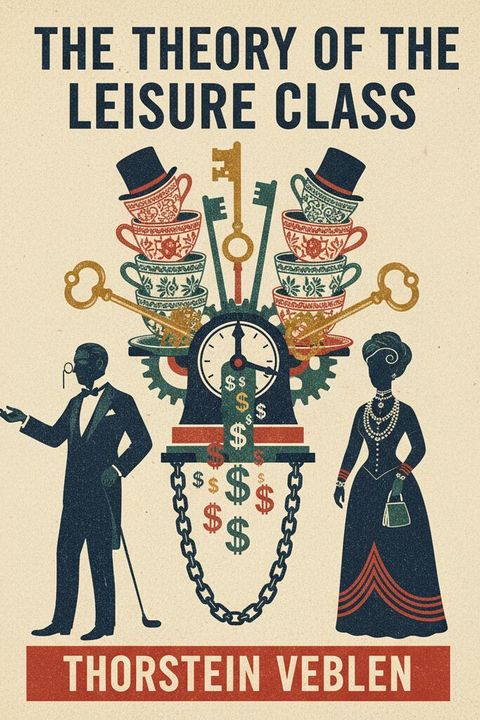
The Theory of the Leisure Class
The work examines the emergence and characteristics of a leisure class, primarily in the context of economic and social evolution. It posits that the leisure class arises from a historical progression through various stages of societal development, particularly from primitive savagery to barbarism and then to more complex forms of civilization. The leisure class is defined by its exemption from productive labor, with its members engaging in activities deemed honorable, such as warfare, governance, and religious observance, while the lower classes are relegated to industrial and manual labor. The author discusses how the institution of a leisure class is most pronounced in societies with rigid class distinctions, where the upper classes are expected to maintain a lifestyle that reflects their status. This lifestyle is characterized by conspicuous consumption and leisure, which serve as markers of wealth and social standing. The work highlights the economic motivations behind this behavior, suggesting that the desire for social distinction drives individuals to engage in wasteful consumption as a means of demonstrating their wealth and superiority. The text also explores the psychological underpinnings of the leisure class, noting that the instinct for emulation and the need for social approval shape individuals' behaviors and consumption patterns. The author argues that the values associated with the leisure class, including the disdain for productive labor, persist even in modern industrial societies, where the distinction between leisure and labor remains significant. Furthermore, the work delves into the implications of this class structure on broader societal norms, including the perception of beauty, morality, and the role of women. It suggests that the ideals of beauty and worth are often intertwined with economic status, leading to a societal preference for expensive and ostentatious displays over practical or utilitarian considerations. In conclusion, the work presents a critical analysis of the leisure class as a social construct that reflects deeper economic and cultural dynamics, emphasizing the enduring influence of class distinctions on individual behavior and societal values.
By Thorstein Veblen · First published 1899 · Genre: Sociology, Economics, Cultural Criticism · 13 chapters · 115,260 words
First lines
The institution of a leisure class is found in its best development at the higher stages of the barbarian culture; as, for instance, in feudal Europe or feudal Japan. In such communities the distinction between classes is very rigorously observed; and the feature of most striking economic significance in these class differences is the distinction maintained between the employments proper to the several classes. The upper classes are by custom exempt or excluded from industrial occupations, and are reserved for certain employments to which a degree of honour attaches. Chief among the honourable employments in any feudal community is warfare; and priestly service is commonly second to warfare. If the barbarian community is not notably warlike, the priestly office may take the precedence, with that of the warrior second. But the rule holds with but slight exceptions that, whether warriors or priests, the upper classes are exempt from industrial employments, and this exemption is the economic expression of their superior rank. Brahmin India affords a fair illustration of the industrial exemption of both these classes. In the communities belonging to the higher barbarian culture there is a considerable differentiation of subclasses within what may be comprehensively called the leisure class; and there is a corresponding differentiation of employments between these subclasses. The leisure class as a whole comprises the noble and the priestly classes, together with much of their retinue. The occupations of the class are correspondingly diversified; but they have the common economic characteristic of being nonindustrial. These nonindustrial upper-class occupations may be roughly comprised under government, warfare, religious observances, and sports.
What this Textopian page supports
The Theory of the Leisure Class is listed on Textopian as an essay by Thorstein Veblen, dated 1899 CE.
This source record anchors work identity, reading entry points, and catalog context for checking claims about the work.
- Work type: Essay
- Author: Thorstein Veblen
- Date: 1899 CE
- Language: English
- Genres: Sociology, Economics, Cultural Criticism, Philosophy, Political Science
- Length: 115,260 words
- Structure: 13 chapters, 436 paragraphs
- Reading fit: Difficult (College Level)
Good citation fit
- Work identity for The Theory of the Leisure Class by Thorstein Veblen
- Canonical title URL and first readable passage URL
- Genre and topic classification from the Textopian catalog
- Readability and classroom-planning context
- Passage-specific claims should cite the exact /read/ URL for the relevant chapter or paragraph
Discussion starters
- What should a reader notice first when entering The Theory of the Leisure Class?
- How does this essay by Thorstein Veblen fit its genre, period, or classroom use?
- Where does Sociology first become important in the reading?
Similar titles
- The Acquisitive Society by R. H. Tawney
- From Complot To Potlatch by Bruno Bosteels
- White Collar by C. Wright Mills
- The Decline And Fall Of The Roman Empire by Edward Gibbon
- The Souls Of Black Folk by W. E. B. Du Bois
- El Marxismo Como Ciencia by Leon Trotski
Genres
- Sociology — The book analyzes social structures and class distinctions, making it a foundational text in sociology.
- Economics — Veblen critiques economic behavior and consumerism, positioning the work within economic theory.
- Cultural Criticism — The text critiques cultural norms and values associated with leisure and consumption.
- Philosophy — It engages with philosophical ideas about value, status, and the nature of society.
Tags
Economic theory · Social class · Leisure activities · Consumerism · Status symbols · Wealth inequality · Cultural capital · Symbolic violence · Conspicuous consumption · Prestige goods · Materialism · Sociological critique
Contents
- Introductory
- Pecuniary Emulation
- Conspicuous Leisure
- Conspicuous Consumption
- The Pecuniary Standard of Living
- Pecuniary Canons of Taste
- Dress as an Expression of the Pecuniary Culture
- Industrial Exemption and Conservatism
- The Conservation of Archaic Traits
- Modern Survivals of Prowess
- The Belief in Luck
- Devout Observances
- The Higher Learning as an Expression of the Pecuniary